Bangamata’s 93rd birth anniversary Tuesday
BSS
07 Aug 2023 11:19 AM
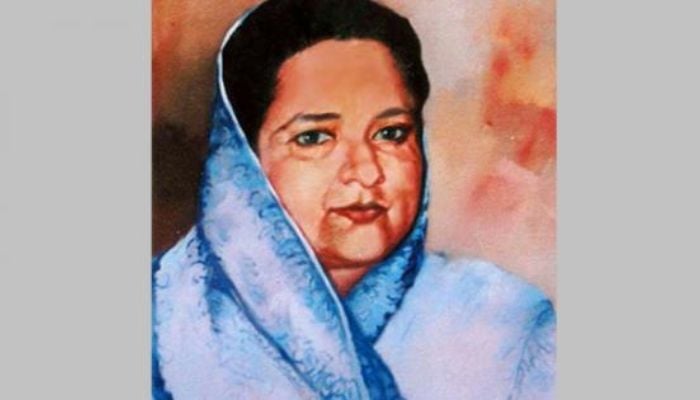
Bangamata Sheikh Fazilatunnesa Mujib
The 93rd birth anniversary of Bangamata Sheikh Fazilatunnesa
Mujib, wife of Father of the Nation Bangabandhu Sheikh Mujibur Rahman, will be
observed Tuesday in a befitting manner across the country.
Bangamata, also known by her nickname Renu, was born on August
8 in 1930 in Tungipara village in Gopalganj. She was a paternal cousin of her
husband Sheikh Mujibur Rahman.
Bangabandhu wrote in his autobiography “The Unfinished
Memoirs” that when their marriage was fixed, he was a teenager. "I heard I
got married. I did not understand anything then. "
Their wedding took place in 1938. Their family life started
after Bangabandhu passed the entrance exam in 1942. That year he got admitted
to Islamia College, Kolkata. His political career began there.
Fazilatunnesa Mujib was under house arrest during Bangladesh
Liberation War until December 17, 1971. She was killed brutally along with
Sheikh Mujibur Rahman and most of his family members on the fateful night of
August 15 in 1975.
Sheikh Fazilatunnesa was born to the Bengali Muslim Sheikh
family in the village of Tungipara, Gopalganj. Her father’s name is Sheikh
Zahurul Haque and her mother’s name is Sheikh Husne Ara Begum.
She was of Iraqi Arab ancestry on both sides of the family,
her paternal grandfather Kashem Sheikh, was the grandson of Sheikh Ekramullah,
who was, in turn, descended from Sheikh Awwal Darwish of Baghdad, a dervish who
had come to preach Islam in Bengal during the time of the later Mughal era of
Bengal.
Her father, Sheikh Zahurul Haque, and mother, Husne Ara
Begum, died when she was three years old.
Marking the birth anniversary of Sheikh Fazilatunnesa, Awami
League (AL) and its associate bodies will carry out programmes to pay respect
to her memory. Wreaths will be placed at her grave in the city’s Banani area on
Tuesday.
Last year in an award-giving ceremony, Prime Minister Sheikh
Hasina sketched Bangmata's key-shadow role in the protracted independence
struggle, particularly in major turning points like the six-point demand,
Bangabandhu's release issue and his March 7 speech.
Sheikh Hasina said Bangladesh's emergence would have been
impossible unless Bangamata would have taken a bold step against the proposed
inclusion of two more points to the Six-Point Demand while Bangabandhu was in
Pakistani military captivity during the Agartala conspiracy case.
The premier said several Awami League leaders were willing
to accept Bangabandhu's release on parole while the trial of the case was
underway, an idea that was strongly opposed by Bangamata who wanted his unconditional
release.
Sheikh Hasina said if Bangabandhu would have come out
accepting parole conditions, no fierce mass movement would have sparked forcing
the then Pakistani junta to abandon the case, freeing the accused.
Bangamata feared in that situation all the accused would
have been hanged on high treason charges, if not killed in captivity like their
co-accused Sergeant Zahirul Haque during the trial. If Bangabandhu got released
on parole, Bangladesh would have never witnessed its independence, the premier
said.
While talking to BSS earlier noted academician and former
Vice-Chancellor of Dhaka University Professor Dr AAMS Arefin Siddique said
Bangamata had played a very crucial role in heartening Bangabandhu to pen the
drafts of three invaluable autobiographic books which would always remain a
precious asset in history of Bangladesh.
"We talked about Bangabandhu at different times. His
speeches and statements have been preserved in different ways. But expressing
his own memories in his own words is a rare one and it had been possible
because of Bangamata," he said.
Prof Arefin, also a noted communication expert, said
Bangabandhu in his own reminiscence in the ‘Unfinished Memoirs’ also mentioned
how Bangamata inspired him to write the books.
He said after the independence, Bangamata had taken the
initiative for the first time to rehabilitate the Biranganas (war heroines),
the women who were brutally tortured and repressed by Pakistani occupational
forces and their local collaborators during the Liberation War.
Under the leadership of Begum Mujib, the work of
rehabilitating the repressed women began at Bangabandhu’s Dhanmondi 32
residence for the first time, he mentioned.
She gathered some distinguished women of society and held
meetings at Dhanmondi 32 residence to decide how to cooperate with the
government and extend support to Bangabandhu in rehabilitating the group of
women, he said.
/KN/

