Bangladesh’s future lies in investigative journalism: Mahfuz Anam
Samakal Correspondent
08 May 2026 17:34 PM
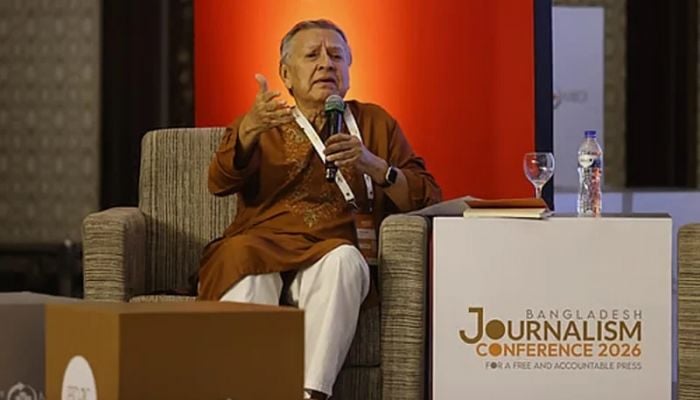
The editor of The Daily Star, Mahfuz Anam, has said that investigative journalism is not enough in Bangladesh and has stressed that the country’s future depends on its proper development.
Speaking at the opening ceremony of the two-day Bangladesh Journalism Conference held at the Radisson Blu Water Garden Hotel in the capital on Friday, Anam said journalists should conduct investigative journalism based on strong ethics, hold institutions accountable and ensure transparency in the expenditure of public funds.
“Elected governance versus independent journalism – this is very necessary for each other. We hope it will develop. Bangladesh’s future lies in investigative journalism,” he declared in response to a question.
Addressing the state of investigative journalism in the country, he observed that it had not been sufficient in the past and whether it would improve in the future remained a critical issue.
He identified the role of the editor as a key pre-condition. “Does an editor have that ethics, does he have that courage, does he have that professional reputation?” Anam asked.
He added that the rise of a strong editorial institution was essential for independent journalism, which in turn served as a pre-condition for genuine investigative journalism.
The Daily Star editor noted that investigative journalists and the media in general could take credit for generating and accelerating public debates on corruption, environmental degradation, and irregularities in various sectors.
However, he questioned whether enough was being done. “The question is, is this investigative journalism asking as many questions as it should towards those in power?” he remarked.
Anam explained that when a reporter engages in investigative journalism, the immediate challenge is exposing the corrupt, many of whom are linked to government circles or advertising revenue. “Their pressure will come. Who will bear that pressure? Editor,” he said.
In his view, the role of the editor becomes principal for investigative journalism to thrive. “Unfortunately, our editors are not rising to that condition.”
He recalled writing a column arguing that editors should not act as PROs of owners and emphasised the need for a clear distinction between the role of media owners and that of editors.
He lamented that the editorial institution had not developed properly in Bangladesh. Recalling earlier times, he mentioned prominent editors such as Abdus Salam and others who commanded respect and influence. Anam pointed to the increasing politicisation of the media as a major problem.
“I think that we who do journalism do not give enough importance to the profession. We easily get involved in politics while doing journalism,” he said.
He described how, under each regime, a group of journalists supporting that regime assumes leadership positions while others associated with opposition parties are sidelined, with their professional existence often coming under threat. This pattern, he noted, reverses whenever power changes hands.
Anam underlined that the fundamental principles of investigative journalism rest on the role of the editor, the ethical standards of media institutions, and the loyalty and devotion of journalists to their profession, which he described as essential pre-conditions. Reflecting on his long career, he said he had been with The Daily Star for 35 years and had witnessed many ups and downs.
“I have seen who is coming to political power or who is falling behind and I have also seen the impact of journalism with the change in political power,” he added.
The editor identified the core challenge facing Bangladesh today as the need to fight misuse of power, corruption, and the misuse of public funds. He argued that the country’s progress depended on good governance, accountability, and transparency, all of which relied heavily on investigative journalism. “Bringing power to account is the main task of investigative journalism. It ensures transparency in the governance process. Only investigative journalism can ensure accountability in our society,” he stated.
Anam described investigative journalism as the heart of democratic development and said it was urgently needed in Bangladesh at this critical juncture. Following multiple regime changes and periods of upheaval, the country now has an elected government and a parliament in place.
He expressed hope that the new government and parliament would learn from the mistakes of the past. One key reason for the fall and weakness of previous governments, he noted, was their failure to allow independent media to develop, because independent media raises difficult questions, checks accountability, and exposes wrongdoing.
He urged the new government to recognise that independent journalism is essential for its own success. “An elected government that is accountable to the people can be more resilient if they allow independent journalism to flourish,” Anam said. He repeated his call for journalists to pursue investigative work based on ethics, to hold institutions accountable, and to ensure transparency over public funds. “Elected governance versus independent journalism – this is very necessary for each other. We hope it will develop. In short, the future of Bangladesh lies in investigative journalism,” he concluded.
When asked whether the problem lay on both sides – with external pressure and editors’ inability to show the necessary courage – Anam replied that editors’ capacity depended on how transparent society itself was. He stressed the importance of editorial accountability and ethics. In this context, he cited Pakistani editor Zafar Abbas as an example, noting that there are many similar elements between the media environments in Bangladesh and Pakistan.

