Increasing private sectors’ investment to reduce risk of disasters
Samakal Correspondent
21 May 2021 23:30 PM । Update: 22 May 2021 08:44 AM
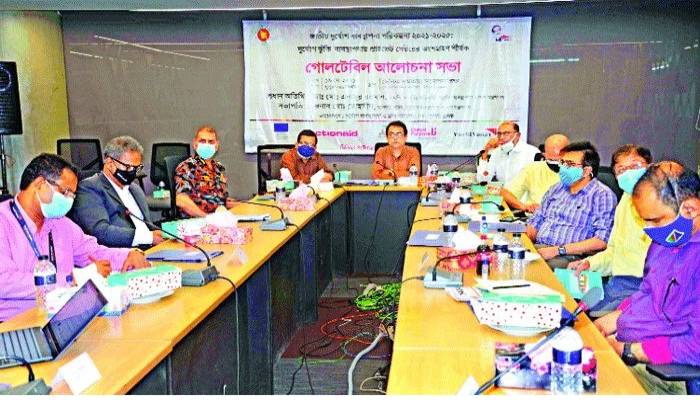
Bangladesh has become a role model in the world in disaster management as well as in various fields. The progress of this country is going on even during the Corona period. But the private sector has not yet been involved in disaster risk management on a large scale. Private sector investment is seen as a cost in this management but it must be seen as an investment. Risks need to be identified before investing. In this case, if the participation and investment of the private sector increases, more positive results will be obtained and amount of damage will be reduced. Businesses suffer the most during any disaster. In developed countries of the world, the private sector also invests in disaster management along with the government. If the participation of this sector is enhanced in this country as well, it will be easier to deal with new disasters, including the risks of climate change in the future.
The speakers came up with the observations at a roundtable meeting titled 'National Disaster Management Plan 2021-2025: Participation of Private Sector in Disaster Risk Management' held at the auditorium of The Daily Samakal office in the city’s Tejgaon on Wednesday. Daily Samakal was the media partner of the roundtable meeting organized by the Ministry of Disaster Management & Relief and the SUPER Project (Strengthening Urban Public-Private Programming for Earthquake Resilience). European Commission, Directorate-General for European Civil Protection and Humanitarian Aid Operations (ECHO) is financing the SUPER Project.
The SUPER Project is being implemented by ActionAid Bangladesh, Dhaka Chamber of Commerce and Industry (DCCI), United Purpose and World Vision Bangladesh.
State Minister for Disaster Management & Relief Dr. Md Enamur Rahman was the chief guest at the discussion moderated by Daily Samakal Acting Editor Mustafiz Shafi. Captain (Retd.) AB Tajul Islam, Chairman, Parliamentary Standing Committee on the Ministry of Disaster Management & Relief was present as special guest with the Secretary of the Ministry of Disaster Management & Relief Md Mohsin in the chair. A good number of personalities also joined the event and spoke online.
Mustafiz Shafi said that the ongoing corona-disaster or global pandemic has made today's discussion more relevant as the nation has lost many private sector entrepreneurs during the Corona period. Involving the private sector in disaster management is now very urgent, he said, adding that everyone must work together to reduce the risk of disaster - not just the public or private sector, it is the responsibility of all of us. This consciousness must be taken in mind, he said adding that Daily Samakal wants to stay with all social initiatives and as a part of social responsibility. He said that they have started this talks and very hopefully, it will move forward. All sectors will play a positive role in reducing disaster risk and damage through negotiations, he said.
Joining the discussion online as the chief guest, the State Minister for Disaster Management & Relief Enamur Rahman said many countries have given some must-follow instructions for garments industry in Bangladesh after the Rana Plaza collapse incident. Meanwhile, Bangladesh Garment Manufacturers and Exporters Association (BGMEA) has implemented these in the factories. Now, the first three of the top ten green garments in the world are located in the country. After the Rana Plaza tragedy, 99.6 percent of Bangladesh's garment factories have implemented disaster risk regulations. As a result, no major accidents have taken place in the garment sector since then. Garment factories during Corona period have invested in health guidelines. So the infection rate here is much lower. Due to the investment, they have become able to do business even in these difficult times. Investing in disaster management will reduce the losses of businesses and if they build a building following the building code, they will get their own benefit.
Highlighting the various initiatives taken by the government to deal with the disaster, the state minister said the Prime Minister is making arrangement for people to live in building that will reduce the damage caused by the disaster. In addition, disaster forecasting updates, awareness raising, post-disaster relief distribution and rehabilitation activities are underway. The government has set up a fund to deal with the disaster. The private sector can contribute to this fund. The state minister said that many scopes have been left open for private sector investment in disaster risk management. Enamur Rahman said if all the ministries except the Ministry of Disaster Management & Relief work on this issues, the entire country will become disaster-tolerant.
Speaking as the special guest, Captain (Retd.) AB Tajul Islam, Chairman, Parliamentary Standing Committee on the Ministry of Disaster Management & Relief, said that the government has been playing a vital role in tackling the disaster. Various private organizations provide money to the fund of the government and the government distributes it. This is not a long-term activity. Now Corona pandemic is going on, more new disasters may come in future. Many people are dying in lightning strikes, he said, adding that people have been hostile to nature and as a result, nature is taking revenge. He suggested adding disaster issues to the education system, further updating science and technology and increasing private sector investment to raise awareness.
Secretary of the Ministry of Disaster Management & Relief Md Mohsin said it took time for many developed countries to recover everything after the disaster but Bangladesh is moving forward quickly after dealing with major disasters year after year. Emphasizing on the institutionalization of disaster risk management, he said many recommendations have emerged from today's discussion that will play a big role in planning and implementation. He informed that disaster impact assessment will be done during future project preparation that will reduce the risk of disasters.
Suresh Bartlett, National Director, World Vision Bangladesh, in his welcome address, said Bangladesh, which is making progress in all areas, is a role model in the world in dealing with disasters. He believes that more success will come with the participation of the private sector and after today's discussion the participation of the private sector in disaster risk management will increase. He vowed that cooperation of SUPER Project with such initiatives of government and private sector will continue in the days ahead.
Rizwan Rahman, President of the Dhaka Chamber of Commerce and Industry (DCCI), said the disaster could not be tackled with money only- as evidenced by the Rana Plaza collapse incident. State minister for disaster and relief has experience in this regard. He recommended setting up of green funds from village to town for disasters, creating awareness, dredging rivers properly, allocating extra funds for research and increasing the spread of technology.
Faruk Hasan, President of the Bangladesh Garment Manufacturers and Exporters Association (BGMEA), said 40 lakh people were working in the garment industry from where $34 billion foreign exchange has come in the current financial year. He said they have set building safety issue as a mandatory. Meanwhile, a central fund has been created and preparations are underway to set up 475 green factories. He said they are very serious in dealing with disasters and in this case, they will take part in any work.
Farah Kabir, Country Director of ActionAid Bangladesh, said, "Everyone is thinking of Corona pandemic now. More such disasters may come in the future. If none of us is risk-free, then no one will be risk-free. Business will not be operated if everyone is not risk-free. The disaster hit everything, including food security. As a result, planning is very important. I would like to see the participation of the private sector with the government's plan."
Dhaka University Institute of Disaster Management and Vulnerability Studies (IDMVS) Director Professor Mahbuba Nasreen said many meetings had been held since 2015 on the participation of the private sector in disaster risk management. She said despite being clear many issues in many meetings, the private sector was thought to be doing CSR or charity only but in the real sense, it is an investment that many do not want to accept. In case of cyclone, businesses suffer more and if they do not invest in this sector, they will suffer more, she opined.
Director General of the Fire Service and Civil Defense Brigadier General Sajjad Hossain said it is very important to increase private sectors’ participation and investment in disaster risk management. The private sector can play a great role in training, raising awareness, building disaster-tolerant buildings, and providing post-disaster assistance and so on that will make the disaster-prone country more disaster tolerant, he observed.
Mukit Billah, Program Assistant, European Commission, Directorate-General for European Civil Protection and Humanitarian Aid Operations, said the SUPER Project aims to increase private sectors’ participation in disaster risk management. He suggested that big disasters cannot be handled by the government alone and in that case, the network can be expanded by involving the private sector.
Kazi Sahidur Rahman, UN Humanitarian Affairs Specialist in Bangladesh, said, "When we thought about the coast in disaster management, there were volunteers. When we are thinking of the disaster in the city, we are not getting them and for this, we are talking about the participation of the private sector."
Naoki Matsumura, Country Program Coordinator (risk reduction) for the Japan International Cooperation Agency (JICA), said Japan could managed everything within 72 hours after a disaster strikes. It is done as they have already worked for this. She said they are doing a lot of work from JICA especially working with buildings.
Dulon Joseph Gomes, Humanitarian and Emergency Affairs, World Vision Bangladesh, said, "We have been working for a long time with the government or private organizations in disaster risk management. The scope of the private sector is much larger. Investment will increase if the risks issues are cleared before the private sector."
Dhaka Ahsania Mission Executive Director Dr M Ehsanur Rahman said it is part of our heritage that the private sector is the first to take the lead in disaster management in the country. Talking is on to make it institutionalization and it has to be done from local to national level, he informed the audience.
In the main article, AM Nasir Uddin, Consortium Manager of ActionAid Bangladesh, said that the National Disaster Management Plan for 2021-25 has been formulated. The plan includes how the private sector can be involved. Institutionalization is mentioned here along with the attachment of monitoring. Arrangements have been made for annual evaluation, he said adding that they have started discussions as 2021 is set for starting the work over the issue.
Masud Rana, Head of DRM & ER Unit at United Purpose, said traders would be hardest hit by the quake. "If we can all work together, we will be able to deal with other disasters like Corona pandemic," he continued.

