Cyclone Mocha’s death toll reaches 202 in Myanmar
Online Desk
17 May 2023 15:07 PM
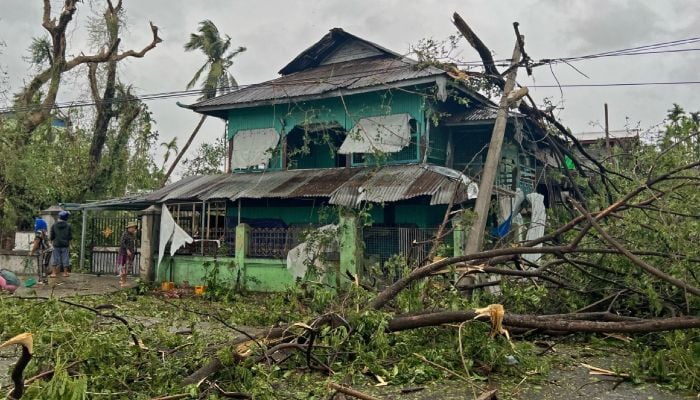
Cyclone Mocha crashed ashore in Myanmar and southeastern Bangladesh on May 14, uprooting trees, scattering flimsy homes in Rohingya displacement camps and bringing a storm surge into low-lying areas. AFP Photo
The death toll from Cyclone Mocha in Myanmar exceeded 200 on
Wednesday as people on the ground started clearing away debris and counting
casualties, with many fearing the death toll will climb far higher as hundreds
are still missing, reports Irrawaddy.
Mocha made landfall on Myanmar’s west coast in Rakhine State
on Sunday with winds of up to 195 km (120 miles) per hour, before crossing into
neighbouring Chin State and Sagaing and Magwe regions.
Aside from the human deaths, it left a trail of destruction,
crippling power pylons, smashing wooden homes and fishing boats, and inundating
tens of thousands of plantations.
Rakhine State is the hardest hit, with the most vulnerable
group being the Rohingya refugees living in camps near the state capital
Sittwe.
As of Wednesday noon, nearly 130 Rohingya people in 11 camps
were reported killed by the storm, according to the Alin Yaung volunteer group,
which has been gathering casualty figures on the ground. Sittwe has 13 Rohingya
camps, which are home to more than 1,00,000 people.
Many were killed by flash floods caused by storm surges,
while others were struck by trees felled by strong winds, especially in San Pya
(also known as Basara), Dar Pai, Bayda and Thae Chaung villages, where camps
are located.
The volunteers said they had buried 110 bodies, including
those of 30 children, according to Islamic funeral rites.
“The number of injured people is very high. There will be more
deaths, as hundreds of people are missing due to the floods,” said one of the
volunteers from Alin Yaung.
At least 46 people died in two other Rohingya villages, Bu
Ma and nearby Khaung Doke Kar, in Sittwe, AFP reported.
Residents of the camps said Myanmar junta soldiers arrived
in 10 trucks to evacuate them prior to the storm, but many were reluctant to
move out due to a lack of proper cyclone shelters, while also believing that
the storm would not be that serious. The soldiers took some elderly people to
makeshift shelters.
“There are only two shelters, at Thae Chaung and Kaung Taka
villages. Each has a capacity for just 500 people. The others are makeshift
shelters at schools and hospitals that were already full. If there had been
enough cyclone shelters, the death toll wouldn’t have been so high,” said a
Rohingya man from Thet Kae Pyin Village who requested anonymity for fear of
reprisal by the regime.
The United Nations refugee office said it was investigating
reports that Rohingya living in displacement camps had been killed in the
storm.
In the state capital, five people were killed—including one
woman who died when the building she took shelter in was damaged—according to the local rescue team the Myitta Yaungchi Foundation.
Myanmar’s regime-controlled media reported on Tuesday that
13 people were killed when a monastery collapsed in a village in Rathedaung
Township and a woman died when a building collapsed in a neighbouring village.
The day before, it said there were five deaths caused by the storm, without
giving details.
In Ponnagyun Township, one man was killed by the storm,
according to local people.
The cyclone also killed three people each in Sagaing and
Magwe regions while leaving a trail of destruction including flooded farms and
damaged homes.
The United Nations’ Office for the Coordination of
Humanitarian Affairs (OCHA) said its early estimates indicate that nearly 3.2
million people are considered to be most vulnerable and likely to have
humanitarian needs.
“Rapid needs assessments (RNAs) and some preliminary
distributions will start once approval is granted in six priority townships in
Rakhine,” said OCHA’s flash update on Tuesday, meaning they are still waiting
for the regime’s approval to provide assistance.
Meanwhile, in Rakhine, relief and support for cyclone victims
from the regime and aid agencies had yet to arrive as of Wednesday, according
to local rescue teams and volunteers.
Junta media aired footage of aid supplies for Rakhine being
loaded onto a ship in the commercial hub Yangon.
A member of the Myitta Yaungchi Foundation, a local rescue
team that has been conducting relief activities in Sittwe, said, “We all are
now in self-reliance mode,” adding that their stocks of rice for victims were
dwindling.
In Thet Kae Pyin Village, Rohingya people injured by the
storm are still in their homes, treating themselves with any remedies available
while sharing their food with others.
“No help, no UN. We are on our own,” said a volunteer.

