Sudan’s factions agree to 7-day ceasefire
AFP
21 May 2023 10:55 AM
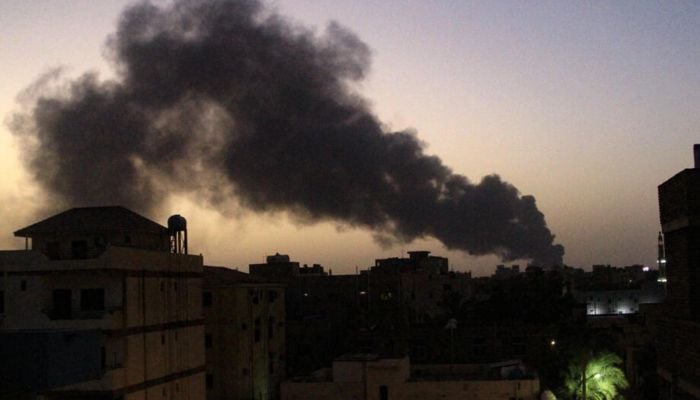
Smoke rises over Khartoum on Friday as air strikes and artillery exchanges grip the Sudanese capital. AFP Photo
Air strikes and artillery exchanges shook the Sudanese
capital Saturday and armed men ransacked the Qatari embassy as the country's
warring generals kept up their struggle for control even as they agreed to a
brief humanitarian pause.
With heavy fighting raging in Khartoum, the rival sides
struck a deal on a seven-day ceasefire beginning the evening of May 22, the
United States and Saudi Arabia said Saturday in a joint statement after talks
in Jeddah.
The ceasefire "shall remain in effect for seven days and
may be extended with the agreement of both parties," it said.
Multiple announced truces have been violated since fighting
broke out five weeks ago, which the Saudi foreign ministry acknowledged in a
statement published by the official Saudi Press Agency early Sunday.
"Unlike previous ceasefires, the Agreement reached in
Jeddah was signed by the parties and will be supported by a US-Saudi and
international-supported ceasefire monitoring mechanism," it said.
It said subsequent talks "will focus on additional
steps necessary to improve security and humanitarian conditions for civilians
such as vacating forces from urban centers, including civilian homes,
accelerating removal of impediments to the free movement of civilians and
humanitarian actors, and enabling public servants to resume their regular
duties."
The power struggle between regular army chief Abdel Fattah
al-Burhan and his former deputy turned rival Mohamed Hamdan Daglo, who heads
the paramilitary Rapid Support Forces (RSF), erupted into fighting on April 15.
The conflict has killed hundreds of people, most of them
civilians, and displaced more than one million.
The United Nations has warned of a fast-deteriorating
humanitarian situation in Africa's third-largest country, where one in three
people already relied on aid before the war.
Saturday's ceasefire announcement comes two weeks after
representatives of the warring generals first gathered in Jeddah for talks.
By May 11 they had signed a commitment to respect
humanitarian principles and allow in badly needed aid.
But UN aid chief Martin Griffiths told AFP on Thursday that
there had been "important and egregious" violations of that
agreement, which fell short of a ceasefire.
Push for talks
On Friday, Burhan sacked Daglo, giving his title of vice
president of the ruling Sovereign Council to former rebel leader Malik Agar,
and appointed three allies to top jobs in the military.
A former rebel leader who signed a peace deal with Khartoum
authorities in 2020, Agar said in a statement Saturday he was determined to try
to "end the war" and press for negotiations.
He also addressed Daglo directly saying "Sudan's
stability can only be re-established by a professional and unified army".
Integration of the RSF into the regular armed forces has
been the main bone of contention between Daglo and Burhan.
The force, which traces its origins to the notorious
Janjaweed militia recruited in the early 2000s to crush a rebellion by ethnic
minority groups in Darfur, is highly mobile but has a reputation for being
ill-disciplined.
Its fighters have been accused of widespread break-ins and
looting, including at diplomatic missions and aid group offices.
'Maximum restraint'
On Saturday, Qatar's embassy was the latest diplomatic
mission to be attacked, drawing condemnation from Doha.
"The embassy staff had previously been evacuated and...
none of the diplomats or embassy staff were subjected to any harm," the
ministry said.
It renewed calls for "an immediate halt to the
fighting".
Qatar did not specifically identify Daglo's RSF as
responsible but a statement from the pro-Burhan authorities put the blame
squarely on the paramilitaries.
The embassies of Jordan, Saudi Arabia and Turkey have also
come under assault in recent weeks.
Saturday's attack came a day after Arab leaders meeting at a
summit in Saudi Arabia urged Sudan's feuding generals to halt the fighting.
Although the main fighting is being played out in Khartoum,
the violence has also spread to the war-ravaged western region of Darfur, where
the RSF has its roots.
In South Darfur capital Nyala, fighting since Thursday has
killed 22 people forcing civilians to flee for safer areas as shells crash on
their homes, the bar association in Darfur has said.
On Friday, the UN aid boss Griffith said he was allocating
$22 million in emergency funds to help Sudanese fleeing the violence.
The funds will help relief efforts in Chad, the Central
African Republic, Egypt and South Sudan where Sudanese have sought refuge, he
said.
The United States promised $103 million for Sudan and
neighbouring countries to support displaced people.

