Crop diversification vital for water security in Barind area
BSS
17 Jun 2023 15:26 PM
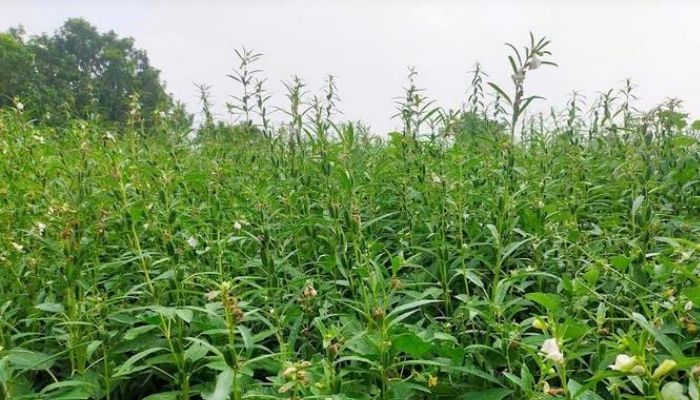
BSS Photo
Instead of depending on only Boro rice, large-scale
promotion of diversified crop farming can be the crucial means of ensuring
water security in the drought-prone Barind area.
The area consisting
of partial parts of Rajshahi, Naogaon and Chapainawabganj districts is
drought-prone due to its geographic location but the farmers used to cultivate
diversified crops to cope with the water-stressed condition since the
immemorial time.
Experts and development workers unanimously viewed that the
grassroots farmers also meet up their water demands from natural water bodies
such as rivers, canals and ponds.
Niamul Bari, professor of the Department of Civil
Engineering at Rajshahi University of Engineering and Technology (RUET), said
the natural surface water resources are facing an endangered condition at
present due to multifarious reasons including prolonged rainless situations.
In this situation, farmers have become dependent on
groundwater for irrigating the farming fields, especially the Irri-Boro paddy
which is a highly irrigation-consumed crop.
Prof Bari, however, opined that water is being adjudged as
one of the vital sources in the transformation process of development of the
present Barind area besides making it green during the last couple of decades.
Lifting of underground water must be reduced to the minimum
as the future of agriculture depends on the availability of water amid a
formidable threat of climate change when there is an alternative to keeping the
food production rate increasing.
He said there should be nature-based solutions for water
challenges in the region. Emphasis should be laid on the need for integrated
solutions in water development plans considering political, social and local
realities.
Apart from this, emphasis should be given to the cultivation
of drought-tolerant crops instead of depending on only Irri-Boro farming in the
area to lessen the gradually mounting pressure on underground water.
Large-scale promotion of less-water-consuming indigenous
crops could be an effective means of mitigating water-stress conditions in the
drought-prone Barind area.
Narrating the sufferings caused by the abnormal lowering of
groundwater National Agriculture Award Winning Farmer Nur Muhammad mentioned
that there are enormous scopes of increasing the acreage of various low-water
consuming crops like wheat, maize, lentil, burley, sesame and chickpea in the
Barind tract.
He mentioned that the ongoing climate change at alarming
rates has severely affected indigenous crop farming and its diversity creating
a real threat to food production.
There is no alternative to encourage the farmers to promote
various cereal crops and vegetables instead of only Irri-Boro paddy on the
dried land to face the water stress condition as its groundwater table has
gradually been declining.
Muhammad said the legitimate rights of the farmers and
others concerned should be protected for encouraging them towards boosting
agricultural production to meet up its gradually mounting demands.
Shahidul Islam, coordinator (Barind Region) of Bangladesh
Resource Centre for Indigenous Knowledge (BARCIK), said utmost emphasis should
be given to practising sustainable agriculture to attain sustainable
development besides achieving the sustainable development goals (SDGs).
Simultaneously, species of diversified crops need to be
protected which is the precondition to sustainable development.
Ensuring water security is very important to ensure food
security and biodiversity and sustainable culture.
Existing adverse impacts of climate change and other natural
catastrophes are posing a serious threat to biodiversity, health security and
water security in the Barind area.
Meanwhile, more than 12.58 lakh community people of 2.66
lakh households are being motivated and encouraged towards the promotion of less water-consuming crops to reduce the pressure on underground water under
the 'Integrated Water Resource Management (IWRM)' project.
The project is being implemented by DASCOH Foundation in
around 1,280 drought-hit villages under 39 union parishads and three
municipalities of eight upazilas in Rajshahi, Naogaon and Chapainawabganj
districts supported by Switzerland since 2014, said Akramul Haque, chief
executive officer of DASCOH Foundation.
The existing adverse impact of climate change is putting
local people into trouble since the hand-driven tube wells are not functioning
here in the dry season, he added.
/KN/

