Seminar on EU-Bangladesh cooperation held
Online Desk
06 Jul 2023 19:03 PM । Update: 06 Jul 2023 19:04 PM
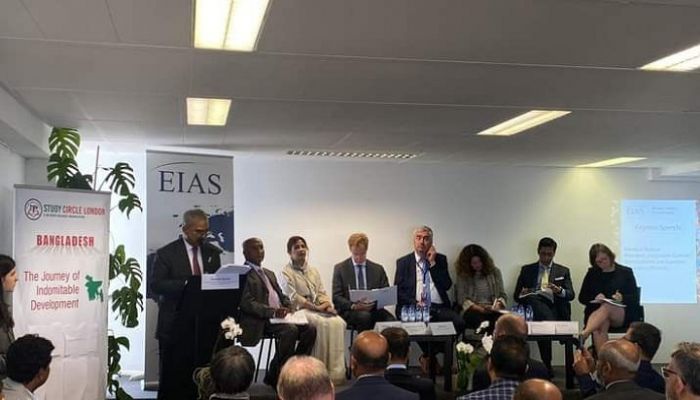
The European Institute for Asian Studies (EIAS) and Study Circle London jointly organise the Conference titled “EU-Bangladesh Cooperation: Opportunities and the Bengal Tiger Economy” at EIAS in Brussels, Belgium on Wednesday.
The European Institute for Asian Studies (EIAS) and Study Circle London have jointly organised the Conference titled “EU-Bangladesh Cooperation: Opportunities and the Bengal Tiger Economy” at EIAS in Brussels, Belgium on Wednesday.
The seminar delved into the fifty years of diplomatic relations between the EU and Bangladesh, explored the implications of Bangladesh's remarkable development and assessed the opportunities for enhanced future collaboration between both partners, said a press release.
A good number of highly distinguished speakers from different institutions and organisations from Bangladesh and Europe took part in the conference presided over by Lin Goethals, EIAS Director.
In his opening speech, Mahbub Hassan Saleh, Ambassador of the Embassy of the People’s Republic of Bangladesh to Belgium, Luxembourg and Mission to the European Union emphasised the robust trade partnership between the EU and Bangladesh, with the EU being the destination for 50% of Bangladeshi global exports.
“Bangladesh’s emergence as a Bengal Tiger Economy since its independence has played a significant role in the formation of this relationship. Yet, the two entities are now seeking to expand their cooperation beyond trade into areas such as climate change, security, connectivity, migration, and the blue economy,” he says.
He added as saying that this cooperation is based on shared values in democracy, justice, gender equality, human rights, and a secular government. Together, the partners also aim to address issues such as the displacement of Myanmar nationals and Rohingya refugees.
The EU and Bangladesh have agreed to initiate negotiations for a Partnership and Cooperation Agreement (PCA) within this year, the diplomat said, adding that this move is seen as a significant step toward taking the relationship to the next level, following Bangladesh’s projected graduation from Least Developed Country (LDC) status into a long-term, mutual, alliance.
Faruque Hassan, President of the Bangladesh Garment Manufacturers and Exporters Association (BGMEA), highlighted the significance of EU-Bangladesh bilateral trade.
He said the clothing and textile industry benefits both markets, and Bangladesh aims to diversify into high-end garments, including sportswear and lingerie, while exploring opportunities in non-cotton markets.
Faruque Hassan also stressed the shift from an agro-based to an industry-based development model in Bangladesh, with two million people joining the labour force annually and projections suggesting that Bangladesh will become the 23rd largest economy by 2050.
Study Circle London Chairman Syed Mozammed Ali subsequently presented their recent study: “Bangladesh: The Journey of Indomitable Development”.
Referring to the transformation that has taken place in Bangladesh as nothing short of a miracle, considering the country was once described as a “bottomless basket”, Bangladesh is currently the 37th largest economy globally, with a total GDP of 480 billion USD in 2022.
Its economy relies heavily on agriculture, with a significant portion dedicated to rice, fish, and vegetable production. Overall, despite being a small country, it accommodates a massive population of approximately 170 million people, with Dhaka alone having a population of 23 million.
The presence of around 600,000 Bangladeshis living in Europe has played a vital role in showcasing their culture, commerce, and cuisine to the outside world. He continued by describing the priorities for further cooperation between the EU and Bangladesh.
While having received 250 million EUR to aid in the reception of Rohingya refugees, further collaboration is needed between the partners and other international organisations. Finally, he recognized the need for enhanced collaboration on climate change.
Member of the European Parliament Milan Zver stressed the need for human capacity development in Bangladesh and inclusive governance, with a specific focus on education, skills development, green inclusive development and energy efficiency.
Rensje Teerink, Head of Division for South Asia of the European External Action Service stated how at their 50th anniversary the relations between Bangladesh and the EU have become more mature and geostrategic.
Advocate Tarana Halim, former MP, former State Minister of Post and Telecommunications of the Government of Bangladesh and current Executive Committee Member of the Bangladesh Awami League, highlighted the need to turn the people of Bangladesh into a highly skilled workforce and to provide them with jobs.
Nahim Razzaq, Member of the Bangladesh Parliament, addressed the transition EU-Bangladesh relations have been going through, especially given the EU’s focus on democracy, food, nutrition, sustainable development, education, and human development, now also having moved on to the green sector.
The Q&A session extensively discussed topics related to Bangladesh's governance, labour issues, trade policy, climate change, skilled labour development, the implementation of laws and regulations, and the upcoming Partnership and Cooperation Agreement.
The compliance of labour laws and ILO standards was thereby addressed, with the EU engaging with Bangladesh on labour reforms and a National Plan of Action being set in motion.
/MHK/

