Industry-academia linkage stressed to reduce skill mismatch
BSS
08 Jul 2023 18:40 PM
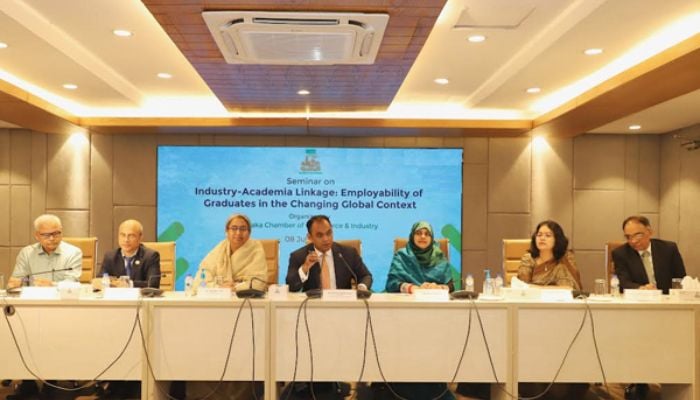
BSS Photo
Speakers at a seminar have stressed on industry-academia
linkage to reduce skills mismatch in various sectors in the country.
They made the remarks while addressing a seminar on
“Industry-Academia Linkage: Employability of Graduates in the Changing Global Context”
held in the capital organised by the Dhaka Chamber of Commerce and Industry
(DCCI) on Saturday.
Education Minister Dr Dipu Moni spoke at the seminar as
chief guest while Executive Chairman (Secretary), National Skills Development
Authority (NSDA) Nasreen Afroz spoke as guest of honour that was presided over
by DCCI president Barrister Sameer Sattar.
Speaking on the occasion, Dipu Moni stressed for
commercialisation of research and development initiatives.
She opined that a transformation in the national curriculum
system is already visible. She also reiterated bringing in soft skills,
re-skilling and up-skilling, teamwork development, technology adaptation,
changing of mindset, demand mapping and expediting the Technical and Vocational
Education and Training (TVET).
Dr Dipu Moni informed that at present the enrollment rate in
the TVET is 17 per cent.
She said diversification of education is more important as
it will not be the right decision to attract students only to the medical or
engineering education system.
Rather, she said the students should have a mentality to
come into nursing, modern farming, freelancing and other jobs since these
sectors have also created a huge demand nowadays.
In this regard, the education minister urged to change the
mindset because no occupation is superior to the others.
Nasreen Afroz, Executive Chairman (Secretary) of the NSDA
said that the NSDA is keen to create skilled manpower.
She also informed that a ‘Skills Qualification Framework’
has been formed under the Chairmanship of the education minister. Fourteen (14)
skills development councils have already been formed, she informed.
Nasreen expressed her hope that in future the relation
between the industry and the academia will be more expedited.
She also requested the industry leaders to arrange such
workshops and seminars incorporating relevant stakeholders.
“NSDA has been arranging funding from the Human Resource
Development Fund of the Ministry of Finance for those who are involved in
conducting skills development training,” she informed.
Dr Sayema Haque Bidisha, Professor of Economics, University
of Dhaka and Research Director, SANEM presented the keynote paper.
She highlighted that one of the challenges of the labour
market of Bangladesh is the absence of a strong linkage between the supply and
demand sides- primarily between academia and the industry.
To address the skills mismatch, strong Industry-Academia
linkage is needed, she said.
By the year 2027, analytical thinking, creative thinking,
artificial intelligence (AI) and big data will have more demand. In the future,
technology will create more jobs, Dr Bidisha added.
DCCI president Sameer Sattar said in the changing global
context and in order to accommodate the graduates to their desired job sectors
as per the demand of industries, there are no alternatives but to ensure better
collaboration, coordination and synchronization between the industry and the
academia to secure the future economic development as well as to reduce the
existing skill mismatch.
He also said that Industry-Academia linkage is instrumental
in creating a skilled and industry-oriented workforce. “It ensures a workforce
- ready with a specialised skill set for the relevant industries but the
linkage has still not been fully developed due to our conventional educational
system.”
Sameer also urged for conducting joint research and
development activities, developing education infrastructure, creating a
national employment database, arranging need-based curriculum design and skills
training as well as strengthening TVET.
According to a statement, every year $8-10 billion are being
remitted from Bangladesh as salary paid to foreign workers, he pointed out.
In the panel discussion session, Professor of the Institute
of Business Administration (IBA) Mohammad Abdul Momen stressed need-based
curriculum development, development of IT infrastructure, skills training and
adopting industry-specific programmes.
“Female participation in our industry is very low,” he
added. Moreover, he urged to reduce dependency on foreign workers working in
different companies in Bangladesh.
Managing Director of Apex Footwear Limited Syed Nasim Manzur
requested private sector representation in the development process of the
curriculum to ensure quality education.
Vice Chancellor of BUET Prof Satya Prasad Majumder
underscored the importance of having joint collaboration and cooperation
between industry and academia.
“Industries should come forward with more research and
development with their own investment,” he added. Besides, Majumder requested
to develop a 4IR policy.
Member of the University Grants Commission (Commission) Prof
Dr Md Sazzad Hossain said that the UGC is going to establish an
industry-academia platform soon.
Former CFO of Snapchat Inc. Imran Khan said that ICT,
innovation, digital marketing and IT outsourcing will create huge job
opportunities for the graduates.
Country Director of ILO Tuomo Poutiainen and Shafquat
Haider, Member, Governing Board, NSDA also spoke on the occasion. DCCI Senior
Vice President SM Golam Faruk Alamgir (Arman) was also present on the occasion.
/KN/

