Dhaka's air world's worst polluted on Sunday
Online Desk
05 Feb 2024 10:40 AM
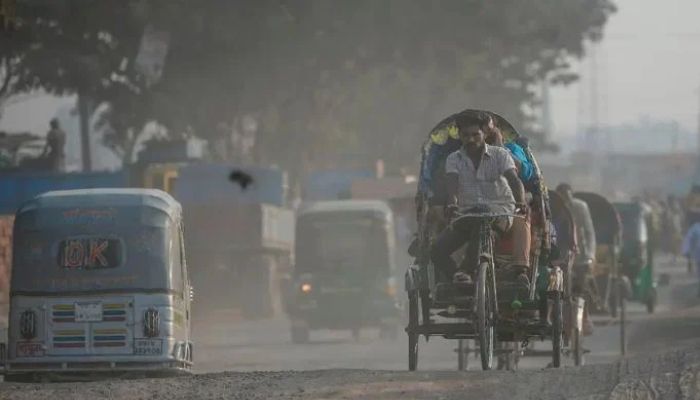
Representational Image
The capital of Bangladesh ranked first among the world's
cities with the worst air pollution on Sunday morning. Dhaka's air quality
index (AQI) was 408 (hazardous) at 10am.
On the second spot, Ghana's Accra had an AQI of 332,
followed by Nepal's Kathmandu, with an AQI of 183.
AQI between 151 and 200 is said to be ‘unhealthy’ while a
range between 201 and 300 is considered ‘very unhealthy.’
The range between 301 to 400 is ranked 'hazardous', posing
serious health risks to residents.
'Good' AQI is between 0 and 50, where air quality is considered satisfactory, and air pollution poses little or no risk.

This screengrab taken from the IQAir website shows the air quality situation in Dhaka at 10am on Sunday
The AQI between 51 and 100 is termed 'moderate.' Pollution
in this range may pose a moderate health concern for a very small number of
individuals. People who are unusually sensitive to ozone or particle pollution
may experience respiratory symptoms.
An AQI between 101 and 200 is considered unhealthy for
sensitive groups. Meanwhile, in Bangladesh, the AQI is based on five criteria
pollutants – Particulate Matter (PM10 and PM2.5), NO2, CO, SO2 and Ozone.
Air pollution has always been a problem in Dhaka. Winter is
often when the air quality deteriorates, and monsoon season is when it gets
better.
According to the World Health Organization (WHO), air
pollution kills an estimated seven million people per year throughout the
world, primarily due to an increase in fatalities from heart disease, stroke,
lung cancer, chronic obstructive pulmonary disease, and acute respiratory
infections.
/KN/

