Interview with Afreen Akhter
Dhaka has no reason to worry about US labour policies
Tasnim Mohsin
29 Feb 2024 22:06 PM । Update: 03 Mar 2024 19:19 PM
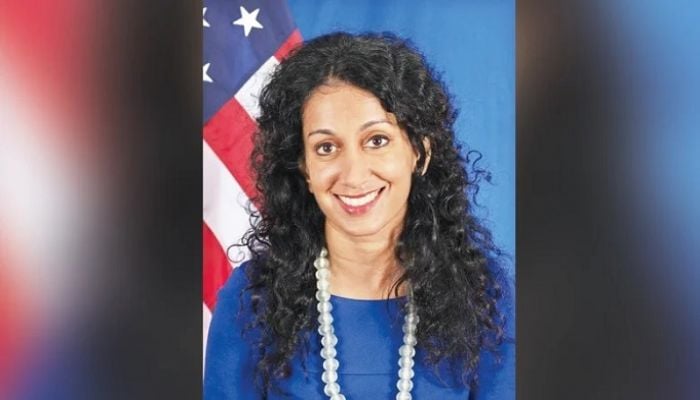
Afreen Akhter, Deputy Assistant Secretary for South and Central Asian Affairs of the US State Department
The United States has announced various sanctions, including trade, on those who will take away the rights of workers, intimidate and attack them around the world. However, there is no reason for Bangladesh to worry about this, said Afreen Akhter, Deputy Assistant Secretary for South and Central Asian Affairs of the US State Department.
She recently visited Dhaka as a member of a high-level delegation of the United States. In an interview with The Daily Samakal during the trip, Afreen highlighted the country's stance on trade, security and defense cooperation between the two countries, Rohingya crisis, exploration of oil and gas in deep sea ports, creation of democratic environment, free civil society.
Tasnim Mohsin took the interview.
Samakal: First visit of US delegation to Bangladesh after January 7 elections. What message did you pass?
Afreen Akhter: During the visit, we met with the representatives of the government, civil society, opposition parties, labour organisers and others. We said in the meeting with the government that Washington is interested in working on the priorities of the two countries. We also discussed how we can support economic growth, labour conditions, climate change mitigation and renewable energy. Along with this, there were talks about increasing defense and security cooperation and maritime security. The discussions were held with the government and other stakeholders so that the civil society can function freely. US representatives meet with the opposition whenever they make visit. We also met with the opposition party in Bangladesh.
Samakal: Why is the high-level visit of the US important?
Afreen Akhtar: Last year, high level delegation visited Dhaka. This time, we have given the government a message to work on priorities like economic growth, climate change, defense and security cooperation, Rohingya refugees and freedom of civil society.
Samakal: What are the priority issues in the ties between the two countries?
Afreen Akhter: The United States appreciates the generosity that Bangladesh has shown by sheltering one million Rohingyas. Rohingya refugees are our priority. So far, the United States has provided $2 billion in aid to the Rohingya. The US will continue its humanitarian assistance. At the same time, the United States is working to ensure a sustainable solution to this crisis. If you think about economic growth, the biggest investor in Bangladesh is the United States. It is also the largest export market for Bangladesh. There is immense potential in this sector. However, it is important to remove legal barriers to facilitate investment. At the same time, the obstacles that US companies face in this country to repatriate their dividends must be removed. The labour situation in Bangladesh needs to be improved. We are observing the protection of workers' rights everywhere in the world, including Bangladesh. Apart from this, we discussed common interests, including security.
Samakal: Your assessment of the Rohingya crisis and the current situation in Myanmar.
Afreen Akhter: Along with the assistance to Bangladesh on this matter, the US will continue its aid for the Rohingyas. Crisis is going on in many parts of the world. So, more or less has to be done for this. Myanmar's current situation is due to past genocides. Now, the Rohingyas do not have any favourable environment for repatriation.
Samakal: What is the United States doing to restore stability in Myanmar?
Afreen Akhter: The US is committed to Indo-Pacific security cooperation. We are concerned about what is happening on the border between Bangladesh and Myanmar. In order to reduce this crisis, the ministry is taking dialogue and other measures under the leadership of the US Secretary of State.
Samakal: Why is Bangladesh so important in the Indo-Pacific strategy?
Afreen Akhter: Like other South Asian countries, Bangladesh is one of the partners of the Indo-Pacific Strategy or IPS. IPS is not really a club to join. IPS aims to build a region that is free, prosperous and secure. We have a lot in common with Bangladesh's policy on IPS. Economic growth is one of them. Apart from this, both countries are interested in building a free, safe and prosperous region. And this is what made it possible to work together.
Samakal: Is the United States really interested in oil and gas exploration in the deep sea of the Bay of Bengal?
Afreen Akhter: US investment is high in the energy sector of Bangladesh. US companies are interested in working on energy in other places, including the deep sea. Along with that, Bangladesh is also interested in renewable energy. We are looking for ways to cooperate in offshore wind and solar power to build Bangladesh's energy security through USAID and other means.
Samakal: What is the United States' assessment of the labour rights situation in Bangladesh?
Afreen Akhter: Protection of workers' rights has gained importance in US global labour policy. During the visit, we met with labour organisers. We have heard from them, we have heard what kind of obstacles they are facing while working. We will work with governments, labour organisations and institutions to overcome these barriers.
Samakal: Is there anything to worry about in labour policy for Bangladesh?
Afreen Akhter: Bangladesh has nothing to worry about. This policy should be done globally, so that workers' rights are guaranteed. We are doing this through various measures. Assistance is also included in the system. The United States has projects to improve labour conditions in Bangladesh.
Samakal: Have the concerns of labour organisers been conveyed to the government?
Afreen Akhter: There was a very open discussion with the government. We want to see real improvement in the labour environment, especially the right to assembly and trade union. An open discussion has been held with the government to amend the law on trade union registration process.
Samakal: What is the assessment of the United States on the free media and civil society of Bangladesh?
Afreen Akhter: We have discussed with representatives of civil society. The United States believes that everyone benefits from a strong civil society and media. Here people can express their concerns and opinions. A society thrives when it is free, open and democratic. We are working to develop these issues in Bangladesh through USAID and other ways.
Samakal: Did Bangladesh show interest in buying Boeing aircraft in the meeting?
Afreen Akhter: Most of the aircrafts of Bangladesh Biman are from Boeing. It is a big help moving forward. Competitively, Boeing is cost-effective, and maintenance and spare parts costs are low. Boeing has an attractive proposal for Bangladesh, the government will consider it.
Samakal: What are the obstacles for US investors in Bangladesh?
Afreen Akhtar: US investors are interested in working in Bangladesh as an emerging market. We have huge investments in various sectors, including energy sector, ready-made garment industry of this country. But the main hurdle for our businesses is the legal complexities, such as sending of profits of companies to their own country. Bangladesh should take these issues into consideration to attract more US investment. We have highlighted these issues in the meeting with the government.
Samakal: What are the main areas of defense cooperation between the two countries?
Afreen Akhter: Security and defense cooperation is one of the priorities of Dhaka-Washington relations. There is over $100 million in US funding to advance Bangladesh's peacekeeping and security sector. We are working to further this relationship. We have to sign the General Security of Military Information Agreement or GSOMIA. If this happens, US defense cooperation for Bangladesh will reach the next level. Apart from this, there is training cooperation between the military forces of the two countries.
Samakal: Is the GSOMIA pact coming soon? Is there any disagreement between the two countries in this regard?
Afreen Akhter: Both countries are committed to the GSOMIA pact. The main purpose of this agreement, along with any other, is to deepen our bilateral security cooperation.
Samakal: What are the obstacles in the relationship between the two countries?
Afreen Akhter: We want to move towards the future with common priorities. We will work with Bangladesh on security and defence, Rohingya crisis and free civil society to create a democratic environment in Bangladesh.
Samakal: Two US ambassadors have been harassed in Bangladesh while on duty. What are the US expectations from the government?
Afreen Akhter: The safety and security of its diplomats is the highest priority of the United States - We have made this clear to the Bangladesh government. I believe the government has realised it.
The interview was published in the print and online editions of The Daily Samakal and has been rewritten for the English version by Mohammed Humayun Kabir, Senior Sub-Editor.

