Interview with Rokeya Sultana
'Bravery of women in mass uprising truly remarkable'
Shaherin Arafat
12 Mar 2025 14:38 PM । Update: 12 Mar 2025 14:39 PM
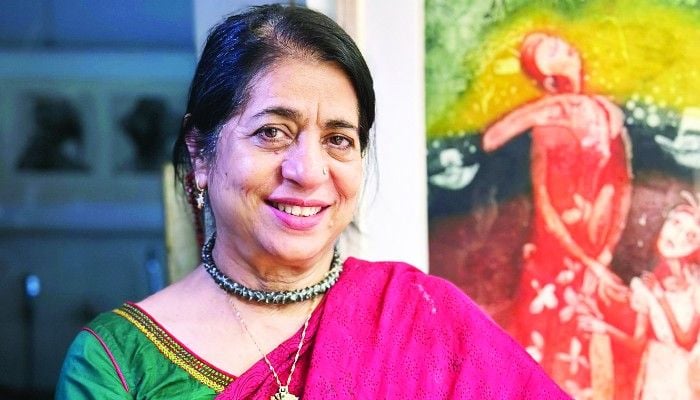
Rokeya Sultana
Rokeya Sultana is a renowned artist with international acclaim. Her artworks have been exhibited in numerous art exhibitions both at home and abroad, earning her countless awards. Recently, she was honoured with the prestigious Ekushey Padak. Through her dedicated artistic practice, she vividly portrays themes of women, motherhood, nature, climate, struggle, and relationships. She recently spoke with Samakal in an interview conducted by Shaherin Arafat.
Can you please tell us about your birth and upbringing?
I was born in 1958. When I was two years old, we moved to Rawalpindi as my father was posted there for work. In 1960, we relocated from East Bengal to Rawalpindi in West Pakistan, where we lived for almost 10 years. It was a place abundant with greenery, with large fields in front of our house where embassy officials would come to play golf. I also saw foreigners there, as well as Air Force and Army personnel who played in those fields. That’s why the area had such vast green spaces. I love nature—it speaks to me. I’ve always been deeply influenced by it. The changes in nature also transform me, and this is reflected in my work. Bangladesh, my riverine motherland, is lush and green.
Your name includes ‘Rokeya’ and ‘Sultana,’ reflecting Rokeya’s creative legacy. Who named you?
My father named me. He studied at Islamia College in Kolkata, now known as Maulana Abul Kalam Azad College, where he completed his bachelor’s and master’s degrees. He grew up in a village and achieved first division in his matriculation exams. I believe he attained a high academic standard. I’ve heard that during his college days, the writer Shawkat Osman was his friend. He used to write for magazines like Saugat. My father also collected folk songs sung by women in his village.
During our childhood, some Bengali families in West Pakistan held strongly onto Bengali culture. We studied in Bengali-medium schools there. My father worked in the police department. I had the opportunity to read his diary, where he wrote things like, ‘Today is Language Day; everyone will go to the Shaheed Minar to offer flowers, but I can’t go due to my job.’ He wrote this with a heavy heart. When my siblings and I chose our careers and subjects, my father encouraged us greatly.
The ‘Madonna’ series is one of your most significant works. Can you tell us how it began?
The reason is quite simple. If we look at art history, almost every significant artist has explored the theme of Madonna, especially during the Renaissance. When my daughter was born, I felt compelled to create a timeless Madonna. If I divide my artistic career into 30-35 years, the Madonna series stands out as one of the most important among the four or five series I’ve worked on. Around 1991, I was sketching in my living room with pencil and charcoal when the idea of Madonna emerged—a mother holding her daughter’s hand, walking down a road. I used a metaphorical approach here, leaving it ambiguous whether it’s a road in Dhaka or somewhere else. This ambiguity allows viewers to interpret it in their own way. That’s how the Madonna series began.
The Madonna series beautifully portrays the struggles and empowerment of women. How did you bring these themes into your artwork?
From a young age, society made me acutely aware of the challenges of being a woman. This existential crisis began to manifest in my work, growing more pronounced as I matured. I observed my mother working at home—her desires, her struggles—which deeply influenced my portrayal of Madonna’s mother. Around that time, Bangladesh’s garment industry was flourishing, and women began playing a pivotal role in the economy. Women from villages came to work in garment factories, and I saw them carrying lunchboxes, and commuting to work. In a conservative country like Bangladesh, they lived in shared accommodations and worked tirelessly. I channelled these observations into the mother and daughter in my work. It’s not just a story of a mother and daughter; it’s about women’s freedom, economic liberation, and personal growth. It’s about their struggles and triumphs.
I also wanted to emphasize that a mother is a human being too. When a woman becomes a mother, we often forget her individuality. In one of my works, I dressed a mother in a magenta saree and added a scratch on her cheek to symbolize her battle. She’s not succumbing to sorrow; she’s fighting. She’s happy with her daughter, travelling by bus or boat. She’s not a goddess; she’s human, which is why I used the magenta saree metaphorically.
Do you see yourself reflected in this Madonna?
Every piece of art we create holds a mirror to ourselves. So, yes, I see myself reflected in my Madonna series.
We are emerging from a year marked by a mass uprising. Yet, violence against women persists—it was happening before, and it continues now.
In the videos of the mass uprising, women were hailed as ‘firebrands,’ standing as shields for men. Often described as embodying motherly qualities, they demonstrated an unwavering instinct to protect their children, which was vividly evident during the uprising. The bravery of women in the mass uprising is truly remarkable. These women displayed extraordinary courage, resilience, and dedication—contributions I believe will be recognized and celebrated. This Women’s Day, let us focus on their pivotal role in safeguarding the motherland and honour their indomitable courage.
Recently, there has been a rise in derogatory comments targeting women’s clothing choices...
Beauty is subjective, shaped by culture, time, and place—clothing is no exception. Everyone has their preferences, and women have the right to choose their attire. If someone feels wronged, they should seek justice through proper channels, not by taking the law into their own hands. The government and citizens both have roles to play. Freedom loses its essence when it’s not upheld with dignity. In my country, both men and women enjoy this freedom. Change won’t happen overnight—it takes time and effort.
Thank you so much for your time.
Thank you, Shaherin and Samakal.

