IPD publishing unchecked propaganda on Bangladesh: Dismislab
Online Desk
27 Mar 2025 15:50 PM । Update: 27 Mar 2025 15:51 PM
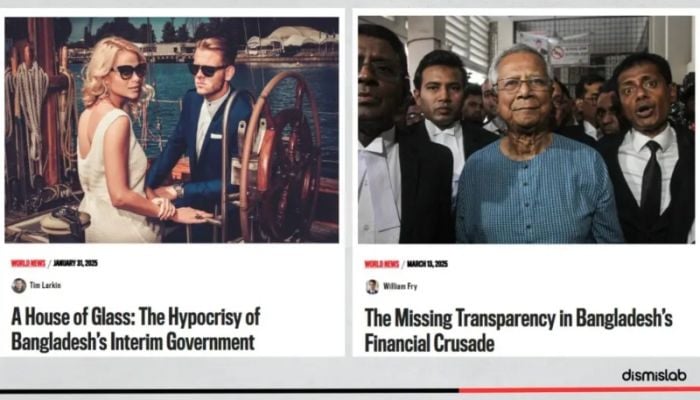
Photo- Dismislab
Independent fact-checker Dismislab has conducted a month-long investigation and found 10 articles in the US-based International Policy Digest (IPD) website critical of Bangladesh’s post-uprising government have been seemingly written by ghost authors.
These ghost authors appear to have no verifiable identities or contacts, often using stolen profile images from sites like Shutterstock. At least two of these articles written by ghost authors have been republished in Bangladeshi news sites without verification and also shared on social media.
Some of these posts were even shared by the ousted prime minister Sheikh Hasina’s son Sajeeb Wazed Joy and other official pages of her Awami League party, amplifying questionable narratives.
One particular target of this campaign has been Bangladesh Bank Governor Dr. Ahsan H. Mansur. In March, he visited the UK to seek the British government’s support to repatriate stolen funds allegedly laundered abroad, including in the UK, by members of Sheikh Hasina’s government. At least three articles in IPD (all coinciding with his visit) target him personally, his banking regulation policies and the reported “lavish life” of his daughter living abroad.
On March 24, 2025, The Guardian reported that MPs from the UK’s All-Party Parliamentary Group (APPG) on Responsible Tax and Corruption received emails before a session with Dr Mansur, also linking to International Policy Digest articles that questioned his daughter’s wealth. The emails, purportedly from a journalist and also a UK public relations firm, suggested MPs should investigate Mansur. The British newspaper could not trace this so-called journalist, and the public relations company refused to reveal on whose behalf it had sent the email to the MPs.
Dismislab's investigation reveals a serious lack in IPD’s editorial process, allowing targeted propaganda and misinformation to make their way onto the website and subsequently into media and social media. As part of this investigation, Dismislab submitted two articles to IPD for publication—one accusing the United Nations of bias in its report on the July uprising and another painting a positive picture of the National Citizen Party (NCP), led by students in the uprising. For each AI-generated article, Dismislab created fake authors using made-up names, stock photos, and false credentials. Both articles contained misinformation that had already been debunked. IPD published the article accusing the UN of bias, while the article praising the NCP remains unpublished.
Ghost Experts
The International Policy Digest, an online magazine founded in 2011 and based in Virginia, has long covered global current events, world affairs, and international relations. From its website, Dismislab documented 10 articles related to Bangladesh that were published after the political shift on August 5, 2024. All eight authors behind these articles were ghostly figures, with no verifiable identities, credentials, or contact details to substantiate their existence.
Tim Larkin’s article that discredits Dr. Mansur and his daughter gained widespread attention in Bangladeshi news outlets as well as on social media. Another ghost author, Kristopher O’Brian, also wrote one article before the uprising, criticizing the caretaker government system that the then-opposition parties had been demanding.
To verify the identities, Dismislab sought to find out if the authors have any presence on social media; whether their profile photos are authentic; whether there is any information about them online; and if they have an email address, website, or affiliation for contacts. All criteria returned negative results for the eight authors. They have no digital presence, and their profile photos published in the IPD were found on stock photo websites such as Shutterstock and Freepik with no accompanying names. No further information about them is available online, and there is no way to contact them.
When approached formally for a response on their verification process, IPD’s Editor-in-Chief John Lyman said in an email that the platform operates on a level of trust with its writers, and admitted that some “fake authors may have slipped through,” given the publication has nearly 3,000 contributors.
He added that some authors occasionally requested anonymity, which he granted, but he did not clarify whether they conduct any background checks before publishing articles.
IPD does not publish articles solely from fake authors; the site regularly features pieces from writers with strong credentials. For example, it published at least five articles on Bangladesh before the uprising, all written by authors with verifiable credentials and largely explored the country’s historical trajectory, regional politics, and economic prospects. However, the investigation found that its editorial and verification process is so weak that anyone can bypass it and get propaganda pieces published without scrutiny.
According to A. Al Mamun, Professor of Mass Communication and Journalism at Rajshahi University, “This is a sustained, well-planned propaganda campaign in favour of the Awami League.” In 2023, an AFP report exposed how fake experts published articles on various local and international websites to spread disinformation ahead of the national election. “At that time, the campaign had a certain form. Now, a different dimension has been added to it. However, I believe it is still being driven from the same place,” he added.
Unreliable IPD articles in Bangladeshi Media, Social Media
Within days of IPD publishing Tim Larkin’s “A House of Glass: The Hypocrisy of Bangladesh’s Interim Government”, several Bangladeshi outlets picked it up. The first Bangla version appeared on BD Digest on February 1. The next day, Khaborer Kagoj reported that the governor’s daughter Mehreen Sarah Mansur was living lavishly in Dubai, questioning the legality of her wealth. Khaborer Kagoj also released a video. Later that morning, Bangladesh First and Barta24 published similar articles. On February 2, Daily Janakantha followed with a report, and SA TV published a video the next day.
On social media, the article was shared from the Facebook page of Bangladesh Students’ League, the recently banned student wing of the Awami League. But it gained traction when Sajeeb Wazed Joy, son of Sheikh Hasina, shared it on X (formerly Twitter) and Facebook, just the day after IPD published it. Subsequently, the article was shared multiple times on X and Facebook from various accounts.
Another IPD article that attracted social media attention was written by one Gustav Ellison, titled “The Unelected Banker: Ahsan Mansur’s Gamble with Bangladesh’s Economy.” It was shared by the official Facebook page of Bangladesh Students’ League.
Professor Mamun urged media outlets to be cautious when using foreign newspaper content or their sources. He said, “When taking content from foreign newspapers, our media outlets should communicate with them to verify the source. They should also ensure that there are no errors or misleading information.”

