Nation celebrates Pahela Baishakh
Online Desk
14 Apr 2025 06:54 AM । Update: 14 Apr 2025 21:37 PM
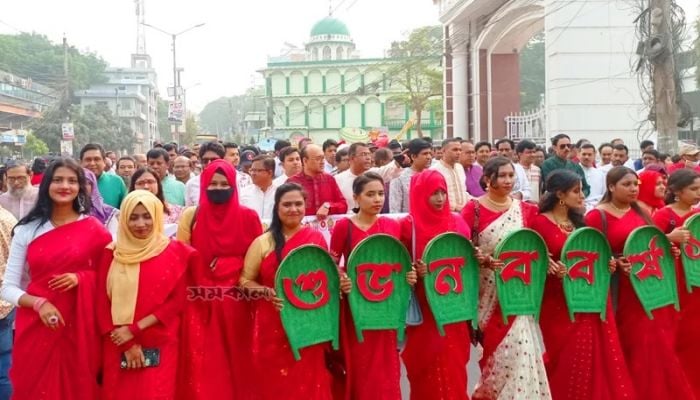
The nation celebrated Pahela Baishakh, the first day of Bangla New Year-1432, on Monday in an inclusive manner involving people from all ethnic groups.
A huge number of people joined the "Nabo Barsho" festivities across the country, particularly in the capital city.
Pahela Baishakh is one of the most colourful festivals through which the country's people bid farewell to the old year and welcome the New Year.
The celebration of Bangla New Year 1432 began with the performance of the national anthem and the song 'Esho He Boishakh, Esho Esho' in the morning of Pahela Baishakh.
The Chhayanaut, a leading cultural organisation of the country,organized a cultural event at Ramna Batamul at dawn to welcome the Pahela Baishakh.
On this occasion, people from all walks of life wear traditional dresses, especially the Bangalee young women wear white sarees with red borders and adorn themselves with bangles, flowers and "tips" while men wear white pyjamas and panjabi or kurta while the ethnic people wear their respective traditional dresses.
According to the programmes taken by the government, special features have been published in newspapers highlighting the significance of the Pahela Baishakh this year instead of publishing special supplements.
Bangladesh Television, Bangladesh Betar and other print and electronic media made illustrated reports putting emphasis on the occasion.
The Faculty of Fine Arts of Dhaka University organized a grand procession titled "Barshobaran Ananda Shubhajatra" at 9am and cultural programme on Pahela Baishakh.
This year, the procession was held in an inclusive and universal manner, ensuring the participation of not only the Bangla community but also the Chakma, Marma, Tripura, Garo, Manipuri, and other ethnic groups as well as female footballers.
Each community showcased their cultural identity through traditional music and instruments.
The Bangladesh Shilpakala Academy coordinated the participation of cultural groups from the three hill districts and other ethnic communities in the procession.
The Ministry of Information and Broadcasting ensured the arrangement of broadcasting the processions on all government and private TV channels, radio stations, commercial radios, and community radios.
On the occasion, different cultural organizations, including the Department of Theatre and Performance Studies of Dhaka University, Shurer Dhara, Rishij Shilpigoshthi, Bulbul Lalitakala Academy, Bangladesh Nritya Shilpi Sangstha, Bangladesh Group Theatre Federation, Ganasangeet Samannay Parishad, Utsab Udjapan Parishad, Band-F Minor, Saimum Shilpigoshthi and Garo cultural organizations organized various programmes.
Colorful processions and cultural programmes were organized in every union, district and upazila on Pahela Baishakh, involving people from all ethnic groups. The processions were brought out at every union across the country.
On the occasion, all district and upazila administrations organized essay competitions, cultural programmes, and traditional fairs on the first day of the Bangla calendar.
Besides, all educational institutions celebrated the Bangla New Year in a festive and grand manner under their own arrangements.
Bangla Academy and the Bangladesh Small and Cottage Industries Corporation (BSCIC) are organizing a weeklong Bashakhi fair on the Bangla Academy premises at a convenient time while they are also organizing discussions and other events on the occasion.
Besides, the Bangladesh Folk Art and Crafts Foundation organized a traditional Bangla New Year fair on the foundation's premises in the city.
Traditional Bangla foods were given to prisoners at all prisons, patients in all hospitals, and all children's homes (orphanages).
Traditional cultural programmes were organized with the participation of children in the children's homes. An exhibition of various products made by prisoners were held.
Bangladesh missions abroad also organized special events to celebrate the Bangla New Year.
All museums and archaeological sites were kept open for public, especially children, adolescents, students, and children with disabilities or special needs are being allowed to enter the sites without ticket.
A special exhibition was held on the history and heritage of the Bangla New Year.
Hotels and clubs organized special events and serving traditional Bangla foods in celebration of the Bangla New Year.
Concerned offices affiliated with the Ministry of Cultural Affairs organized discussions, exhibitions, quiz competitions, essay competitions, painting competitions and other events in celebration of the Bangla New Year.
The cultural institutes, centers and academies of the ethnic minority groups organized different events under their own management.
On the occasion of Bangla New Year, Bangladesh Shilpakala Academy organized a colorful drone show and cultural programme at the South Plaza of the Jatiya Sangsad under the patronage of the Ministry of Cultural Affairs.
On the occasion of New Year, a Chaitra Sankranti concert has been organized at Suhrawardy Udyan in the city on the day of Chaitra Sankranti.
Besides, on Pahela Baishakh roaming music, an art exhibition and a stick-fighting (Lathi Khela) were organized.
Law enforcement agencies have taken the overall security at the national, district, and upazila levels during the celebration of the New Year 1432.
Along with ensuring security, they ensured the access of people from all walks of life to event venues without any hindrance. Additionally, the Fire Service and Civil Defence provided necessary assistance to ensure fire safety.
At the district and upazila level fairs, the reflection of local traditions and folk culture were portrayed. The local administrations took necessary measures to ensure that no gambling or obscene activities take place at the fairs.
The day is a public holiday.
Bangladesh Television, Bangladesh Betar and private television channels broadcast the programmes.
On the occasion, a sufficient number of medical service centers were set up around Suhrawardy Udyan and Ramna Park.
Besides, Dhaka WASA made arrangements around Suhrawardy Udyan and Ramna Park to supply fresh water.
A sufficient number of mobile toilets were set up around Suhrawardy Udyan and Ramna Park.
Measures were taken to promote the highlight the importance of Bangla New Year as a cultural heritage through social media and various religious institutions.
Some historians attribute the Bengali calendar to Mughal Emperor Akbar, who introduced the Bangla year for the purpose of tax collection.
During the Mughal rule, land taxes were collected from Bangla people according to the Islamic Hijri calendar. This calendar was a lunar calendar, and its new year did not coincide with the solar agricultural cycles.
Akbar asked the royal astronomer Fathullah Shirazi to create a new calendar by combining the lunar Islamic calendar and solar Hindu calendar already in use, and this was known as Fasholi shan (harvest calendar).

