Political will inevitable to combat corruption: Finance Adviser
Samakal Correspondent
09 Dec 2025 21:09 PM
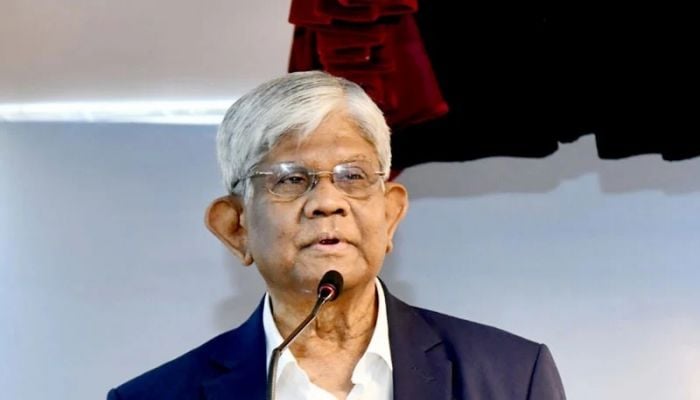
Strong political will is indispensable in the fight against corruption, as it is the only force capable of preventing the moral and institutional decay of society.
This observation was made by Finance Adviser Professor Salehuddin Ahmed while speaking as the chief guest at a discussion meeting organised on the occasion of International Anti-Corruption Day 2025.
The programme was held on Tuesday at the National Theatre Auditorium in Segunbagicha, Dhaka.
The event was chaired by Anti-Corruption Commission (ACC) Chairman Dr. Mohammad Abdul Momen.
Special guests included Director General of Bangladesh Institute of Development Studies (BIDS) Dr. AK Enamul Haque, ACC Commissioner Brigadier General (retd) Hafiz Ahsan Farid, and Mian Muhammad Ali Akbar Azizi.
The welcome address was delivered by ACC Secretary Mohammad Khaled Rahim. Senior ACC officials along with officers and staff of all ranks attended the programme.
Earlier in the morning, while inaugurating the day-long observance of International Anti-Corruption Day, ACC Chairman Dr. Mohammad Abdul Momen urged citizens not to vote for corrupt individuals in the upcoming national parliament election.
He stressed that if voters collectively reject corrupt candidates and extortionists, corruption can be curbed to a significant extent.
During the discussion session, Finance Adviser Salehuddin Ahmed emphasised that the overall working system of the country must be reformed and a strong social movement built to eradicate corruption.
He recalled that in the past, corrupt individuals were socially ostracised and despised.
Speaking specifically about the financial sector, the Adviser pointed out that transparency and accountability remain major challenges in this critical area. Thousands of crores of taka have been siphoned off from the banking sector over the years.
He questioned how many of the perpetrators have actually been punished proportionately.
In numerous cases, even when accused persons spend their entire lives in jail, trials are not concluded and convictions are not secured. Yet the irreparable damage they have inflicted on the national economy through corruption remains, he said.
The Adviser stressed that information about corruption must come forward from every level of society.
Recalling the social attitude toward the corrupt in earlier times, he said corrupt individuals once struggled to marry off their sons and daughters because no family wanted any alliance with them.
Today, however, the picture is completely reversed: people rush to attend their functions and show them respect. The corrupt are now being rewarded instead of shunned.
“We must reverse this trend,” he asserted.
Special guest Dr. AK Enamul Haque, Director General of BIDS, observed that no country in the world has succeeded in eliminating corruption through punishment alone. Sustained social awareness is crucial to prevent and control corruption.
He noted that Bangladesh suffers from 14–15 different forms of corruption, yet efforts are largely confined to tackling bribery. In the age of information technology, corruption has become sophisticated and scientific, with perpetrators constantly inventing new methods.
In his presidential address, ACC Chairman Dr. Mohammad Abdul Momen alleged that over the past 15 years, many individuals who committed serious crimes were allowed to flee the country by the then political elite in exchange for huge sums of money.
He told the audience that the people themselves will now have to decide whether or not to elect such individuals in the forthcoming election.
“The time has come to choose honest and capable representatives,” he said.
Dr. Momen further stated that corruption has penetrated every crack and crevice of society, but it can be gradually eliminated. Over the last 15 years, massive amounts of money have been laundered abroad. Bangladesh lacks effective bilateral mechanisms with many of those countries to recover the funds, and in some cases even the proper channels of communication do not exist. State money is lying overseas as “dirty money.”
Previously, remittances used to flow into Bangladesh from the Middle East and the United States; now the direction has reversed. Laundered money is later brought back into the country through various means and legalised, with numerous incentives built into the process.
Transforming such an entrenched structure cannot happen overnight, in a month, or even in a year, he acknowledged.
Speakers at the programme unanimously stressed that even if 100 percent of voters reject corruption, it will not disappear on its own. The upcoming election presents an opportunity to remove corrupt rulers, extortionists and terrorists from power. Many individuals involved in corruption fled the country after 5 August last year, ranging from the former Chief Justice of the Supreme Court to the Khatib of Baitul Mukarram National Mosque, demonstrating just how deeply corruption had taken root.
One example cited was the wealth statement submitted by a former Prime Minister during the 2008 election, which declared ownership of 5.21 acres of agricultural land.
The figure raised no red flags even after cross-verification with income-tax returns. Subsequent investigation, however, revealed actual ownership of 29 acres. Discrepancies were also found in declared vehicles: two additional cars were listed, one registered in the name of a then MP and the other in the name of a former State Minister for Youth and Sports, both purchased under the banner of “Sudha Sadan” without availing government subsidies. Had these irregularities been detected at the time, the nomination would have been cancelled, preventing that individual from becoming an MP, Prime Minister, or leading their party to power.
ACC Commissioner Brigadier General (Retd.) Hafiz Ahsan Farid suggested that full details of all government projects should be published online and any subsequent updates immediately made public. Once public money is stolen, recovery becomes extremely difficult; therefore, preventive vigilance is essential, he said.
The programme was also attended by ACC Director Generals Mir Md. Zainul Abedin Shibli, Abdullah-al-Zahid, Akhter Hossain, Abu Hena Mustafa Zaman, Mokammel Haque along with directors, deputy directors, assistant directors and deputy assistant directors of the Commission.

