Low-quality battery is a major issue
Samakal Correspondent
20 Jan 2026 21:32 PM
Mahmudur Rahman is a businessman who lives in Charfason, Bhola. In the past, his house used to light up brightly every night. He had a small 20-watt solar home system that powered his fan, lamp, and TV. Even when there was no electricity from the grid, his house did not fall into darkness, and he did not have to suffer in the heat without a fan. Those good days are now over. After a few years, the battery in his system stopped holding a charge properly. There was no easy way for him to get a new battery installed. The company what provided the solar system to him no longer has any office or presence in the area.
Mahmudur Rahman said, "The system worked really well at first. But after about four years, the battery would not charge anymore. I faced a lot of trouble even when I tried to buy and fit a new battery. The company's office has disappeared. Now the whole system is useless. When power cuts started becoming frequent last year, I had no choice but to buy a new battery myself."
Stories like this—where batteries stop working—are now very common in places like Charfason or Dhaniya. Abdur Rahman from Dhaniya Union bought a solar system from Grameen Shakti back in 2010. He has already had to replace the battery twice. He explained, "The first battery did not even last three years. I got a replacement because it was still under warranty. But for the second one, I had to pay money myself. Now that second battery has also stopped working."
This same problem is happening not just in Bhola, but in almost all the coastal and remote areas across the country. The organisation run by the government called Infrastructure Development Company Limited (IDCOL) has said that most of the 5.357 million solar home systems they helped distribute—along with those given out under the 'Test Relief (TR)' project by the Department of Disaster Management—are now facing issues with their batteries.
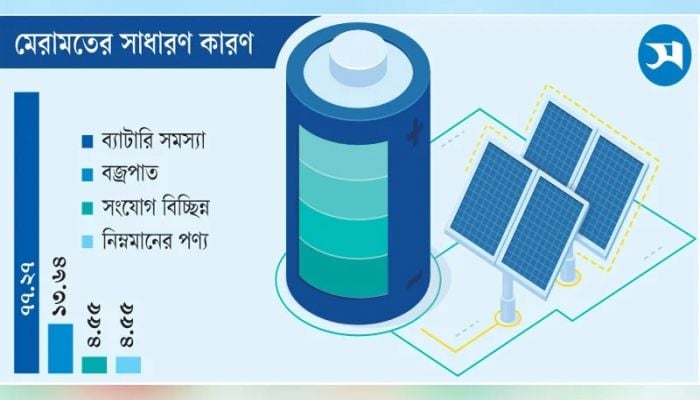
A recent survey jointly operated by the Daily Samakal and the research organisation Center for Policy Dialogue (CPD) researched at solar power systems in 40 different communities. It found that the most frequent problem people face is with the batteries. Local repair workers also said again and again that batteries cause the most trouble—they often need to be replaced or fixed. Battery problems have turned out to be a major weak point in how people in villages use solar power. Both the users and the people who provide services have complained a lot about batteries.
Battery issues are the main reason why so many solar systems stop working. About 77 percent of the people surveyed pointed to batteries as the biggest cause of failure. Around 5 percent of them said the problem comes from low-quality products overall. They explained that if the quality, strength, and after-sales support for batteries were better, far fewer systems would fail. This would help people keep using solar power for a long time in a reliable way.
Between 2003 and 2018, 56 private organisations—including Grameen Shakti, Coastal Electrification, and Mahila Unnayan Samiti—worked with IDCOL to distribute solar home systems in different parts of the country. In remote villages, char areas, and hilly regions where electricity from the national grid could not reach, these solar home systems that run on sunlight were the only source of light for people.
According to IDCOL's official 'Technical Specifications for Solar Home Systems,' the battery should last at least five years. If the battery fails during the warranty time, the partner organisations are supposed to replace it for free. But in real life, this has not happened properly. Most customers have complained that the organisations did not keep their promises about replacing batteries. On top of that, many of these organisations have shut down their businesses and left the area.
Musa Mia of Charbata Union in Subarnachar, Noakhali, said, "When the grid electricity goes off, we are left in total darkness. The children suffer a lot because of it. Now our solar batteries do not even last for one hour. The batteries we got from local brokers were brought into the market illegally. No one is taking any responsibility for them."
Some local government officials have said that certain companies supplied low-quality batteries without getting proper approval from the government. This problem is especially bad in coastal areas, where the salty air makes batteries damaged even faster. Many poor families cannot afford to buy new batteries because they are expensive. A good-quality 12-volt battery now costs between Tk7,000 and Tk10,000. For low-income households, this amount of money is simply too much to cost.
Abu Taleb from Charfason said, "At first, we paid about Tk15,000 to install the solar system. We thought that once we spent the money, it would run for many years without more big costs. But now we have to replace the battery every two or three years. That is very hard for ordinary people like us to manage."
Energy expert Professor M. Tamim thinks the solar home system project was a great idea when it started. However, over time it has fallen apart because of poor quality control, low-quality equipment coming into the market, and not enough maintenance support.
He added, "Right now, our country is facing a serious energy crisis. There are shortages of gas, coal, and oil in every sector. At this moment, solar energy could have been the biggest and best alternative source. But we have not been able to make sure it lasts and stays useful."
An official from IDCOL's renewable energy department said, "We have now become much stricter about checking and controlling quality. Most of the old batteries have reached the end of their life span and cannot be replaced easily. We are planning to introduce new and improved systems, and we are thinking about using lithium-ion batteries in them."
He also mentioned that the government is now focusing more on 'solar mini grid' and 'rooftop solar' projects. At the same time, there is a proposal to create a special fund that would help restart and fix the old solar home systems.
Toxic air from burning old batteries
Across the country, a dangerous cycle has started: people burn old batteries that can no longer be used. This includes batteries from home solar systems and other uses. These unusable batteries are taken to small, local factories that are not properly set up or allowed to operate. The factories melt down the batteries to reuse the lead, but they do this in very inefficient and unauthorised ways. These places do not have permission from the Department of Environment. The smoke, acid, and ash from them are harming the environment, farmland, and people's health without anyone realising the full danger.
Lead from batteries stays in the environment for hundreds of years. In these factories, workers break open the batteries and take out the lead parts, then wash them with water. The dirty water full of chemicals flows into rivers, canals, and fields. This pollutes the soil and water, and it enters the food chain. Lead gets into fish and vegetables, and then into people's bodies when they consume that food.
One such battery-burning factory is operating openly on the banks of the Padma River in the Paturia Ghat area of Shibalay Upazila, Manikganj. Trucks bring old batteries there all day long, and the burning happens in furnaces at night. The whole area fills up with thick black smoke and a strong, terrible smell of acid.
This factory is close to the Paturia launch ghat and ferry ghat, where thousands of people pass by every day. Teachers and students from the nearby Daskandi Government Primary School are also breathing in this smoke and acid. You can see on the ground that during the day, workers open the batteries and separate the lead plates. At night, they melt those plates to get lead. People working at the factory said, "We buy old batteries from Dhaka and Savar, then bring them here to extract lead. From one tonne of batteries, we get about 600 kg of lead."
In another example, in Yakub Ali's factory in Ratil village, Ratil union, Kashiani upazila, Gopalganj, batteries are burned in three furnaces all through the night—from 10 pm to 4 am. In the morning, the lead is loaded onto trucks and sent to different factories. In that area, trees and crops are covered in black ash. Sugarcane leaves, grass, and vines have turned black from the pollution. Local people also say that some cows have died after eating the grass covered in this ash.
Near a brick kiln in Bablatala Bazar, Dattapara Union, Shibchar Upazila, Madaripur, there is a lead factory on the land of Motahar Hossain Member. Its owner is Jahangir Alam from Gaibandha. From 8 pm to 5 am, they burn old batteries in a furnace using wood and coal to get the lead out. Local people say the smoke irritates the nose, mouth, and eyes even from two to three kilometers away. Children and older people in the area keep getting breathing problems regularly.
Dr. Md. Kamruzzaman, the Director General of the Department of Environment, explained that the smoke and acid coming from burning batteries are extremely dangerous for people, animals, and plants. Lead particles in the air get into the body when people breathe them in. This harms the blood, liver, kidneys, and nervous system. In children, it harms brain development and thinking ability. It is also very risky for pregnant women.

