Solar panels, grid electricity available in every home of Charfasson
Zahidur Rahman
24 Jan 2026 16:01 PM । Update: 24 Jan 2026 16:01 PM
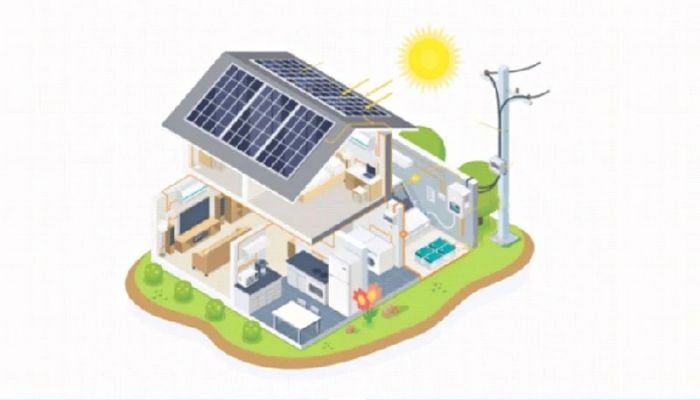
Bhola is an island district in the south of Bangladesh. The distance from Dhaka is about 287 kilometers. From there, Charfasson Upazila is another 75 kilometers away. Storms, tidal waves and various disasters are mixed with this coastal upazila. The light of solar electricity is shining in the homes of people struggling to survive by fighting disasters. Although there are problems with solar panels and examples of reduced use in many parts of the country, a different scenario has been found in Charfasson.
While visiting the upazila, it has been seen that solar panels are being used in some way or another in every neighbourhood and neighbourhood of Charfasson, starting from the remote villages of Charfasson to the upazila headquarters. Educational institutions, shops, and even mosques and temples have not been left out. Even though there is electricity connection, the presence of solar electricity is clear in every home.
Abdur Rahman, a farmer from the southern Aicha area of Charfasson, has been using solar electricity for the past six years. Although his house has electricity from the national grid, it is not reliable. He said the electricity goes out after a little storm or rain. Even if there is no storm, the electricity is not always there. Then there is no choice but to use solar power. After buying it for the first time, there was no further expense. The lamp, fan, TV all work.
Abdur Rahman installed a panel in his house at a cost of about Tk50,000. He paid the money in installments. Now there is no more trouble. In his words, it is enough to spend once. 6-7 lamps, a fan, and a TV can be operated. It has 20-year warranty.
Rashed Faraji of Aslampur in Charfasson Upazila Sadar took a solar power installation from the private organisation Coast Foundation in 2025. Earlier, he installed Surjer Hasi panels in his shop in 2022. The lights are on in five rooms of his house, and the fan runs in two rooms. The house got electricity connection in 2015. But Rashed's experience is that even after having grid electricity, solar is essential. He said electricity is not available during the day, it comes for two-three hours at night. Children cannot study due to load shedding. Ice factories are closed. Even if there is a slight drop in pressure, there is no electricity for four to five days. Then the only hope is solar.
Rashed spent Tk22,000 at his house and Tk8,000 at the shop. He has been using the battery for 10 years, although the warranty was five to seven years. He bought a new battery from a local shop. His monthly electricity bill now does not exceed Tk500 to Tk600.
Rakib Hossain of Nazrul Nagar Union in Charfasson bought a solar panel from a Hamko company in installments in 2005. At that time, there was no electricity in his area. Now, even though he has electricity, he has not given up on solar. His family has five lights and a fan. He is satisfied even though he gets an electricity bill of 800 taka per month. Because, solar is the only hope in the fluctuations of electricity.
Arif Hossain, a resident of Char Jamuna in Nilkamal Union in Dularhat, bought a solar panel from Rahim Afroz in 2006 in monthly installments of Tk1,200. Electricity was connected to the area in 2019. He is still using that solar. Arif said, "There have been no problems with solar. I clean the panel every two to three months. I change the water in the battery. Once a year, the battery goes down, and if I change the water and charge it, it will be fixed. Four fans and seven lights in the house run on the power of that solar.”
Locals said that 90 percent of the people of Charfasson are still dependent on solar power in one way or another. Because there is a grid electricity transmission line and connection, but there is no round-the-clock service. Power goes out day after day due to a slight storm or low pressure. Load shedding is at such a level that local businesses and industries are practically paralysed. Local businessman Nazmul Haque said that there is no electricity during the day, and it comes for a short time at night. Everyone is forced to use solar panels to run their business.
In some schools in remote areas of Charfasson, the use of solar power has made education easier. School teacher Mahfuzul Haque said that when the power went out, classes used to be held in the dark. Now, thanks to solar power, at least the fan runs and there is light. Students are also more focused on their studies.
Nasima Akhter, a resident of Char Colony, works as a seamstress. She said that because of the solar power, she can work at night by running a sewing machine and lights. As a result, the family's income is increasing a little.
The people of Charfasson have found their own solutions to the uncertainty of electricity. Each person has a different experience. However, everyone's point is the same - one cannot completely rely on electricity from the national grid. Due to solar power, children's education is on the right track; shops have been kept open; and at least lights have been guaranteed in homes. And that is a great achievement in this storm-prone coastal town.
Solar lights are also shining on the roads
Once upon a time, the streets of Charfasson would gradually become dark after dusk. As soon as they step out of their houses, it is dark all around. The inaccessible chars and village roads were places of fear for pedestrians. They had to return home from the village market in groups. They used to have a flashlight in their hand, some with a hurricane in their hand. Now the scene has changed. The use of flashlights or hurricanes has almost disappeared in rural areas. As soon as dusk falls, solar-powered street lights start shining from the market to the village roads.
A total of 1,483 solar street lights have been installed on the roads and in the market and market places of 21 unions of Charfasson upazila. They turn on automatically every evening as dusk falls. There is no problem of load shedding. They spread light all night long. This has changed the rural lifestyle. Abdul Karim, a resident of the local Rifpara village, said he used to be afraid to walk on dark roads. Now the village roads also shine like in the city. Thefts and robberies have decreased. The lights are shining in front of Monir Hossain's shop at the Manura Bazar in Dwipchar Kukri-Mukri. He said that no one used to come to this market at night before. Now, due to the street lights, the shops are open till night. Consequently, business has also increased.
Police sources said that since the installation of solar lights, crimes like theft, robbery and snatching have decreased in the remote villages of Charfasson. Criminals are not able to take advantage of the darkness. Local women can now visit the market even after evening.
These street lights were installed from the Rural Infrastructure Renovation and Maintenance Programme (TR and KABITA) of the Department of Relief and Disaster Management. Some 1,483 solar street lights were installed in the first and second phases of the 2018-19 fiscal year.
In the same project, 1,803 solar home systems were installed in the homes of needy families, including mosques, temples, schools and colleges. The cost was Tk16,78,04,660.
Charfasson Upazila Nirbahi Officer Rasna Sharmin Mithi said, "Solar lights have not only provided light in this coastal town, they have changed the way of life. The market is open for longer hours, various events are held in educational institutions, and people can return home safely."
Repeated defects in new ones
Severe heat, humid days, and dark nights without electricity - this situation had become unbearable for Rafiqul Islam, an Omani resident of Charfasson Upazila. Then he saw that several families in the area had installed solar home systems. Seeing that the fan and TV were working, he installed a 20-watt solar system on his own roof. The time was 2011. It cost about Tk15,000. Initially, it was working well. Rafiqul received reliable electricity for a few years. But after four years, the battery stopped holding electricity. Then, when he went to buy a new battery for Tk4,000, he found that the Coastal Electrification and Women's Development Association, from whom he had bought the system, was no longer in the area. The office had closed down.
Rafiqul's son Sajedul Islam Rabbi said, "The solar panel was lying useless for a long time. Finally, in June last year, when load shedding increased, we bought a new battery. But it is doubtful how long that will last either. Faruk Majhi, a jailer in Dhania Union, also had the same experience. He bought a solar system from Grameen Shakti in 2010. He has already had to replace the battery twice. Faruk Majhi said the solar system that was there before worked well for many years. Now the battery is getting damaged again and again. The cost is increasing, but there is no reliable electricity.
Speaking locally, it was learned that the systems of those who bought home solar between 2000 and 2010 have been quite durable. Many sets are still in operation. But those who have bought new systems in recent years are suffering comparatively more.
Shahidul Haque, a school teacher in Charfasson, said, "A relative of mine bought solar in 2005, and it is still running. But I bought one in 2018, and both the battery and inverter broke down.” He said, initially, solar home systems were made with quality materials. But later, as demand increased, low-quality batteries and inverters came into the market. These break down quickly. A section of traders are ruining the market by bringing low-quality components. As a result, the common people are losing trust. The government needs to strengthen quality control in this regard.

