May Day
Labour wages fail to keep pace with inflation
Abu Hena Muhib
01 May 2026 18:11 PM
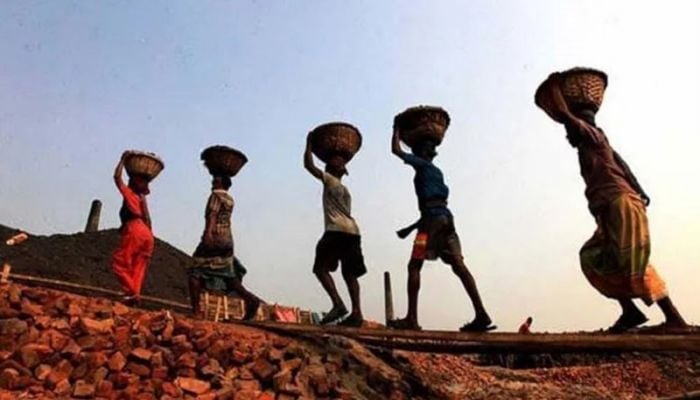
The world of Mashiur, a porter at Karwan Bazar in the capital, has now become empty. For this middle-aged man who returned from abroad, accepting this difficult job is filled with pain. His disappointment began two years ago in the deserts of Dubai.
The first five months of his migration to the Middle East passed without incident. But after the sixth month, the company had no work. The contract worker Mashiur became unemployed. After spending a month in the desert without any income, he returned home carrying the burden of a loan.
Half the cost of going abroad was met through that loan. Twelve annas of the loan is still to be repaid. Without capital, there is no way to do anything. Helpless Mashiur took to the streets with a basket in his hand, bearing the burden of earning his livelihood. He would deliver the baskets of customers who came to the market by car or wanted them taken to their homes. Every morning he would take the train from Gazipur to Tejgaon station and return home in the afternoon by train.
He said he had to pay the moneylender Tk30 per day as rent for the basket. He paid Tk20 twice a day for toilet fees. He managed his lunch within Tk50. Almost all his income was spent on paying the loan instalments.
Today, Friday, the great May Day is being celebrated amid such hardships faced by millions of working people like Mashiur. Against the backdrop of workers’ agitating movements that arose due to excessive labour without fixed hours and intense exploitation at low wages, a strike was called in Chicago, USA, on May 1, 1886.
The workers demanded eight hours of work, eight hours of rest, and eight hours of recreation daily, along with fair wages. At one point, many workers were killed in reckless police firing. In 1890, the Second International Paris Congress decided to celebrate May 1 as ‘May Day’ worldwide. After independence, the day has been observed nationally in Bangladesh since 1972.
The country is currently experiencing high inflation. When inflation rises, low-income people are the most affected. The prices of goods in the market increase at a higher rate than the monthly rise in workers’ wages. As a result, workers’ wages never catch up with inflation. The excess of expenses over income pushes them into debt. According to the latest Consumer Price Index (CPI) and Wage Rate Index (WRI) report by the Bangladesh Bureau of Statistics, the national wage growth rate in March stood at 8.09 percent.
However, the national inflation rate in the same month was 8.71 percent. The pressure of inflation is even greater on the poor, because their income is mostly spent on purchasing a few daily necessities, including rice.
Majnu Mia, a 70-year-old rickshaw puller from the Tejgaon area, said, “I am in great trouble, father. The price of a kilogram of rice is Tk60. At this age, I pull a rickshaw because of stomach problems. My son works in a garment factory and gives me something every month. But he also has his own family.”
The latest labour force survey by the Bangladesh Bureau of Statistics reveals that 84 percent of the employed population in the country works in the informal sector. This totals 58 million people, who do not receive state recognition as workers. The state takes no responsibility for them. They have no legal or social protection. If they face injustice at work, they do not even have the opportunity to file a case in labour courts.
The Labour Amendment Bill passed by the National Assembly last month also failed to recognise workers in the informal sector as workers. Syed Sultan Uddin Ahmed, head of the Labour Reform Commission formed during the interim government and executive director of the Bangladesh Institute of Labour Studies, told Daily Samakal that the issue of including informal sector workers in the labour law amendment should have been given the highest priority. In the recommendations of the reform commission, they were asked to be granted the same rights and privileges as other workers under labour law, along with additional benefits in certain cases.
It was also suggested to bring them under the scope of social security. As a state measure, separate offices or desks were proposed for them at the head offices of all departments under the Ministry of Labour and Employment at district and upazila levels, so they could lodge complaints and seek redress. None of these recommendations were included in the law.
According to the definition of the International Labour Organization, private unregistered institutions, establishments under individuals or landlords that do not have a legal entity, do not maintain complete accounts, are not required to report production, and are private and unregistered, fall under the informal sector. Workers in this sector are known as informal sector workers. Informal workers are mainly found in agriculture, industry, and services. In agriculture, 98.63 percent are informal. In the industry sector, the figure is 82.75 percent.
A large portion of informal sector workers live in rural areas. According to the Bangladesh Bureau of Statistics, 87.4 percent of total rural workers are in the informal sector, numbering 46.11 million. For urban workers, the rate is slightly lower at 74.5 percent, or 13.57 million. Among female workers, 95.7 percent work in the informal sector.
Although slightly better than the informal sector, the condition of workers in the formal sector is not much improved. Many industrial sectors have not yet been brought under the minimum wage framework. Workers are forced to accept whatever the employer offers. At least 55 such sectors have not announced a minimum wage. According to the Department of Inspection of Factories and Establishments under the Ministry of Labour, there are 102 recognised industries in the country. Of these, the government has announced minimum wages for only 47 industries.
Raisa Islam, Secretary of the Government’s Minimum Wage Board, told Daily Samakal that two new industries will be brought under the minimum wage framework. The process of including 20 more industries is underway. The latest minimum wage for petrol pump workers was set in March.
Workers most at risk from external shocks
A recent report by the United Nations Economic and Social Commission for Asia and the Pacific has stated that a long-term and continuous decline in export demand will affect the labour sector. Informal and contract workers will be the most at risk. The World Bank has warned that 1.2 million people in Bangladesh could fall below the poverty line again due to the impact of the war in the Middle East. A recently published report by the organisation noted that poverty alleviation and public welfare in Bangladesh have deteriorated over the last three years. The main reasons cited were limitations in productive employment creation, weak growth in workers’ income, and high inflation, which have reduced the impact of poverty reduction through economic growth.
Picture of job losses in the garment sector
According to sources from the two organisations of the ready-made garment sector, BGMEA and BKMEA, 400 garment factories have closed in the last three years. Many more factories are currently facing severe financial vulnerability. On average, 2,000 workers were employed in each of these factories.
BGMEA President Mahmud Hasan Khan told Daily Samakal yesterday that the industry is facing a crisis due to continuously rising business operating costs, the lack of a suitable business-friendly environment, and declining demand in the global market. As a result, many factories have been forced to close.
According to BGMEA sources, while factories have closed, 269 new factories have entered garment production in the last three years. Many workers from the closed factories have found jobs in the new ones. Accordingly, the number of unemployed workers from this sector could be around 270,000.

