UNICEF warned 10 times, sent 5-6 formal letters over measles vaccine shortage
Samakal Correspondent
20 May 2026 18:45 PM
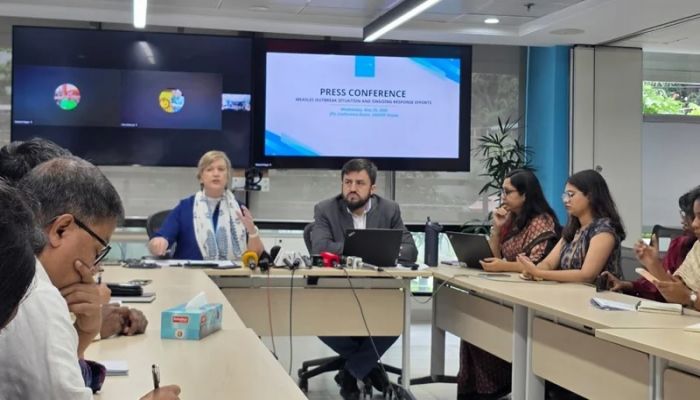
The United Nations Children's Fund (UNICEF) has stated that routine measles vaccines remained in short supply in Bangladesh for a prolonged period last year, prompting the organisation to issue 10 warnings and send five to six formal letters to the authorities since 2024.
The details were shared at a press conference titled “Measles Outbreak Situation and Ongoing Prevention Activities”, held on Wednesday afternoon at the JPG Conference Room of the UNICEF Bangladesh office in Dhaka.
UNICEF Bangladesh representative Rana Flowers spoke during the event.
UNICEF said that from August to November 2025, the country received 17.8 million measles vaccines, which amounted to only one-third of the total demand. Bangladesh requires approximately 70 million measles vaccines annually, yet sufficient routine vaccines were not available for a long time, gradually complicating the situation.
The organisation warned the government on at least 10 occasions in meetings since 2024 and sent official letters five to six times. Both the Ministry of Health and the Ministry of Foreign Affairs were informed about the shortage.
According to the press conference, the prolonged disruption in routine vaccination left many children unvaccinated, which increased the risk of measles spreading across the country and eventually led to a major outbreak.
Routine measles vaccination was reintroduced in the country in May this year. The government and development partners are now placing strong emphasis on rapidly strengthening the vaccination programme, bringing vulnerable children under its coverage, and carrying out special surveillance in affected areas.
UNICEF representative Rana Flowers stressed that there should be no disruption in regular vaccination programmes to control highly contagious diseases such as measles. She warned that failure to ensure adequate vaccine supply on time could lead to major health risks in the future.
Responding to a question about the delay in the procurement process after the current government assumed office, Ms Flowers said the reason was a decision by the interim government’s cabinet to purchase vaccines through open tender.
“I don’t think such a decision has ever been taken before. But you can verify this with the Ministry of Health,” she added.
Ms Flowers noted that she did not have the exact date at hand but confirmed that UNICEF sent five to six letters between August 2024 and February 2026, with the last one arriving just before the new government took office.
“We hoped that the letter would be on the desk of the new government,” she said.
She added that UNICEF had repeatedly pressed for an emergency meeting. “At the same time, I can say that I have sat with the interim advisers and staff at least 10 times. My staff and I have said that we are worried. You can see from my face that I am worried that you are going to face a vaccine shortage. It was clear that if we could not bring the vaccine into the country, there would be problems.”
When asked whether there had been a vaccine shortage in Bangladesh in the last two years, Ms Flowers replied that UNICEF had predicted a vaccine shortage in 2024 which could affect various diseases over the next two years. “So we were warning in advance and constantly reminding them that they were going to face a shortage.”
At the press conference, Rana Flowers observed that there are many lessons to be learned from the measles outbreak in Bangladesh. She emphasised the importance of conducting an “after action review” or subsequent discussion following the incident.
“We will look into why nearly 500,000 children have been missing out on the vaccination programme every year for many years,” she said, describing the figure as a “rough estimate”.
She added that future efforts would focus on improving the ability to bring children together in health centres and venues such as pre-schools and pre-primary schools. “There is no point in blaming anyone now. Now we have to make it work in such a way that no child in this country dies of preventable diseases in the future.”
Regarding the vaccine procurement process, Ms Flowers explained that while open tender is the most transparent way to procure most items, vaccines are different because they are highly specialised products. “Here you are not just buying antibiotics for 100,000 people, you are aiming to reach a much larger number of people. You have to make sure that you have a vaccine that is approved by the World Health Organization (WHO). So you do not go after the cheapest vaccine. You take the vaccine that is proven to be effective and has no side effects.”
She noted that UNICEF decided many years ago to procure and invest in vaccines for the world. The organisation procures vaccines from most countries, maintains direct relationships with manufacturers, and regularly checks quality. Because of large-volume purchases, UNICEF can secure favourable prices. “We know that it is not possible to get a tender for a price lower than the price at which UNICEF gets the vaccine,” she added.

