Formation of govt-controlled Human Rights Commission to be a suicidal decision: Dr Iftekharuzzaman
Samakal Correspondent
02 Jul 2026 20:59 PM
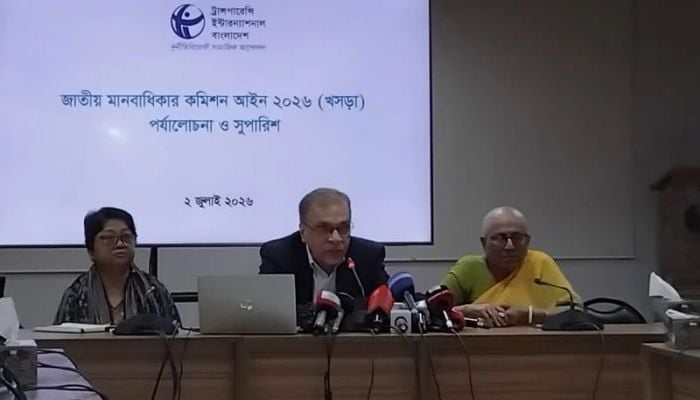
If the National Human Rights Commission Act is passed according to the draft prepared by the government, it will not be possible to form an independent and effective Commission as per international standards, said Dr Iftekharuzzaman, Executive Director of Transparency International Bangladesh (TIB).
He said that imposing an ineffective human rights commission on the people and controlling the government would be a suicidal decision for the current government.
He made these remarks at a meeting titled 'National Human Rights Commission Act-2026 (Draft) Review and Recommendations' organised at the TIB office at Midas Center in Dhanmondi, Dhaka, on Thursday.
The meeting was organised by Transparency International Bangladesh (TIB) and Human Rights Forum Bangladesh (HRFB).
At the meeting, TIB expressed concern over the draft of the National Human Rights Commission Act-2026.
The organisation claimed that if the law is enacted according to the current draft, there is a risk that the commission's powers will be curtailed and its independence and effectiveness will be affected.
Dr Iftekharuzzaman said that although many countries in the world have more authoritarian and autocratic governments than Bangladesh, there are very few examples of national institutions being rendered ineffective by partyisation in this way.
People's expectations are very high for the elected government after the popular uprising, he said, adding, therefore, the government will give the national institutions an opportunity to work independently without weakening them.
He said that the government or political force that runs state institutions under party influence is ultimately the victim of the negative consequences of that ineffective institution because power is not permanent.
TIB reviewed the draft law and highlighted 19 recommendations.
Dr Iftekharuzzaman said that if these recommendations are not implemented, the government will prove that they do not have the real will to establish an independent and effective National Human Rights Commission in the country.
He said that if the BNP's 31-point state reform programme, election manifesto and the pledge given in the July Charter are implemented, it is possible to form an independent human rights commission outside the control of the government.
In response to a question in the meeting, he said that a section of those in power in the country weaken state institutions for short-term benefits. In many cases, anti-change forces are active within the government. Along with political influence, the influence of bureaucracy is also important in this regard, which is reflected in the draft Human Rights Commission Act.
TIB also raised specific objections to some clauses of the draft.
Dr Iftekharuzzaman said, “The Commission's powers of investigation, inspection and supervision in Section 13 do not clearly include the inspection of possible secret detention centres or so-called 'mirror houses' of law enforcement agencies, intelligence and surveillance agencies. As a result, the effectiveness of the Commission in investigating allegations of secret detention or illegal detention may be questioned.”
In addition, TIB opposes the proposal to limit the Commission's powers to investigate allegations of human rights violations against members of the law enforcement agencies in Section 20 of the draft.
The organisation believes that if these provisions remain in place, the Commission's ability to conduct independent investigations and play an effective role will be severely affected.

