Rising fuel prices
Long queues at pumps, traffic jams on roads, city life strained
Drohi Tara
10 Hours Ago
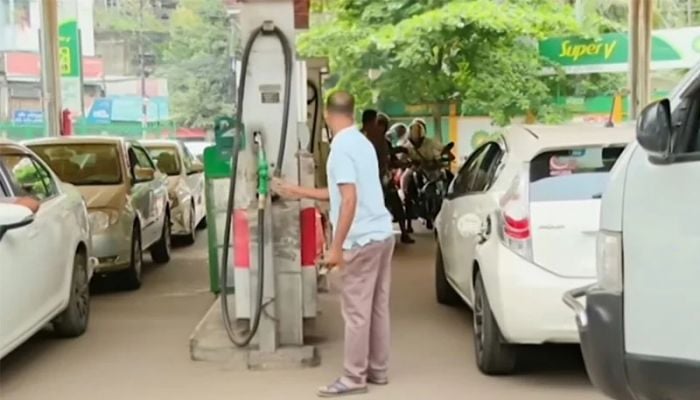
It is midday at the Malibagh Chowdhurypara station in the capital. Vehicles have no normal speed on the main road. Private cars, microbuses, and motorcycles are stuck ahead and behind. Some people are honking, others trying to squeeze through any gap. A little further ahead, one of the major causes of the congestion becomes clear: a long line of vehicles waiting for fuel in front of the filling station.
The same scene is visible in Haji Para as well. Alongside private cars, there are microbuses, motorcycles—and even ambulances—waiting in a queue that stretches all the way to Rampura Bazar. In some places the line of vehicles waiting to enter the pump has come close to the main road. Consequently, people coming for fuel are suffering, while ordinary passengers travelling along the same road are also taking extra time to reach their destinations.
In the meantime, the government has increased the price of fuel oil by Tk20 per litre since last Sunday. At the new rates, diesel is selling at Tk135, petrol at Tk160, and octane at Tk165 per litre. The price of kerosene has been fixed at Tk155.
After the price hike, not only have the meters at the pumps changed, but the daily commuting calculations of city residents are also changing.
From pump queues to road congestion
On-site observation shows that when the line of vehicles waiting to enter the filling station comes close to the main road, the speed of vehicles moving alongside slows down. One vehicle waits for a chance to enter the pump, with several more behind it. Consequently, the pressure created at one point spreads to the surrounding roads.
Private-sector employee Shormi Zaman said, “After office hours there is already traffic. On top of that, if there is a line of cars in front of the pump, you get stuck in the same place for even longer. By the time you get home, the whole evening has been spent on the road. Our leisure time from life is decreasing.”
Cars are there, but usage has decreased
The impact of the fuel price increase is also clear on private car owners. Shamsul Haque, an official of a private organisation, has kept his regularly used car in the garage for about three months. He said, “Earlier I would take the car out whenever needed. Now I calculate the fuel cost before going out. Keeping the car in the garage has become a kind of permanent style. Unless it is urgently necessary, I go by rickshaw or other vehicles.”
Young Rakib Hasan regularly commutes to the office on a motorcycle. With considerable irritation he said, “Nothing is changing. We are sinking even deeper. No savings are accumulating. Earlier I used the bike to save time. But with the increased fuel cost, I no longer go anywhere unnecessary. Previously I would take the bike out for any work; now I often try to walk or go by bus.”
Extra hassle in ride-sharing too
Although private car usage has decreased, there is no relief for ride-sharing users. In services like Uber and Pathao, the pressure of fuel costs is falling on the drivers; passengers are also facing higher fares and longer journeys during busy hours.
Farzana Rahman, who has been using ride-sharing regularly for nearly two years, said, “I used to take ride-sharing to save time. But now if the fare is higher, it is difficult to take it every day. On the other hand, if I go by bus, more time is spent in traffic jams. Now bus fares have also increased. So the daily commuting calculation has to be redone.”
Ambulances also waiting
Ambulances standing in the pump queues also catch the eye. Since time is crucial in transporting patients, waiting to collect fuel is putting extra pressure on the drivers. Ambulance driver Kamal Hossain said, “When there is a patient, every single minute is important. So I try to keep fuel in advance. But if the need arises suddenly, standing in line has become a matter of great worry now.”
Habits changing due to fuel prices
The impact of the fuel price hike is no longer limited only to paying more money at the pump. Extra expense and loss of income for drivers, extra fare and waste of time for passengers, and reduced use of cars by private owners—together these are changing the commuting habits of city life.
On the busy roads of Malibagh and Haji Para, the calculation of that price increase is no longer just on paper—it is visible in the long queues in front of the pumps, the vehicles stuck in traffic jams, and the pressure of extra travel costs on passengers.
Tea-stall owner Taizul beside the Haji Para petrol pump said, “The price of food items is rising, the price of oil is rising, electricity is not available at home, we don’t get cooking gas—how long can we keep managing all this, that’s what I’m thinking. Maybe I’ll have to go back to the village from Dhaka again.”

