Experts urge to extend support for community led erosion management
Online Desk
26 Sep 2019 11:33 AM । Update: 26 Sep 2019 11:39 AM
Water experts today called for supporting the cost-effective community led solutions such as ‘Bandal’ and ecosystems-based approaches to control river erosion by using the avenues offered in existing policy frame-work.
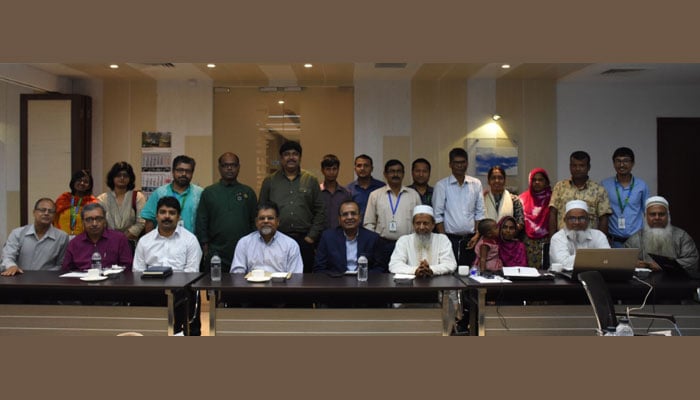
The key ask was to create legal options for issuing permissions at local level, local funding and protection of river bank vegetation, and provision for knowledge support, which will enable ‘Community Led Solution’ to river erosion in Bangladesh. This came as part of a policy dialogue organized today by Oxfam in Bangladesh and Institute of Water and Flood Management (IWFM). The dialogue held today in the city urged the government to effectively roll out the ‘Water Rules 2018’ to empower grassroots communities for inclusive water resources governance.
The discussion was based on two successful pilots, which proved the bandals work efficiently to stabilize river banks. One of the pilots were in Kazipur- Sirajganj, which was jointly done by IWFM-BUET and Kyoto University of Japan and reclaimed more than 17,000 square meters of land in just one year. The other pilot was in Rowmari-Kurigram in the bank of River Jinjiram, and it was a self-funded initiative of local villagers. The discussion found out the self-managed initiatives of the communities as more sustainable and cost-effective option, therefore suggested to create support systems for locally led initiatives.
In the policy discussion, Director General of Institute of Water Modelling (IWM), Professor Dr. Monowar Hossain said ‘Small projects are often more effective, as the provide immediate results, cost less and sustain more, while keeping vested interest groups in distance’, appreciating the success of the pilot initiatives which successfully reduced river erosion in target sites.

A range of stakeholders representing Bangladesh Water Development Board, Bangladesh Inland Water Transport Authority, Center for Environmental and Geographic Information Services, Institute of Water Modelling, Water Resource Planning Organization, Bangladesh Forest Department, Gana Unnayan Kendra, Riverine People, Bangladesh University of Engineering and Technology, Oxfam in Bangladesh and villagers of Namapara village of Rowmari-Kurigram participated in the dialogue.
Erosion pritiorizes on the top of any policy agenda, since it is considered as one of the major hazards induced by river systems in Bangladesh. Our country’s National Water Policy 1999 emphasizes on controlling it in cooperation with other riparian countries at the regional level and through planned actions at the national level, especially to avoid landlessness of riparian communities.
However, till now, big infrastructure like dam and embankment tops in the policy agenda of Bangladesh as major way or river protection. And, this kind of infrastructure has severe repercussion on the health of river ecosystems. On the other hand, Bandals, can provide protection from erosion keeping the river ecosystems intact. Unlike hard engineering erosion control structures, it is an environmentally friendly technology and can be implemented using minimal resources.
Therefore, Oxfam and IWFM came together to bridge the gap between science and indigenous knowledge in using Bandals, to create strong evidence for highlighting it in current policy framework of Bangladesh. This dialogue is an initial effort to push this towards a more robust policy influencing process, as part of Transboundary Rivers for Our Sustainable Advancement (TROSA) programme. Press Release.

