The Daily Samakal and Gano Shakkharata Obhijaan Webinar
Measures should be taken to develop, protect skills of domestic workers
Samakal Correspondent
13 Dec 2020 05:51 AM । Update: 13 Dec 2020 07:02 AM
The number of domestic workers in Bangladesh is about 21 lakh. Outside Dhaka City Corporation, about 78 percent of them are women. The number of child domestic workers is about 4.2 lakh. In the capital Dhaka alone, the number of women engaged in domestic work is about three lakh. Of these, 57.78 percent are full-time and 61.5 percent are part-time. More than eight lakh domestic workers are also employed abroad. This large number of people in the informal sector continues to contribute to the country's economy without being recognized as workers by law. They are sending remittances to the country. Besides, the incidents of harassment and torture are also increasing.
According to eminent persons, although the 'Domestic Workers Protection and Welfare Policy' was enacted in 2015 to protect the rights of domestic workers, no steps have been taken to implement it. It should take quick steps to implement. As well as it is necessary to conduct training to develop their professional skills and conduct awareness activities to change the mindset of homeowners. These suggestions were given by eminent personalities in a webinar titled 'Development of Life Skills and Professional Skills of Women Domestic Workers: Our Expectations and Actions' organized online on Saturday.
With the assistance of Oxfam, the webinar was organized as a joint venture between the Gano Shakkharata Obhijaan (Mass Literacy Campaign) and The Daily Samakal. It was chaired by Rasheda K Chowdhury, executive director of the Gano Shakkharata Obhijaan and former adviser to the caretaker government.
The webinar was conducted by Samakal Assistant Editor Sheikh Rokon.
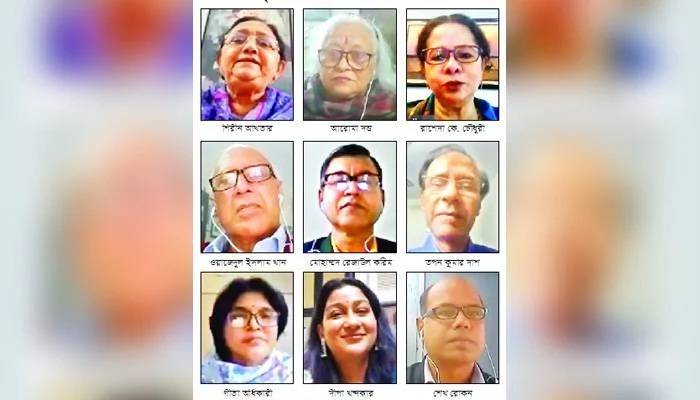
Members of Parliament Shirin Akhter, Aroma Dutta, Member of National Skills Development Authority (Registration and Certification) and Additional Secretary Mohammad Rezaul Karim, Informal Sector Industry Skills Council (ISISC) Chairman Mirza Nurul Gani Shovon, former CEO of the National Skills Development Authority ABM Khorshed Alam, Bangladesh Manpower Export and Training Bureau Director (Training) Dr Md Sakhawat Ali, Oxfam's brand ambassador, actress Deepa Khandaker, Oxfam's Gender Justice and Inclusion Program head Mahmuda Sultana, Oxfam's Securing Rights project coordinator Gita Rani Adhikari, Nari Maitree's executive director Shaheen Akter Dolly, member of the Central Monitoring Cell for Domestic Workers of the Ministry of Labour and Employment Dr Wajedul Islam Khan and Dhaka University Assistant Professor of Sociology Debashish Kundu spoke on the webinar.
Tapan Kumar Das, Deputy Director of Gano Shakkharata Obhijaan, presented the article at the webinar. He said domestic workers do not have formal education. Many domestic workers have lost their jobs due to Covid-19. Many have fallen into financial crisis due to lack of alternative sources of income. Although relief has been officially distributed among the poor and marginalized, many domestic workers have been deprived of it. During the lockdown, five percent of the domestic workers were able to go to work, while 25 percent of the domestic workers did not get paid. Employers are in contact with only 35 percent of domestic workers.
Rasheda K Chowdhury said the main obstacle to ensuring the protection of the rights of domestic workers is that the profession is not officially recognized. Even the implementation of 'Domestic Workers Protection and Welfare Policy-2015' is slow. There is no law. There is no initiative to publicize the policy to protect their rights. So the media has to play an important role. There are countless positive stories that are happening in society. They have to be published in the form of reports. This will encourage homeowners as well as domestic workers.
Shirin Akhtar said that the fight for the rights of domestic workers is going on internationally. The ILO Convention on Decent Work for them-189 was adopted at the 2011 ILO Conference. In Bangladesh, domestic workers are being deprived of their rights and are being tortured in various ways. In order to ensure their rights and dignity, their recognition as workers and to organize them as skilled manpower, it is necessary to sign ILO Convention-189.
She added that domestic workers are not given appointment letters. Many times they are fired from work without notice. They do not have a specific working hours and salary structure. In order to change this position, everyone's attitude has to change. Besides, the government has to enact laws, including implementation of policies, to protect domestic workers.
Aroma Dutta said most of the domestic workers are uneducated. When they face hard reality, they headed towards the city. And thinking it was easy, he/she chooses the job of a house help. But the landlord or the middle person who is employed by the domestic worker knows what the policy is, or what kind of punishment can be meted out if the rights of the domestic worker are violated or tortured. We need to find these places. We have to make them aware as well. Only then most of the problems will be solved.
Mohammad Rezaul Karim said there is no alternative to training to acquire skills. We only train domestic workers who are sent abroad. We improve the quality of their work and then certify. However, Oxfam has started the work of developing the skills of those who are working as domestic workers in the country.
He added that most of the victims in the country are those who live in full-time homes. And the level of violence against those who work part-time is much lower. In these cases, the householder should be made aware.
Mirza Nurul Gani Shovon said the policy has not been implemented in the last five years to protect domestic workers. But they have been contributing to the economic sector of the country. The overall development of the country is not possible without excluding this huge population.
A B M Khorshed Alam said two issues need to be emphasized in protecting the rights of domestic workers, such as skills development through training and implementation of policies. He said that if domestic workers acquire skills, torture and violence will be reduced in many cases. Because, the girl from the village can easily do other work, including the use of microwave, gas oven, washing machine, in urban families.
Dr Md Sakhawat Ali said there is no alternative to training domestic workers. Even then, there is no proper training for them. Recently, training centers for manpower and employment have been instructed for their training arrangement. They will start that training soon.
Dr Wajedul Islam Khan said the domestic workers have lost their own names. In the society they are called ‘Bua’. He urged everyone to play a role in refraining from calling them ‘Bua’.
Deepa Khandaker said we have to make workplaces of domestic workers safe so that they can do everything without fear, they can take food without taking anyone's permission. They will not be worry about what they will do now, she said, adding domestic workers are abused not only physically, but also mentally.
Mahmuda Sultana said that a domestic worker has rights as well as he/she also has a duty. So both need to work to make them aware of their responsibilities.
Dr Debashish Kundu said that a lot of writing and research have been done on domestic workers. But that study was not implemented. There is no representative from the domestic workers in this discussion. As a result, we do not know what they feel or need.
Shaheen Akter Dolly said that an evaluation committee has been formed with the domestic workers. They are kept present there. They will be included in the cell formed by the government, but it is not seen effective.
Sheikh Rokon said that they often use the phrase 'Day-time' to describe the level of manual labour. But there is no such thing in the case of domestic workers. As long as they stay awake, they have to work. They are not guaranteed of their adequate sleep. They are the most deprived among the deprived, the most exploited among the exploited. They have no organization, no minimum wage. It goes without saying that there is no opportunity to see how much their human rights are protected in the corner of the house. Only when they are oppressed does their deprivation and exploitation come to the light. There is not even much discussion about them in the state and society. He said that Samakal, as part of its editorial policy and social responsibility, takes a firm stand on the issue of rights, dignity and protection of domestic workers. This webinar is part of that continuity with the Gano Shakkharata Obhijaan and Oxfam.
It is noted that the Gano Shakkharata Obhijaan is implementing a project titled 'Securing Rights of Women Domestic Workers in Bangladesh' with the support of Oxfam to enhance the professional skills and decent employment of domestic workers and their welfare and protection. Under this project, the Gano Shakkharata Obhijaan is implementing advocacy activities under the auspices of the National Skills Development Authority (NSDA) to develop skills, training manuals and materials for domestic workers as well as formalize the profession.

