E-waste poses serious health hazard in Bangladesh
Online Desk
02 Feb 2021 09:17 AM
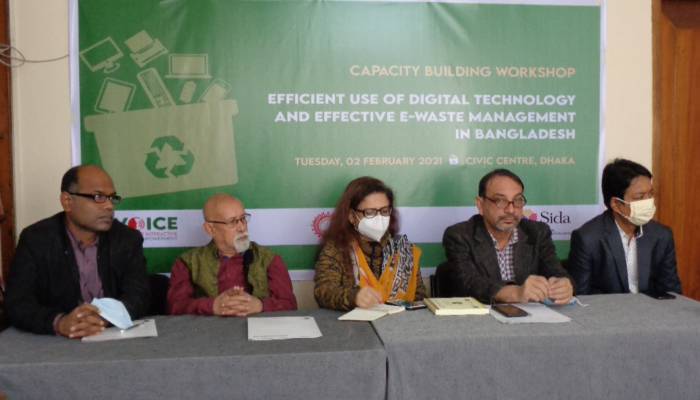
E-waste is increasing in Bangladesh at the rate of 20 per cent every year, creating a grave health concern for all.
Experts said e-waste contains highly toxic chemicals components that can contaminate soil, groundwater and air, as well as affects the workers and the community living around it.
Speakers demanded the intervention of government to come up with certain policies on how to deal with e-waste management in a capacity building workshop held in CIVIC centre at the city on Tuesday, said a press release.
The event titled “Efficient Use of Digital Technology and Effective E-Waste Management in Bangladesh” was organized by Voices for interactive Choice and Empowerment (VOICE) with the support of Association for Progressive Communication (APC).
A good number of journalists, women and youths and participants from NGOs, CSOs joined the workshop.
Eminent journalist and writer Saleem Samad, North South University teacher Dr. Aireen Zaman, Secretary General of Reverine People Sheikh Rokon, former president of Dhaka Reporters Unity Jamal Uddin, Darpan’s director Bashanti Shaha spoke as resource experts.
The session was moderated by Ahmed Swapan Mahmud, Executive Director of VOICE while the key note presentation was delivered by Abtab Khan Shawon, programme officer at VOICE.
The presentation explained how rapid economic and technological development has resulted in amplified use of electronic good and increased e-waste leading towards a new environmental challenge.
Bangladesh generates around 2.8 million metric tons of e-waste every year. Throughout the last two decades cell-phones alone produced 10,504 metric tons of toxics e-waste. Approximately 50,000 children are informally involved with e-waste collection.
Every year around 296,302 TV sets are scrapped and generate approximately 0.17 million metric tons of e-waste. E-waste, generated from ship breaking yards, alone accounts for more than 2.5 million metric tons of toxics e-waste each year. It causes death to more than 15 per cent of child workers as a result of e-waste recycling. An additional 83 per cent become exposed to toxics substances.
Bangladesh currently has no specific environmental policy or act or guidelines to directly manage the e-waste problem. Though a draft regulation on ‘E-waste management rules’ was developed and amended in 2011 and 2017 respectively under the Environment Conservation Act, 1995, but no progress in rules acceptance and implementation has been visible till date.
Speakers in the workshop demanded an integrated collaboration of policy formulation and intervention, community awareness, effective waste management system, knowledge creation and recycling of e-waste through public private partnership participation.
The participants also highlighted for urgent need to establish e-waste treatment plant and the Local E-good producers’ involvement in the process. Moreover, the discussion strongly urged for further research, investigation and knowledge intervention in the sector.

