Gender responsive planning and budgeting program for tea garden workers held
Online Desk
26 Aug 2021 11:28 AM
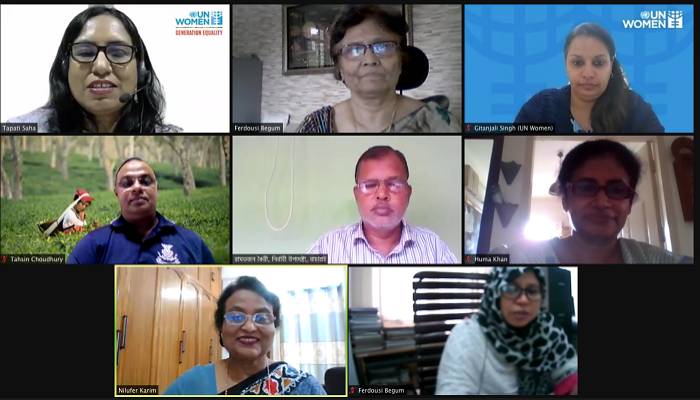
A national level multi stakeholders’ consultation on gender responsive planning and budgeting (GRPB) and social protection of tea garden workers in Bangladesh was held on Thursday.
The virtual discussion explored ways to develop a common understanding of social protection issues of female tea gardens workers by leveraging GRPB as a tool to ensure national policies, plans and strategies are responsive to the immediate and long-term needs of tea garden workers and their family members, said a press release.
Under the UN Joint Program (JP) on “Enhancing social protection for female tea garden workers and their families in Sylhet Division of Bangladesh” was implemented jointly by ILO, UNFPA, UNICEF and UN Women.
The webinar was organized by UN Women Bangladesh.
Tapati Saha from UN Women Bangladesh and Nilufer Ahmed Karim, National Consultant shared the key-note speech with an overview on UN Joint Programme for tea garden workers and GRPB.
In her key-note presentation, Saha highlighted findings from the two divisional level workshops with local government, Bangladesh Tea Association (BTA), Bangladesh Cha Sramik Union (BCSA), UN agencies and civil society organizations, held in Sylhet earlier this year.
Major findings included-access to the health system and support services especially maternity and childcare and WASH services at tea-gardens, transport and communication system, social protection support and services for tea-garden workers, increase of wages or access to other employment opportunities, long working hours.
Recommendations from the divisional level were also shared that included national and local level policies to address the practical needs of women workers and their family members, stakeholder partnerships and coordination and gender equality and empowerment of women and girls in the tea gardens with skills, opportunities, and leadership.
Welcoming everyone at the webinar, Gitanjali Singh, Head of agency, a.i, UN Women Bangladesh, in her speech stressed on three points that include transformative financing for gender equality, allocations (outlays) translating into real, tangible changes in the lives of women, girls and the need to advance gender responsive social protection measures.
“According to our national action plan Ministry of Women and Children’s Affairs (MoWCA) is trying to ensure no women, especially from the vulnerable groups will be left behind. We hope to bring 100% pregnant women under maternity allowance coverage including the female tea- garden workers by 2025” said Ferdousi Begum, Deputy Secretary, Budget and Audit, Ministry of Women and Children Affairs during her speech at the webinar.
Reiterating her points, Md Nayeb Ali, Deputy secretary, Ministry of Social Affairs (MoSA) said, “We have policies that need to be taken into practice. We have to take the tea garden community as a focus in the decision-making process, prepare budget based on their skills and remove the wage disparity they face.”
“While working with tea garden workers, we understood the gaps that exist in the social protection laws-policies and we have communicated these concerns to the tea garden owners, government, and other stakeholders. Together under the coordination of the UNRCO, UNFPA, UNICEF, UNFPA, ILO we are making progress to upholding the major concerns of the tea gardens which need long-term comprehensive support” stressed Alex Chicham, Coordinator, UN Joint Programme during his speech.
Stressing on a comprehensive social protection system for the tea garden workers, Dr Sayema Haque Bidisha, Professor, Department of Economics, University of Dhaka highlighted on MoWCA’s leading role to enhance gender responsive budgeting with a special focus on the need of female tea garden workers.
Present as experts, Dr Bazlul H Khondker, Professor, Department of Economics, University of Dhaka and Ferdousi Sultana Begum, Gender and Social Protection Expert mentioned on the linkage of social protection system of the tea-garden workers to the national social security strategy.
Amongst the panelists Tahsin Ahmed Choudhury from Bangladesh tea Association (BTA) and Rambhajan Kairi, Leader, Bangladesh Cha Sramik Union (BCSU) also spoke about the steps they are taking to ensure overall wellbeing of the tea-garden workers and their family members.
Huma Khan, Human Rights Advisor, UNRC office ended the discussion recommending continued commitment and actions from the stakeholders present at the webinar. UN Women, ILO, UNFPA and UNICEF are implementing this Joint Programme (JP) on “Enhancing social protection for female tea garden workers and their families in Sylhet Division, Bangladesh”, supported by the Sustainable Development Goals (SDGs) Fund, with the Ministry of Labour and Employment (MoLE) and other relevant Ministries, Bangladesh Tea Association (BTA) and Bangladesh Cha Shramik Union (BCSU) representing tea garden workers.

