The China-led AIIB gently rumbles to life
Online Desk
01 Jul 2016 00:43 AM
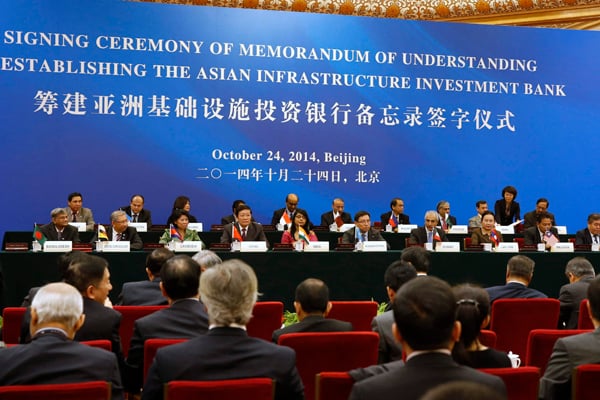
Photo: IBTimes
Roughly six months after officially opening for business, the China-led Asian Infrastructure Investment Bank is beginning to rumble to life, reports the Nikkei Asian Review.
At its first annual meeting, on June 25 in Beijing, the bank announced its first set of loans and adopted a plan to increase the number of member countries early in the next year.
For its first two years, the AIIB appears keen to prioritize expanding its membership and consolidating its organizational framework, while adopting a safe, stable lending stance.
There are also indications that within the next year or so, the bank will gradually begin taking on distinctly Chinese characteristics.
In his speech at the opening of the meeting, Vice Premier Zhang Gaoli, who is ranked seventh in the Chinese Communist Party leadership, appeared intent on addressing concerns that the bank is out to disrupt the global financial status quo, largely created by the U.S. "The AIIB must willingly learn from and emulate other international institutions' successful experiences," Zhang said.
In a similar vein, AIIB President Jin Liqun told the press that the bank and the Asian Development Bank, led by Japan and the U.S. can work together well and learn from each other.
Of the widely watched first set of loans, only one is provided by the AIIB alone, with the remaining three being separately co-financed by the ADB, the World Bank and the European Bank for Reconstruction and Development. All of the loans entail low-risk financing for government projects. Jin has made his aversion to risk clear, saying that for lending assets, quality is by far the most important. Also, the bank's lending target for this year is a conservative $1.2 billion.
The AIIB said on June 24 that the first four loans, including one for a power grid project in Bangladesh, total $509 million. The bank will provide all of the $165 million for the Bangladesh project, which involves installing power lines and laying lines underground. The bank decided to be the sole lender apparently to demonstrate its ability to examine loan applications on its own. As for teaming up with the World Bank, the ADB and the EBRD for the other three loans, the AIIB wanted to show that it has the cooperation of the major existing international financial institutions.
The choice of lending targets suggests the hand of the Chinese government, the AIIB's biggest shareholder. This spring, the bank seriously considered financing a power grid refurbishing project in India, but the plan eventually fell through. Meanwhile, a project in Pakistan-- India's rival and a country with which China has been emphasizing stronger diplomatic relations-- won AIIB financing.
The AIIB is the first full-fledged international institution set up under the initiative of China. If it falters soon after its launch, Chinese President Xi Jinping and other senior officials would lose face. As such, the bank appears to be putting priority on increasing the number of member nations and consolidating its internal structure for the time being.
The AIIB currently has 57 member nations, with 24 more countries from Europe, Latin America and elsewhere having expressed their desire to participate. If these countries apply for membership by the end of September, they could potentially be in early next year, bringing the number of members above the ADB's 67.
One problem, however, is a shortage of staff. Currently, the bank has only 39 employees, less than the number of member nations. Jin said that the AIIB scrutinizes the competence of applicants before hiring them. But relatively few people are well-versed in international infrastructure financing. The bank has apparently been hiring officials retired from other international financial institutions. Jin has said one of the AIIB's high-ranking officials will be Japanese, and that the bank plans to boost the number of employees to 100 by the end of the year.
After a relatively slow first year-- targeting loans of $1.2 billion in 2016-- the bank plans to ramp up lending to $2.5 billion in 2017 and to $3.5 billion in 2018, according to sources close to the bank. For the time being, the AIIB plans to run approvals for two more loans through the board of governors, which consists of representatives of member nations.
After that, however, the approval process will be handled by management instead. With the board of governors out of the picture, Beijing could very well have stronger influence in selecting projects. Given that possibility, the bank will have to devise ways to enhance the transparency of its operations.
The AIIB was launched in December 2015 to help feed Asia's voracious appetite for roads, power plants and other infrastructure, with China taking a leading stake of about 30% in the bank. The initial idea for the institution was put forth by Chinese President Xi in October 2013.
Member nations include India, Russia, South Korea, the U.K., Germany and France. Japan and the U.S. have remained conspicuous holdouts. Some see the bank as a Chinese challenge to the postwar financial order.

