ICCB for emphasis on gas exploration to curb fuel crunch
Samakal Correspondent
10 Jun 2023 19:08 PM
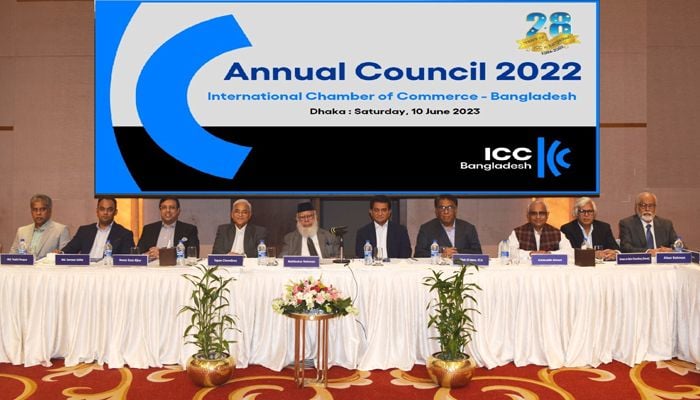
The International Chamber of Commerce, Bangladesh (ICCB) has
suggested the government place more emphasis on gas exploration, so the
country’s dependence on expensive liquefied natural gas (LNG) can be reduced.
Additionally, the ICCB also urged addressing some key issues
for overcoming the challenges such as inflationary pressure, problems in the
energy sector, infrastructure, project implementation and non-performing loans
(NPLs).
The ICCB executive board came up with such suggestions at
its 28th annual council held in the capital on Saturday.
According to an ICCB press release, the board suggested
addressing some key issues for overcoming the challenges. Inflationary Pressure - to contain
inflationary pressure, there should be appropriate monetary and fiscal
policies.
In the energy sector, increasing dependence on imported
fossil fuels, LNG and coal for power generation has intensified risks,
negatively affecting foreign currency reserves and swelling subsidy burdens.
So, Bangladesh should move faster with its exploration
activities both on-shore and off-shore to replace expensive LNG with its own
natural gas reserve as well as establish Nuclear/ Renewable energies to avoid
the adverse effect of climate change.
It said balance-of-payments deficit; rising commodity prices
and a surge in imports resulted in a balance of payments (BoP) deficit.
The ICCB noted that there is an urgent need for Bangladesh
to diversify its export market and products, and sign FTAs with major Asian
countries.
In the case of infrastructure, it said as Bangladesh strives
forward, infrastructure will play a crucial role in stimulating and crowding-in
private sector investment.
By some estimates, Bangladesh will require to make
investments of well over $100 billion in the course of the next decade to build
ports and roads, set up rail lines for the management of goods, establish
power-generation & distribution capabilities, provide utilities and
services to meet the ever-increasing demands of the economy.
In project implementation, it said a one-month extension
raises project cost by 0.95 per cent, therefore, it is an urgent need to ensure
timely project implementation to save cost as well as time.
In the area of non-performing loans (NPLs), the total volume
of non-performing loans (NPLs) has increased by more than three times in the
last 10 years. The banking sector needs more stringent lending policies and
their enforcement, to tackle the problem of NPLs.
In the agriculture sector, the ICCB said the farming sector
has individually employed more than 40.6 per cent of people, either directly or
indirectly.
"Climate change is a big challenge, which we are facing
and will have to face with the use of new agricultural technologies and
adaptability. We must closely follow global adaptation technologies and
concentrate more on new examples of climate adaptability which is best suited
for us."
In the IT industry, the international chamber said
technology is currently used in every facet of life to benefit Bangladesh's
digital economy.
"Our nation will become Smart Bangladesh by 2041.
Although the human resources in the IT sector are increasing in the country,
they need to be developed to be suitable for the industry and Human Resource
Development."
It said several studies conducted by the BIDS have revealed
a substantial gap in the skill sets of workers in labour-incentive industries
such as readymade garments (RMG), light engineering and electronics, leather
and footwear, and agro-food processing. Enterprises have emphasized the need
for a demand-based educational system and increased appropriate training
activities to minimize these gaps.
Speaking on the occasion, ICCB president Mahbubur Rahman
said Bangladesh is now on track for graduating from the least developed country
status in 2026. To achieve this, the country needs to maintain a GDP growth
rate of over 8 per cent and increase its per capita income to around $13,000
from $2,824 now in less than two decades to reach the milestones.
"Graduation to a middle-income country will require
Bangladesh to fulfil a number of international compliances. Therefore, good
governance must also be addressed in both the public and the private sector,
which is still far below the global indexes," said ICCB President Mahbubur
while presenting the executive board report.
Rahman mentioned while chasing big dreams, there are also
mega challenges. "Bangladesh made a rapid recovery from the Covid-19
pandemic supported by prudent macroeconomic policies. But, the economy now
faces considerable challenges with global economic uncertainty," he noted.
The Council approved the Auditor's Report of 2022 and
appointed Auditor for the year 2023.
The council meeting was attended, among others, by ICCB vice
president AK Azad; executive board members: Kutubuddin Ahmed, Anwar-ul-Alam Chowdhury
(Parvez); Aftab Ul Islam,; Md Fazlul Hoque & Tapan Chowdhury; Md. Sameer
Sattar, president, DCCI; Naser Ezaz Bijoy, president, FICCI; Muhammad A.
(Rumee) Ali, chairman, ICCB Banking Commission & Vice Chairman, BIAC; ICCB
secretary general Ataur Rahman; Abul Kasem Khan, managing director, A K Khan
Telecom Ltd.; Rizwan Rahman, managing director, ETBL Securities & Exchange
Limited.
/KN/

