Govt may lose Tk 1,327 crore in revenue annually if deal with US comes into effect: CPD
Samakal Correspondent
10 Mar 2026 16:22 PM
The government is likely to lose around Tk 1,327 crore in import duty revenue annually if the Bangladesh-US trade agreement comes into effect, according to the Centre for Policy Dialogue (CPD), a private research institute.
At the same time, the agreement may create an obligation to provide similar benefits to other countries under the World Trade Organisation (WTO), which could create a big risk in the future, the organisation believes.
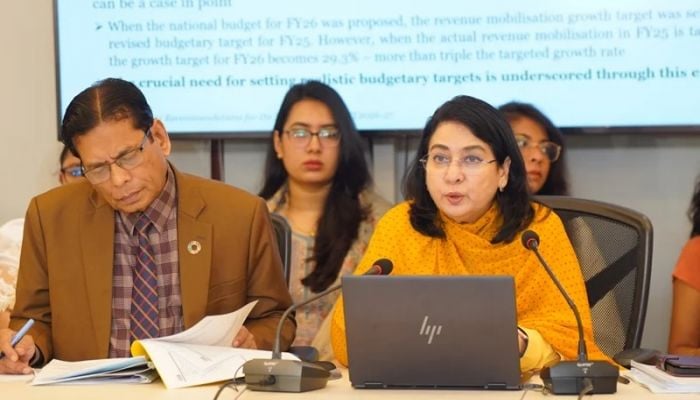
The organisation's Executive Director Dr Fahmida Khatun said this at a media briefing titled 'Recommendations for the National Budget 2026-27 Fiscal Year' at the CPD office in Dhanmondi in the capital on Tuesday.
While presenting the main article, Dr Fahmida Khatun said that Bangladesh has recently signed a trade agreement titled 'Agreement on Reciprocal Trade' with the US. Under this agreement, duty-free benefits will be provided to about 4,500 products imported from the US. In addition, duty-free benefits are planned for 2,210 more types of products in the next five to ten years.
She said that the government earns about Tk 1,327 crore in import duty revenue annually from these products. If the agreement comes into effect, the government may lose this revenue. She also mentioned that unilaterally granting duty-free market benefits to the United States may conflict with WTO policies.
As a result, pressure may be created to provide the same benefits to other member countries under the WTO.
Dr Fahmida Khatun also said that the government's expenditure may also increase due to the condition of purchasing certain products from the United States under the agreement. Therefore, the government needs to re-evaluate the impact of the agreement on revenue and government expenditure. If necessary, this issue needs to be discussed with the United States.
In response to a question on this matter, Professor Mustafizur Rahman, Honorary Fellow of CPD, said that in recent times, the trend of using trade as a weapon has increased, which is weakening the World Trade Organisation.
He said that the content of this agreement needs to be disclosed, because it has several financial risks.
He said that a large part of the implementation of the agreement depends on the private sector. But if the private sector has to be encouraged to import goods from the United States, then the government may have to provide subsidies. Otherwise, the answer to the question of why they would import goods from the United States will have to be found.
In addition, commercial relations with a third country, where goods can or cannot be purchased from, are also involved, which may also affect the question of the country's sovereignty.
Professor Mustafizur Rahman said that after the directive of the US Supreme Court, an opportunity has been created for new discussions on this issue. Bangladesh can re-evaluate the agreement if it wants.
Dr Fahmida Khatun also highlighted the achievement of the revenue collection target as a major challenge in the media briefing. She said that the growth in revenue collection till January of the current fiscal year was 12.9 percent, while the target was 34.5 percent.
In order to achieve the target in the remaining period, revenue collection will have to be collected at a rate of 59.4 percent, which is not realistically possible.
She said that the current revenue deficit has stood at around Tk 60,000 crore. Due to low revenue collection, the government has to rely more on the banking sector. Till December of the current fiscal year, the government has borrowed Tk 59,655 crore from the banking sector. On the other hand, non-bank loans and foreign aid have decreased significantly.
Dr Fahmida Khatun said that taking additional loans from banks is creating risks in the financial sector and credit flow to the private sector is also decreasing. At the same time, inflation is above 8 percent. If there is a problem in fuel supply due to the ongoing war in the Middle East, further pressure on inflation may be created, because a large part of Bangladesh's fuel is imported from that region.
She also said that the implementation of the Annual Development Programme (ADP) is also showing slowness. The ADP implementation rate till January of the current fiscal year was only 20.3 percent, which is the lowest in the last 15 years.
The executive director of CPD said that export income has decreased by 3.2 percent in the current fiscal year, while imports have increased by 3.9 percent till January.
She said that while preparing the budget for the next fiscal year, one should move away from setting ambitious targets. Because even though a high target was set in the current fiscal year, it could not be achieved.
Dr Fahmida Khatun said that the government's election manifesto had set a target of increasing the tax-GDP ratio to 15 percent. But in reality, this ratio is around 6.8 percent in the current fiscal year. As a result, long-term effective revenue management and reforms are needed to achieve this target.
She also said that unnecessary government expenditure should be reduced and initiatives should be taken to increase investment because due to the decrease in investment, employment opportunities are also decreasing.

