FBCCI urges not to increase prices of goods due to pay scale
Samakal Correspondent
01 Sep 2026 21:47 PM
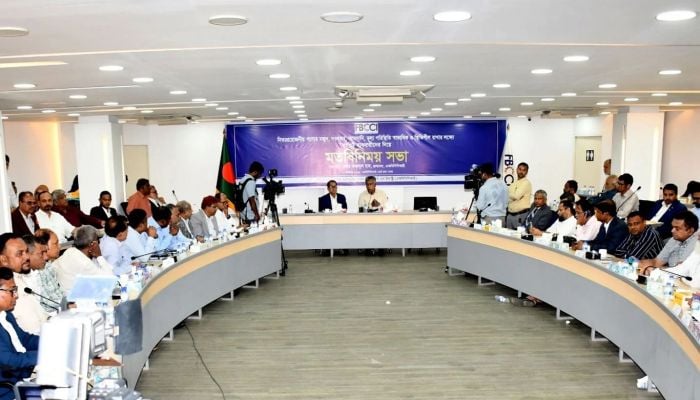
Md Fazlul Haque, the administrator of the apex body of traders, the Federation of Bangladesh Chambers of Commerce and Industry (FBCCI), has urged traders not to increase the prices of goods in the market following the approval of the pay scale for government employees.
On the other hand, traders said that if letters of credit or LCs cannot be opened and the gas-electricity crisis is not resolved on an urgent basis, production will be disrupted. Supply will decrease, which will push up the price of goods.
At the same time, they demanded an end to extortion and syndicates in the supply system of goods.
These issues came up in a meeting with the concerned traders held at the FBCCI office in Motijheel in the capital on Tuesday to keep the stock, supply, import and price situation of daily necessities normal and stable.
Importers, wholesalers and retailers of daily necessities were present at the meeting.
In his speech at the meeting, the administrator of FBCCI said that after the approval of the pay scale or salary structure for government employees, concerns have arisen in the minds of the common people about the price of daily necessities.
In such a situation, traders should assure consumers that the pay scale has nothing to do with the increase in the price of daily necessities. They should promise that the price of the goods will not increase.
At the same time, he said that he would present the valuable opinions and suggestions received in the meeting at the policy-making level.
In an open discussion, Shyambazar Agricultural Products Store Owners and Traders Association president Farid Uddin said that there is no such thing as miniket rice. The fine rice that is sold for Tk50 per kg in the open market is packaged by corporate institutions and sold for Tk70. This is how syndicates are being formed. If corporates are not reined in, the syndicate cannot be stopped.
Stating that traders are fed up with extortion, he said that police members in Moulvibazar are taking extortion. Along with this, political activists are also taking extortion. Traders are in danger due to the pressure of extortion from both sides.
Stating that the price of a bag of flour has increased by Tk200 to Tk300 in the last two weeks, Bangladesh Bread Biscuit and Confectionery Manufacturers Association president Jalal Uddin said that the prices of the three main raw materials of their products, flour, oil and sugar, have increased abnormally.
At least 20 bakery factories have closed in the last six months due to lack of business.
He said that if the prices of oil, sugar and flour do not come down, they will soon increase the prices of bread and biscuit products by 20 per cent through an official announcement.
Regarding the vegetable market, Saifur Rahman, general secretary of the Karwan Bazar Pakka Market Arat Malik Samiti, said that raw materials are sold on all roads adjacent to Karwan Bazar outside the designated arat.
They do not have any trade licence. Because of them, the market often becomes uncontrolled.
Sohel Akhter, director of the Narayanganj Chamber, informed about the abnormal increase in the price of pulses.
He said that in the last 10-15 days, anchor dal has increased by Tk10-Tk12 per kg. Similarly, the prices of other pulses have also increased. But the price of domestically produced khesari dal is at its lowest. This is discouraging farmers.
Liakat Hossain of Jatrabari Traders’ Association said there is a syndicate in the market. Otherwise, how can a farmer’s Tk10 kg of green chillies be sold for Tk100 in Dhaka?
Pointing to extortion, Kazi Anisuzzaman, office secretary of the Khilgaon City Corporation Super Market Owners Association, said it is important to ensure the security of the market.
Fish Farm Owners Association of Bangladesh (FOAB) general secretary Zakir Hossain said that fish are caught in the sea for free. However, when the fish reaches the market, the prices skyrocket.
Bangladesh Edible Oil Wholesale Traders Association president Golam Mawla said that the production of daily necessities is being disrupted due to the gas crisis. If the supply of gas does not increase, the supply of goods in the market will decrease. This may affect the price.
He claimed that although it is not visible, there is actually syndicate violence.
He said that TCB buys oil-sugar-pulses from local companies instead of importing them. This does not have a positive impact on the market. TCB should produce or import.
Zakir Hossain, general secretary of Supermarket Owners Association, expressed his fear that bad days are coming for the market.
He said that the production of goods in various factories is being disrupted due to the gas-power crisis. This is reducing the supply in the market. If this continues, more crises will arise in the future.
He suggested reducing the turnover of products in the supply chain to keep the daily commodities market stable.
Bangladesh Sugar Traders Association president Abul Hashem expressed the same concern.
He said that companies have reported that their production is decreasing. Due to this, they have reduced the supply of products in the market. This is affecting the prices.
In this context, the FBCCI administrator wanted to know from the importers why production may be disrupted due to gas shortage but the prices of products increase.
In response to this question, Meghna Group of Industries (MJI) adviser Shafiur Rahman said that the price of products is determined based on the cost of importing raw materials from the world market and the cost of production.
In response to the same question, MJI senior deputy general manager Taslim Shahriar said that India is one of the world’s largest sugar producing countries. But recently the country has been importing sugar. This is affecting the price of sugar in the world market.
TK Group of Industries director Shafiul Athar Taslim said that the problem will not be solved by just discussing it. Everything depends on production. Ninety-nine per cent of the country’s demand for sugar, 95 per cent of edible oil and 92 per cent of wheat is imported. If these products are not imported regularly, there will be problems in the production and supply of products. Therefore, it is important to resolve the gas and electricity crisis.
He said that 95 per cent of the country’s consumer goods are imported. The government should keep abreast of the market prices and supply situation of the sources.
Biswajit Saha, director of City Group, highlighted the complexity of opening LC. He said that it is important to monitor why LCs are not being opened in banks. If LCs for daily necessities are not opened by October, there may be a shortage of products next Ramadan.
In response to criticism about the price of polao rice, Irfan Group’s assistant general manager Ziaur Rahman said that this time production has decreased by 20 per cent and exports have also decreased, which is why the price of rice has increased.
A representative of Nabil Group said that they have no negative impact on production, marketing or price.

