'US working in new ways to help BD counter violent extremism'
Online Desk
17 May 2016 08:24 AM
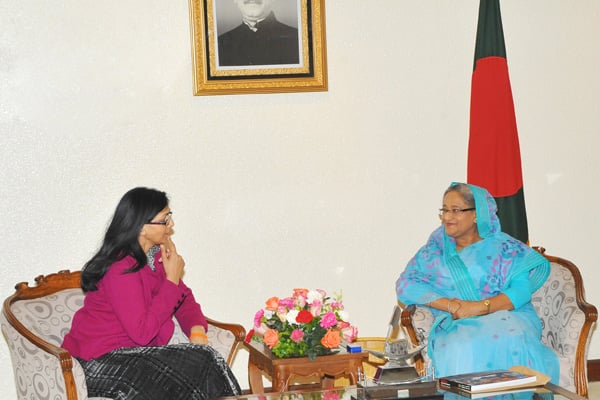
Nisha Desai Biswal, assistant secretary of Bureau of South and Central Asian Affairs, US Department of State with Prime Minister Sheikh Hasina. Photo- Focus Bangla
The United States has said they are now working in “new ways” to help the government of Bangladesh understand and deal with the “new contours” of threat of violent extremism in addition to expanding programs that seek to counter this threat, reports the UNB.
“Bangladesh has a history of overcoming difficult challenges,” said Nisha Desai Biswal, Assistant Secretary, Bureau of South and Central Asian Affairs, while giving her testimony on FY 2017 budget priorities of the US for South Asia.
She also said they are hopeful that, with a determined partnership, they can also help Bangladesh defeat the extremists and terrorists that threaten “vibrant society” in Bangladesh.
Biswal, who recently visited Dhaka, said many of the gains that Bangladesh has made in human development and economic growth risk “being undermined by the escalating extremist violence.”
According to her written statement submitted for the record at the House Committee on Foreign Affairs, Subcommittee on Asia and the Pacific, in Washington, DC on May 11, with nearly 2.8 million followers, US Embassy Dhaka has the largest Facebook fan base of any US mission in the world, and uses it to reach a large youth audience and present attractive alternatives to violent extremist ideologies.
Biswal said Bangladesh’s rivers and its strategic location in the Bay of Bengal also make it a critical linkage in their regional connectivity efforts.
“Our $207.9 million budget request for FY 2017 will build on past progress to ensure Bangladesh’s future success,” she said adding that they are investing in Bangladesh’s success because it is a key strategic partner both in South Asia and on global challenges like climate change and peacekeeping.
Describing Bangladesh as a “Dynamic country” the US Assistant Secretary said many challenges remain in this dynamic country.
On her recent Dhaka visit in the aftermath of the attack on Xulhaz Mannan, she said they underscored Secretary John Kerry’s message to the government and people of Bangladesh that during a time of such challenge it is more important than ever to respect the rule of law, political rights, and the ability for Bangladeshis to speak their mind.
Quoting IMF, Biswal said Bangladesh is projected be a top 30 economy by the year 2030, with its middle-class tripling over the next 10 years. “Countries of South Asia are playing critical roles in regional and global issues that are of great consequence to US interests.”
However, South Asia’s growth will not occur in a vacuum-- instability, insecurity, and inadequate institutions could easily derail this success story, Biswal said.
Giving a brief update on the Indo-Pacific Economic Corridor (IPEC), their flagship regional connectivity effort in South Asia, Biswal said the South Asia remains among the least economically integrated regions in the world, and non-tariff barriers to trade are a major cause.
For example, she said, it takes up to 20 separate authorizations for merchants to import and export goods from India to Bangladesh and, even after that, cargo must be reloaded onto new trucks because of differences in axle loading and road quality.
“With targeted interventions, IPEC finds diplomatic and programmatic solutions to such problems and becomes a connectivity force-multiplier,” said the US Assistant Secretary.
She said a feasibility study they funded led to the construction of a 500 megawatt transmission line between Bangladesh and India.
“We’ve now hired consultants to help Bangladesh harmonize its grid code with its neighbors-- making it easier to move energy to where it’s needed most and facilitating the expansion of that 500 megawatt line to 1000 megawatts.”
She said they have invited South Asian port operators to learn best practices from-- and forge business partnerships with-- their counterparts in Baltimore, New Orleans, and New York and New Jersey.
In the coming years, Biswal said, the countries of South Asia will assume an ever-greater role and importance in global affairs.
At the same time, she added, there will be more opportunities for US businesses to invest in and trade with the region, which will generate more jobs and economic growth here at home.
“With smart, focused engagement, we can ensure that South Asians and Americans alike continue to reap the benefits of regional stability, security, and prosperity,” Biswal said.

