Plastic waste turned into tiles – a first in Bangladesh
BSS
05 Jun 2023 12:53 PM
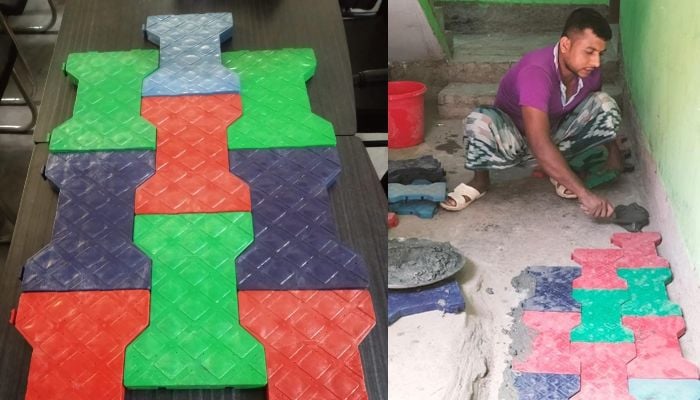
BSS Photo
A small entrepreneur in the Kamrangichar area in Dhaka has
made cost-effective pavement tiles for the first time in Bangladesh by
recycling plastic waste, one of the factors of environmental degradation.
"I have already produced 1,000 pieces of tiles by recycling
plastic waste... I am very optimistic that these tiles will be commercially
viable as it is cost-effective and durable compared to ceramic tiles,"
Nazir Hossain, who turned the plastic waste into assets, told BSS on Monday.
The plastic tile was formally launched Monday at the
"Poribesh Mela (environment fair) 2023" marking World Environment Day
under the theme of 'solution to plastic pollution".
This innovation seems to give a new idea to the country's
waste experts who are desperately looking for sustainable solutions to manage
plastic waste while nearly 650 tons of plastic waste have been collected daily
only in Dhaka.
Nazir, the owner of the Hossain engineering workshop in the
Kamrangichar area in the capital, thanked a local non-government organization
named Resource Integration Center (RIC) that facilitated him to turn his
innovation into reality.
The RIC with the support of the Palli Karma-Sahayak
Foundation (PKSF) has been implementing a pilot waste management project named
Sustainable Enterprise Project (SEP) in Kamrangichar, Lalbag, Islambagh and
Shyampur areas under the Dhaka South City Corporation.
"Our project objective is to develop manufacturing
units for producing improved durable, attractive plastic materials as well to
participate in community development for ensuring an environment-friendly
atmosphere," said Zahir Uddin Ahmed, project coordinator of the SEP.
Apart from helping the community to ensure
environment-friendly plastic waste management systematically, he said, they are
also working to introduce different innovations to produce tiles, bricks and
even fuels from plastic waste.
Nazir, who has been making moulds and patterns for plastic
items for a long time, said plastic tiles are cost-effective and lighter
compare to ceramic tiles.
"One day, I have seen that the city corporation was
constructing a footpath in front of my workshop with earthen tiles... that day
I thought- why should I not try to make tiles by recycling plastic waste?"
he said while sharing his story.
Nazir said he shared his idea with the local NGO and took a
soft loan to set for making a mould to produce the tiles. "I collected raw
materials from plastic waste and try my luck," he added.
He fixed the price of 11/7.5 inched plastic tile that
weighed 280-300 grams at Tk 42 which is cheaper than the traditional ceramic
tiles. "I keep the price low so that even in the village these could be
used," he added.
After making the tiles, Nazir with the help of RIC sent his
products to BUET for quality testing where he received a positive certificate
that his plastic tiles could be used on a commercial basis.
BUET mechanical engineering department professor Abdus Salam
Akand said they took 12 tests to check the materials and found that as a first
version of the product, the quality is overall good.
"But, there is scope to further improve the
tiles," he said adding that improvement of a product through RnD is a
continuous process.
The professor said the plastic tiles will not be a
substitute for the ceramic ones, but they can be used for different purposes.
"As it is lighter and durable people can use it on their rooftop or it can
be used at footpaths and workshops," he said.
There are 7th types of plastic on the earth, and all types
of plastic can be used as raw materials for producing tiles. Among the types,
LDP, HDP and PP are more effective to produce tiles due to market price.
Akand said the plastic tiles would be reused through
recycling after their lifetime. "Plastic tiles have the potentials to be
used on a commercial basis if the entrepreneurs can produce it in large
volume," he added.
SEP project coordinator said they named the tiles 3R
(Reduce, Reuse and Recycle) tiles to promote the recycling of plastic waste.
"Now, we are trying to make a linkage between the
entrepreneurs and developers and government bodies so that these recycled tiles
would be commercially used," he said adding that plastic tiles are even
easier to install than concrete or clay tiles.
This kind of tiles made from plastic waste has already been
used on a commercial basis in India, Egypt, Kenya, and some other countries.
RIC project coordinator Ahmed said they have been working
with other entrepreneurs to produce bricks and fuel out of plastic waste.
Though approximately 5,110 registered plastic manufacturing
units engaged 1.5 million people generating business worth Tk 30,000 crore
annually for the domestic market, only 37.2 per cent is recycled while annual
per capita plastic consumption in Dhaka alone is 22.25kg.
The government has set a target to recycle 50 per cent of plastics by 2025 under its National Action Plan for Sustainable Plastic Management.

