A ‘once-in-200 years’ heat wave caught Southeast Asia off guard
Online Desk
07 Jun 2023 14:52 PM
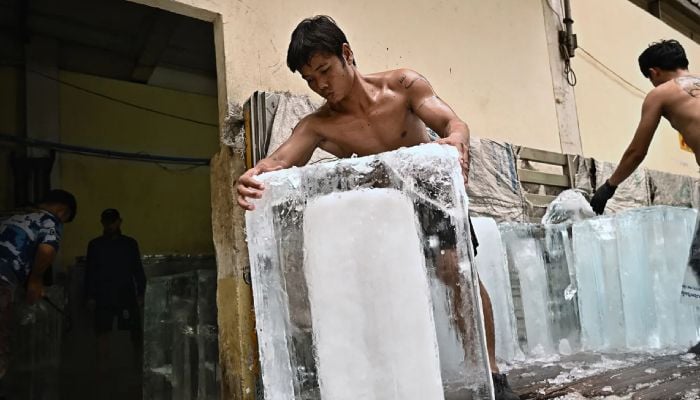
Workers move blocks of ice into a storage unit at a fresh market during heat wave conditions in Bangkok on April 25. AFP Photo
The 'harshest heat wave' in its history has caught Southeast
Asia off guard, and climate change will make them more common. Those hit the
hardest had to improvise to survive, reports Carlotta Dotto, Krystina Shveda
and Lou Robinson from CNN.
Every day, countless mopeds crisscross the congested city of
Hanoi, in Vietnam, with commuters travelling to work or motorbike taxis
dropping off everything from parcels to cooked food and clients.
One of them is Phong, 42, who starts his shift at 5am to
beat the rush hour, navigating the dense swarm of mopeds and driving for over
12 hours a day with little rest.
But an unprecedented heat wave that engulfed his country in
the past two months has made Phong’s job even more arduous. To get through the
heat of the day, he equipped himself with a hat, wet handkerchiefs and several
bottles of water – precautions that provided little relief as recorded daytime
temperatures soared to more than 40 degrees Celsius (104 degrees Fahrenheit).
The average May temperature in Hanoi is 32 degrees Celsius
(90 degrees Fahrenheit).
“If I get a heatstroke, I would be forced to suspend driving
to recover,” he told CNN. “But I cannot afford it.”
Phong, who declined to give his surname, said he carries a
tiny umbrella to protect his phone, the main tool he uses for work as a driver
for the ride-hailing platform Grab, along with his bike. If the phone breaks,
he misses out on much-needed income. “I was worried that the battery would
overheat once exposed to the sun,” he said.
Nearby in the same city, sanitation worker Dinh Van Hung,
53, toils all day cleaning garbage from the bustling streets of Hanoi’s central
Dong Da district.
“It is impossible to avoid the heat, especially at noon and
early afternoon,” Dinh told CNN. “Extreme temperatures also make the garbage
smell more unpleasant, the hard work is now even more difficult, directly
affecting my health and labour.”
Dinh says “There is no other way” but to change when he
starts and finishes his shift.
“I try to work early in the morning or afternoon and
evening,” he said. “During lunch break when the temperature is too high, I find
a sidewalk in a small alley, spread out the cardboard sheets to rest for a
while and then resume work in the afternoon.”
Phong and Dinh are among millions of drivers, street
vendors, cleaners, builders, farmers, and other outdoor or informal economy
workers across Southeast Asia who were hit the hardest during what experts
called the region’s “harshest heat wave on record.”
Workers like them make up the backbone of many societies but
are disproportionately affected by extreme weather events, with dangerously
high temperatures greatly impacting their health and the already precarious
nature of their professions.
April and May are typically the hottest months of the year
in Southeast Asia, as temperatures rise before monsoon rains bring some relief.
But this year, they reached levels never experienced before in most countries
of the region, including tourism hotspots Thailand and Vietnam.
Thailand saw its hottest day in history at 45.4 degrees
Celsius (114 degrees Fahrenheit) on April 15, while neighbouring Laos topped
out at 43.5 degrees Celsius (110 degrees Fahrenheit) for two consecutive days
in May, and Vietnam’s all-time record was broken in early May with 44.2 degrees
Celsius (112 degrees Fahrenheit), according to analysis of weather stations
data by a climatologist and weather historian Maximiliano Herrera.
Herrera described it as “the most brutal never-ending heat
wave” that has continued into June. On June 1, Vietnam broke the record for its
hottest June day in history with 43.8 degrees Celsius (111 degrees Fahrenheit)
– with 29 days of the month to go.
In a recent report from the World Weather Attribution (WWA),
an international coalition of scientists said the April heat wave in Southeast
Asia was a once-in-200-year event that would have been “virtually impossible”
without human-caused climate change.
The scorching heat in Southeast Asia was made even more
unbearable and dangerous due to high humidity – a deadly combination.
Humid heat causes extreme distress and climate change can
make it worse
Humidity, on top of extreme temperatures, makes it even
harder for your body to try and cool itself down.
Heat-related illnesses, such as heat stroke and heat
exhaustion, have severe symptoms and can be life-threatening, especially for
those with heart disease and kidney problems, diabetes, and pregnant people.
“When the surrounding humidity is very high, the body will
continue to sweat trying to release moisture to cool itself, but because the
sweat is not evaporating it will eventually lead to severe dehydration, and in
acute cases, it can lead to heat strokes and deaths,” said Mariam Zachariah,
research associate in near-real time attribution of extreme events to climate
change at World Weather Attribution initiative at Imperial College London.
“Which is why a humid heat wave is more dangerous than a dry
heat wave,” she told CNN.
To understand the health risks of humid heat, scientists
often calculate the “feels-like” temperature – a single measure of how hot it
feels to the human body when air temperature and humidity are both taken into
account, sometimes alongside other factors such as wind chill.
Perceived heat is usually several degrees higher than
observed temperature and gives a more accurate reading of how heat affects
people.
CNN analysis of Copernicus Climate Change Service data found
that between early April and late May, all six countries in the continental
portion of Southeast Asia had reached perceived temperatures close to 40
degrees Celsius (104 degrees Fahrenheit) or more every single day. This is
above a threshold considered dangerous, especially for people with health
problems or those not used to extreme heat.
In Thailand, 20 days in April and at least 10 days in May
reached feels-like temperatures above 46 degrees Celsius (115 degrees
Fahrenheit). At this level, thermal heat stress becomes “extreme” and is
considered life-threatening for anybody including healthy people used to
extreme humid heat.
Throughout April and May, Vietnam, Cambodia, Laos and
Malaysia all had several days with the potential to cause extreme heat stress.
Myanmar had 12 such days – until Cyclone Mocha brought relative relief, but
severe devastation when it made landfall on May 14.
The April-May heat wave in Southeast Asia caused widespread
hospitalisations, damaged roads, sparked fires and led to school closures,
however, the number of deaths remains unknown, according to the World Weather
Attribution report.
The study found that, because of climate change, the heat
was more than two degrees hotter in perceived temperature than it could have
been without global warming caused by pollution.
“When the atmosphere becomes warmer, its ability to hold the
moisture becomes higher and therefore the chances of humid heat waves also
increase,” Zachariah, one of the authors, told CNN.
If global warming continues to increase to 2 degrees Celsius
(3.6 degrees Fahrenheit), such humid heat waves could occur ten times more
often, according to the study.
And if emissions continue to increase at the same pace, the
next two decades could already see 30 more deaths per million from the heat in
Thailand, and 130 more deaths per million by the end of the century, according
to the UN’s Human Climate Horizons projections.
For Myanmar that number would be 30 and 520 more deaths per
million respectively, for Cambodia – 40 and 270, data shows.
Extreme temperatures hit the poor and vulnerable the most
“Occupation, age, health conditions and disabilities, access
to health care services, socioeconomic status, even gender – these are all
factors that can make people more or less vulnerable to heat waves,” said Chaya
Vaddhanaphuti, one of the WWA report’s authors and lecturer at the department
of geography at Chiang Mai University in Thailand.
Marginalised members of society, those without adequate
access to healthcare and cooling systems, and those in jobs that are exposed to
extremely hot and humid conditions are most at risk of heat stress.
“It’s important to talk about who can adapt, who can cope,
and who has the resources to be able to do this,” Emmanuel Raju, also an author
and director of the Copenhagen Center for Disaster Research, said in a press
conference on May 17.
“For those working in the informal economy a lost day means
a day lost in wages,” Raju said.
More than 60 per cent of the employed population in
Southeast Asia work in informal employment, and over 80 per cent in Cambodia
and Myanmar, according to a 2018 International Labour Organization (ILO)
report.
In late April, Thai health authorities issued an extreme
heat alert for the capital Bangkok and several other places across the country,
warning people to stay indoors and of heat stroke dangers.
But for migrant workers like Supot Klongsap, nicknamed
“Nui,” who temporarily left his home to work in construction in Bangkok during
the pre-monsoon season, staying indoors was simply not an option.
He said that this year’s hot season was exceptional, causing
him to sweat all the time and feel exhausted. “I started to sweat from 8 a.m.,
and it was difficult to work. I felt very exhausted from losing so much water.”
Nui, who slept at the construction site, said even the
nights were unbearable. “Water coming from the pipe even during nighttime
remained very hot just like it was boiled. It was difficult to find comfort.”
He said the accommodation for construction workers is roofed
and walled with corrugated sheets, and it barely protects from heat. Any access
to air-conditioned rooms is a luxury Nui couldn’t afford. “We had to rely on
buying ice and adding it to our drinks, our simple way to cool down,” he said.
A 2021 study found that outdoor workers in developing
countries have higher core body temperature than those working indoors, and
they are two to three times more at risk of dehydration, leading to a higher
chance of reduced kidney function and other related conditions.
In Thailand, the government recommends reactive measures,
such as staying indoors, hydrating adequately, wearing light-coloured clothes,
and avoiding certain foods, Chaya told CNN.
“But that doesn’t mean that everybody has the same capacity
to do so.”
The burden of cost often falls on individuals, Chaya said,
making it their responsibility to cope with the heat.
What is needed, he said, is a cohesive international plan
that can protect the more vulnerable populations in the face of increasing
climate change risks, and proactive measures to prevent potential health
issues.
Governments need to develop large-scale solutions, such as
early warning systems for heat, passive and active cooling for all, urban
planning, and heat action plans, World Weather Attribution scientists
recommended in their report.
Communities adapt to protect livelihoods
Intensifying heat waves not only affect individuals’ health,
but threaten the environment and people’s livelihoods, worsen air quality,
destroy crops, increase wildfire risk, and damage infrastructure – so the need
for government action plans on heat waves is vital.
In Yotpieng and Phon villages in northeastern Laos, people’s
livelihoods are intimately connected with weather patterns.
Villagers’ lives here revolve around tea. For centuries,
every day at 7 a.m. the tea farmers start collecting leaves, until 11 a.m. when
they would bring the harvest back home. The survival of these communities
depends on collecting tea leaves to generate income for whole families.
But this year’s extreme heat is disrupting their ability to
work according to their ancient working habits – they had to change from
working in the morning to the afternoon during heat waves, and they are worried
the quality and quantity of tea leaves will be affected, members of the local
community told CNN.
”[The] weather is extremely hot for everyone this year and
farmers are struggling,” according to Chintanaphone Keovichith, management
officer at the Lao Farmer Network.
“This year the weather is hotter than last year, and the tea
leaves are dry,” said tea farmer, Boua Seng.
The manager of a 1,000-year-old tea processing factory,
Vieng Samai Lobia Yaw, said she is worried this year’s tea leaves have not
grown enough, which decreases harvest by almost 50 per cent daily.
“It’s so wasteful – we spend more capital on labourers’ fees
but getting less product,” she said.
For now, tea farmers in Laos have invented solutions to
protect their trees. Some have planted large fruit trees, such as peach or
plum, to provide shade for tea plantations, while others added more compost to
nourish their plants.
“The tea [trees] in the shade will have a nice green leaf,
but the ones without shade will have a yellow leaf,” explained tea farmer
Thongsouk. “We also collect additional income by selling fruit products.”
But they cannot do it alone.
Without a comprehensive international approach to rapidly
reduce planet-warming pollution and address the interconnected impacts of
extreme weather events on individuals, communities, and the environment, the
health and economic costs from heat waves will only worsen as the climate
crisis unfolds.
As May turns into June, many are still waiting for some
respite.
“May was the worst month – that’s when the rain usually comes in, but this year [it] still hasn’t arrived yet,” said Chintanaphone.

