Kotkoti of Mahasthangarh: A Bite of History, Faith and Tradition
Eyazem Palash
21 Sep 2025 15:51 PM
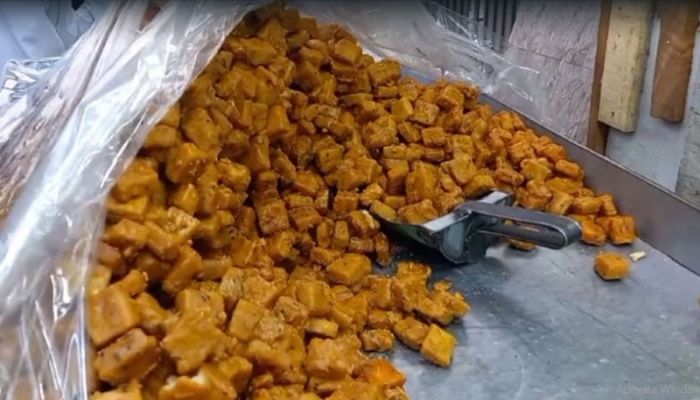
Samakal Photo
It is a dry square of sweet, much like a cookie in texture. Tossed in jaggery, the red delicacy is called 'kotkoti.' Mahasthangarh (Pundranagar), the ancient capital of Bengal, is where the sweet originated, yet now it has become known even outside Bangladesh.
Once upon a time, kotkoti was only offered at the local mazars (shrines). But after 200 years, it has now become part of the local tradition.
As per folklore, kotkoti made out of flour was first made to distribute at Hazrat Shah Sultan Balkhi (R) Mahi Sowar's mazar. Till then, kotkoti has been the item distributed at mazar visitations or milads. Aside from that, the quality sweet item is also a favourite among the locals.
An essential purchase, a flourishing trade
Jimma Khatun, a woman who is planning to visit the Hazrat Shah Sultan Balkhi (R) Mahi Sowar's mazar, said she is buying kotkoti to distribute later. She visits the mazar for mental peace, and when she has a wish (manat) to make. She always buys kotkoti during her visits.
Local traders said they get more customers on Friday. Thousands of people visit the mazar every day. Each of the shops sells around Tk 1 lakh worth of kotkoti daily.
Around 25 big shops display a large selection of varieties of kotkoti every day. Among them are Lal Miah Kotkoti Ghor, Nasir Kotkoti Palace, Hamu Mama Kotkoti Palace, Sultan Kotkoti Palace, China Kotkoti Ghor, Alauddin Kotkoti Bhandar, Jinnah Kotkoti Bhandar, Fatema Kotkoti Palace, Al Amin Kotkoti Palace, Layeb Kotkoti Bhandar, Shahadat Kotkoti Bhandar, etc.
On Friday, around a hundred makeshift shops also appear. On average, 150 maunds of kotkoti is sold daily during peak season. Depending on taste and quality, the price of each kg of kotkoti ranges from Tk 160 to Tk 300.
The name originated from the crunch the sweet makes while eating. In the past, kotkoti was quite hard. Nowadays, the preparation is assisted by technology, and the dough is made using dalda, so kotkoti has become softer in texture and does not make the same crunch while chewing anymore.
Lal Miah Kotkoti Ghor is the oldest kotkoti seller in the area. The owner, Mohammad Lal Miah Pramanik, said his father introduced him to kotkoti trading in Mahasthangarh at the tender age of 12. He used to be a kotkoti hawker at first. Now he has his own large kotkoti showroom.
The family business of making kotkoti is nearly 180 years old, the trader said. His grandfather Johor Pramanik's father was the first in the family to sell kotkoti, and since then, the trade has continued down the bloodline.
Jinnah Miah, the owner of Jinnah Kotkoti Bhandar, said a number of local factories make kotkoti. Out of 50 kotkoti factories, 10 are large, and they produce around 100 maunds of kotkoti daily.
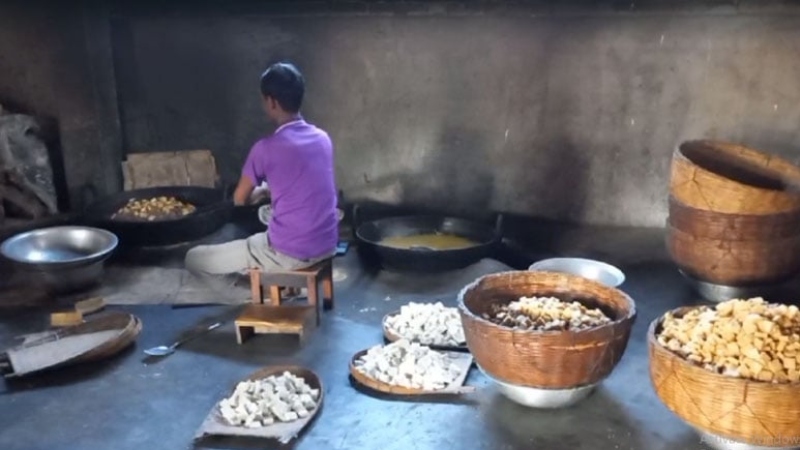
The steps of making kotkoti
Traders and bakers of kotkoti said there is no definite history surrounding the local delicacy. According to folklore, it became a tradition after it was distributed at the mazar. In the past, the dough was made out of wheat flour and fried in oil. Nowadays, ghee or dalda is used.
The main ingredient of kotkoti is fragrant rice, soaked in water for 3-4 hours. After the rice becomes soft, it is strained and dried for 15-20 minutes. It is then ground into a fine flour. The rice flour is then mixed with a little bit of oil to make a dough. The dough is spread on a metal surface and left to harden slightly.
The hardened dough is cut into 1.5 square inch pieces and fried. Once it assumes a golden exterior, it is tossed in liquid jaggery or sugar solution. It takes only five minutes for it to cool and become the delicacy known as kotkoti.

