A PR stunt amid a massacre in Gaza
Belén Fernández
22 Oct 2023 17:57 PM
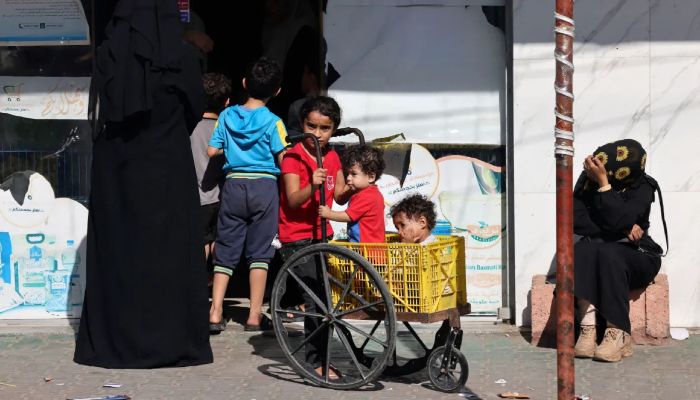
Palestinians wait to receive food aid outside a supermarket in Rafah. AFP Photo
The 20 trucks of humanitarian aid that entered Gaza are just
a distraction from Israel’s continuing murderous war on the Palestinians.
Friday, October 20 was supposed to be a particularly
humanitarian day for the “world’s most moral army”, ie, the one that has
slaughtered more than 4,000 humans in the Gaza Strip over the past two weeks,
half of them children.
According to United States President Joe Biden – who
continues to wholeheartedly back the Israeli slaughter-fest in Gaza both
morally and financially while pretending to care a tiny bit about the victims
of the whole arrangement – Israel had agreed to allow some 20 humanitarian aid
trucks to enter the besieged Palestinian enclave on Friday via the shuttered
Rafah crossing from Egypt. Depending on how that went, the US president said,
more aid trucks could then follow.
A statement from Israeli Prime Minister Benjamin Netanyahu’s
office on Wednesday affirmed that, “in light of President Biden’s demand,
Israel will not thwart humanitarian supplies from Egypt as long as it is only
food, water and medicine for the civilian population in the southern Gaza
Strip”.
Biden, it seems, was a tad more excited about the PR stunt
than everyone’s favourite “moral army”.
To be sure, the non-thwarting pledge would have been
slightly more credible had Israel not repeatedly bombed Rafah and the other
areas of southern Gaza to which thousands of civilians from the north have
evacuated under orders from Israel itself.
As might have been predicted, the aid trucks were held up
all day Friday on the Egyptian side of the border as the Israeli army continued
its pulverisation efforts in the Palestinian territory.
They only managed to enter Gaza on Saturday morning after
another nighttime killing spree by Israeli warplanes which killed at least 46
Palestinians.
The fewer people left alive in Gaza, the fewer “humanitarian
supplies” needed, right?
Of course, if Israel was actually concerned with allowing
aid to reach Palestinian civilians in the Gaza Strip, it could simply suspend
the illegal land, air and sea blockade of Gaza which it has maintained for more
than 16 years.
Over this period, the fluctuating catalogue of banned and
restricted items has proved consistently diabolically ludicrous, and has
included everything from medical devices to flour, rice, salt, toilet paper,
soap, notebooks and pens.
Israel also happens to share its very own land border with
the Gaza Strip. This means that, were the Israeli government ever in a
genuinely non-thwarty mood, it could with superlative ease permit the
cross-border movement of cancer medication and other helpful stuff.
As this latest war underscores, however, Israel prefers the
“shooting fish in a barrel” approach to Gaza, and the 20 aid trucks allowed to
go through Rafah are merely a drop in the bucket (or barrel) in a humanitarian
catastrophe of unspeakable proportions.
Normally, some 450 trucks enter Gaza daily carrying supplies
to help residents survive the debilitating blockade.
Back in 2012, a United Nations report warned that, in the
absence of “Herculean efforts … in such sectors as energy, education, health,
water and sanitation”, the Gaza Strip would not be “a liveable place” by 2020.
Obviously, regular bouts of mass killing by the Israeli army
have done nothing to increase chances of “liveability” over the years; ditto
for Israeli attacks on infrastructure pertaining to each and every one of the
aforementioned “sectors”.
Now, three years past the 2020 marker, Gaza appears to have
entered into a state of distinct uninhabitability, particularly in the
aftermath of Israel’s announcement on October 9 that it would commence a
“complete siege” of the Gaza Strip, including a total ban on the passage of
food, water, and fuel into the territory.
This, mind you, was nine days prior to the promise to “not
thwart humanitarian supplies from Egypt”.
What happens, then, to 2.3 million people without food,
water, electricity or medicine who are trapped in a sliver of land that is
rapidly being reduced to rubble? In Joe Biden’s view, apparently, we won’t have
to find out – so long as we can get a couple of aid trucks in.
In reality, though, hunger is as good a weapon of war as any
– just ask the Nazis, among others. As Alex de Waal, executive director of the
World Peace Foundation, noted in a 2017 essay for the London Review of Books,
“forced starvation was one of the instruments of the Holocaust” and an
“effective instrument of mass murder”.
And regardless of whatever smattering of aid is allowed into
Gaza without being “thwarted” by Israel, death by hunger remains a living
threat.
But there are still plenty of other ways to die, as was
underscored on Tuesday, October 17, when an attack on Gaza City’s al-Ahli Arab
Hospital killed some 470 people.
Notwithstanding Israel’s extensive track record of targeting
Palestinian healthcare facilities, ambulances and medical personnel, the
Israeli government undertook to deny committing the atrocity – a denial that
was quickly backed up by the ever-omniscient Biden, head of another country
known for bombing hospitals.
A rather more convincing picture was painted by
British-Palestinian surgeon Dr Ghassan Abu-Sittah, the co-founder of the
Conflict Medicine Programme at the American University of Beirut Medical
Center, who was present at al-Ahli Hospital at the time of the attack and who
described it as an Israeli “massacre by appointment”.
Writing on his Facebook page, Abu-Sittah pointed out that
the Israeli government had been “openly saying it was going to target hospitals
for the last week and the world just stood by and did nothing”. He continued:
“I saw a body of a toddler who was missing a head”.
And as those meagre 20 humanitarian aid trucks roll into
Gaza, any fig leaf of aid can’t hide the fact that this is one big massacre by
appointment.
Writer: Belén Fernández is an Al Jazeera columnist.
She is the author of Inside Siglo XXI: Locked Up in Mexico’s Largest
Immigration Center (OR Books, 2022), Checkpoint Zipolite: Quarantine in a Small
Place (OR Books, 2021), Exile: Rejecting America and Finding the World (OR Books,
2019), Martyrs Never Die: Travels through South Lebanon (Warscapes, 2016), and
The Imperial Messenger: Thomas Friedman at Work (Verso, 2011). She is a
contributing editor at Jacobin Magazine, and has written for the New York
Times, the London Review of Books blog, Current Affairs, and Middle East Eye,
among numerous other publications.
/KN/

