Opinion
The ICJ ruling was a legal victory at the cost of Palestinian lives
Andrew Mitrovica
29 Jan 2024 15:25 PM
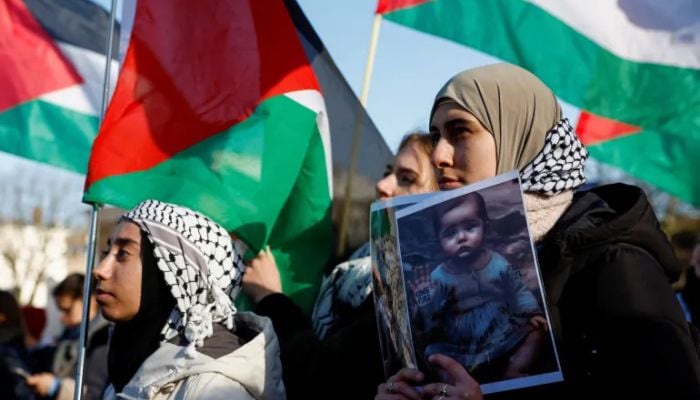
Pro-Palestinian protesters attend a demonstration outside the International Court of Justice. Reuters Photo
I need to preface this column with the following proviso:
Given the scale of the cruel circumstances, my reading of the much-anticipated
preliminary ruling by the International Court of Justice (ICJ) in response to
South Africa’s brief accusing Israel of genocide is of little, if any,
importance.
Since the court issued its findings, I have chosen instead
to heed the reactions of the Palestinian diaspora and their surviving brothers
and sisters in what remains of Gaza, the occupied West Bank, and beyond.
Their voices count. Not mine.
Of course, more than 26,000 Palestinians – and counting – no
longer have a voice. They are dead. Annihilated by a fanatical Israeli cabinet
that has killed hundreds more Palestinians while a gallery of white, Western
columnists like me parse the significance and merits of the court’s just
announced “provisional” measures.
We must always remember that blatant and instructive fact.
Two camps have emerged.
The first has hailed the court’s decision as a watershed
moment. Israel has been held finally to account after decades of evading
accountability for the litany of outrages it has committed against generation
after generation of Palestinians.
The other lasting and overarching import of the court’s
decrees is that Israel’s Western-backed and tolerated licence to displace, maim
and kill Palestinians without consequences is over.
Near unanimously, the court was convinced that South Africa
made a plausible case demonstrating that Israel has displayed the intent to
execute genocide.
As a result, the court is required, by international law, to
proceed with a full hearing and, ultimately, to render a verdict on the seminal
question: Is Israel guilty of the crime of genocide in Gaza?
Near unanimously, the court, in effect, rejected the
establishment media notion that the calamity unfolding in Gaza was a “war”
between adversaries; but, rather, is prima facie evidence of a deliberate
campaign by Israel to erase, wholesale, a people and a nation.
As such, Israel was required by international law to enact
“immediate” steps to stop the horrors it has unleashed with such unremitting
ferocity over the past four months.
Towards that end, the court instructed Israel, near
unanimously, to deliver a report to South Africa in a month for its review.
Israel is obliged to detail how, when and where it has taken
the compulsory measures not only to prevent genocide, but also the incitement
to genocide and to allow humanitarian aid to reach the starving and destitute
souls who call the devastated enclave home.
The implicit meaning of the court’s order was that Israel
had to adopt a ceasefire.
As South Africa’s foreign minister, Naledi Pandor, explained
to reporters outside The Hague: “I believe that in exercising the order, there
would have to be a ceasefire. Without it, the order doesn’t actually work.”
The irony is as inescapable as it is delicious.
An apartheid regime has been directed by a court to answer
to a country that, in due and patient course, freed itself from another
apartheid regime.
The court’s judgement is particularly satisfying because it
represents a stiff and damning rebuttal to the now discredited claim made by
the usual diplomats in the usual capitals that South Africa’s persuasive
petition was “meritless” and “counterproductive”.
To its credit, the court has dealt an emphatic, fatal blow
to that hollow bit of rhetorical chicanery.
In a tangible and historic precedent, Israel and its
complicit, evangelical sponsors, have been put on notice by the ICJ.
About time.
“History – with a capital H – was made today,” the
Palestinian writer and editor, Mouin Rabbani wrote on X. “Israel is as of today
associated with the crime of genocide primarily as perpetrator, not victim.
Israel’s policies towards the Palestinian people will henceforth be judged on
their own merits rather than against the long shadow of European history.”
In this broader context, Rabbani argues that the
understandable chagrin over the justices not calling explicitly for a
“ceasefire” is moot since Israel signalled – publicly and repeatedly – that it
would continue with its “killing rage” whatever the court’s edicts.
Still, there is a legion of disappointed Palestinians
interviewed by Al Jazeera and the few other news organisations with a permanent
presence in Gaza.
They described the court’s refusal to demand a ceasefire and
halt Israel’s latest invasion as a predictable “failure” that has only fuelled
their abiding mistrust of the “international community” and the so-called
“global justice system”.
“Although I don’t trust the international community, I had a
small glimmer of hope that the court would rule on a ceasefire in Gaza,”
54-year-old Ahmed al-Naffar said from outside the Al-Aqsa Martyrs Hospital in
central Gaza’s Deir el-Balah on Friday.
He is not alone.
“The court gave Israel another month to continue killing,
displacing, and starving us,” Gaza-based journalist Aseel Mousa told the Middle
East Eye. “Israel [has] an opportunity to continue to exterminate us while
supplying us with scraps of the food, medicine, and essential life necessities
we need.”
The pervasive disappointment is compounded by the ICJ’s
glaring and jarring hypocrisy.
Writing from occupied East Jerusalem, Palestinian poet,
Mohammed El-Kurd, posted this blunt tweet on X: “Lots of people are making
excuses. The ICJ can and has historically called for a ceasefire. In 2022, it
demanded ‘Russia shall immediately suspend the military operation it commenced
[in Ukraine.]’”
I oscillate between these two, disparate perspectives.
The comeuppance that Israel may or may not receive at The
Hague several months or years hence will be deserving and long overdue.
But the imperative of now; the imperative to halt the
suffering and killing of Palestinians is the more urgent necessity.
The optimist in me hopes that the ICJ’s ruling hastens,
somehow, the end – for good – of the murderous madness and the quick return of
Israelis held by Hamas to their despondent families.
The pessimist in me suspects that nothing will change soon
on the ground in Gaza and the occupied West Bank. The slaughter of innocents
will go on. Palestinian children, the old, and infirm will succumb to hunger
and disease as their families huddle in a sea of flimsy, rain-soaked tents
while Israel turns the whole of Gaza into dust and memory.
And, despite the ICJ’s injunctions, much of the world will
enable Israel’s wanton siege and carnage of Gaza today and tomorrow as it did
yesterday.
Yet, the flippant few who dismiss the ICJ’s stinging rebuff
of Israel as symbolic or irrelevant should take careful note of how Tel Aviv
and Washington have greeted the court’s ruling.
For its formulaic part, Israel has trotted out the tired
canard that the ICJ is a hive of “anti-Semitic bias”.
What an unserious reply to a serious indictment.
Meanwhile, in a calculated and cynical attempt to divert
attention from the remarkable proceedings at The Hague, the White House
announced a suspension of its relatively paltry aid to the UN Relief and Works
Agency for Palestine Refugees in the Near East (UNRWA) in light of Israeli
allegations that some of the organisation’s staff were implicated in the
October 7 attacks.
Convenient timing, wouldn’t you say?
South Africa’s daring gambit at the ICJ may already be
paying welcomed dividends with word that a tentative agreement is close to
release the Israeli captives in exchange for a temporary ceasefire.
So, take a deep, well-earned bow, South Africa.
The author is an Al Jazeera columnist based in
Toronto.

