Opinion
Politics of space: The case of the Themis statue and spatial dominance in Dhaka
Eyazem Palash
31 Oct 2025 17:48 PM । Update: 31 Oct 2025 17:49 PM
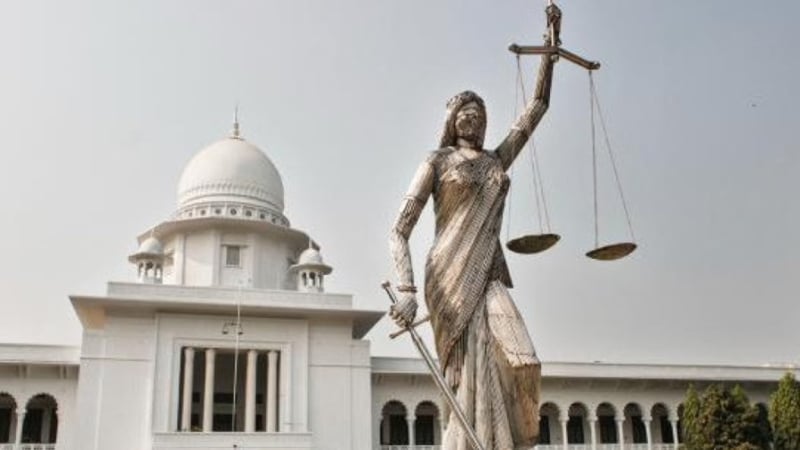
The biggest news items in August last year all centred around the same theme- the ousting of Sheikh Hasina's regime. The relatively less palatable incident of a mob vandalising the statue of Themis in front of the installed in front of the extended building of the High Court Division of the Supreme Court on August 6, and subsequently pulling it down the next day, did not garner much attention from the populace.
Themis remains a marked example of how an inanimate statue can become the target of political dominance. The sculpture was installed in front of the Supreme Court's main building on December 16, 2016.
Sculptor Mrinal Haque had fashioned the statue after the ancient Roman personification of justice- a blindfolded woman holding a sword and a set of scales.
Soon, Hefazat-e-Islam Bangladesh claimed that the statue was of a "Greek Goddess" and clamoured for its removal. Consequently, it was displaced on May 25, 2017. A section of cultural activists protested the removal, and it was installed in front of the annexe building instead. The discourse over this matter went quiet.
Naturally, the question arises: why did a discourse regarding Themis' installation in front of the Supreme Court start up, when there are numerous other statues in Dhaka and elsewhere in the country? And why did the discourse end when it was moved to a different location?
Space, Power and Symbolism
It may be noted that location also plays an important role here. Themis was installed in an urban area; important for both parties in discord here. Historically, these two parties have been trying to establish their dominance both politically and culturally in this urban space for nearly two decades.
As per David Harvey's Spatio-Temporal theory, that the concept of space can never be sovereign, relational, or relative in and of itself. Whether it takes on one or all of these characteristics depends entirely on context and circumstance. The problem of properly conceptualizing space, Harvey argues, can only be resolved through human practice that acknowledges and respects its complexity.
This idea becomes nationally and politically relevant when our spatial and temporal experiences intersect with social and political relations. In other words, space and time do not exist as neutral or abstract dimensions; they are socially produced through human activities — economic, cultural, and political.
Thus, space acquires meaning only when people act within it. When a nation or community expresses itself through specific historical and spatial conditions — through politics, culture, or economy — that space and time become socially and nationally significant.
The Spatial Politics of Themis
Regarding the location where the Themis statue was placed, we notice several important infrastructure. The High Court itself is important to the general populace. The Eidgah grounds next to it also hold religious significance. The High Court Mazar and Mosque both are nearby. The Press Club and Secretariat, both important political infrastructures, are also located nearby. All of these influential structures make the location of Themis important.
It may be noted that an inanimate object such as a statue cannot give rise to a debate itself. People are the ones who project their own thoughts and interpretations on it, and cause debates.
Aside from space, the time when the debate centring Themis arose, is also of significance. At that time, the 11th National Parliamentary Elections were near. Hefazat-E-Islam Bangladesh called for a movement on February 6, and held a dialogue with the then prime minister Sheikh Hasina on April 11.
At the dialogue, Sheikh Hasina admitted that she also did not like that a Greek goddess' statue was placed in front of the High Court. She later spoke to the then chief justice Surendra Kumar Sinha.
In response, Sinha said, "The statue installed in front of the Court wears a saree, turning Themis into a Bangladesh prototype. Through it, a courageous message is conveyed."
Meanwhile, the sculptor said the statue was built as the personification of justice. It is the statue of a Bangladesh saree-clad woman, not a Greek goddess.
As the statue was uprooted during the student-people mass movement, and cultural activists remained silent regarding the issue, it is evident that the debate's main reason was political dominance. More specifically- to establish dominance in the urban space. However, both the patries could've reaqched a compromise instead of subjecting the statue to be a pawn in their politics. That way, the statue could've been the symbol of political dominance in Dhaka.

