May 'Mujibnagar Day' be celebrated by all
Shamsul Huda
17 Apr 2026 13:24 PM
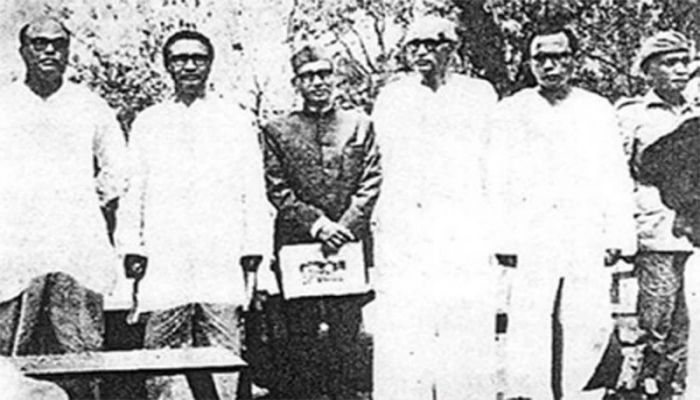
Mujibnagar Day holds great importance in the history of Bangladesh’s struggle for independence. On April 10, 1971, the Provisional Government of Bangladesh was formed. This government later provided central leadership during the Liberation War.
Although the formal swearing-in ceremony was planned for April 10, it could not take place on that day because of the activities of the Pakistani occupation forces and the security risks involved.
Considering the situation, the formal swearing-in of the Provisional Government was held on April 17 at Baidyanathtala, which is now known as Mujibnagar.
In this government, Bangabandhu Sheikh Mujibur Rahman was declared President, even though he was imprisoned in Pakistan at the time. In his absence, Vice President Syed Nazrul Islam acted as the Provisional President, and Tajuddin Ahmed became Prime Minister.
The day is also linked to the formal declaration of Bangladesh’s independence. The declaration prepared on April 10 explained the reasons behind the independence of Bangladesh. On April 17, Professor M. Yusuf Ali, a member of the Constituent Assembly, formally read out the Declaration of Independence at Mujibnagar. This reading officially approved the declaration made on March 26 and stated that Bangladesh’s independence had come into effect from that day.
Earlier, the Awami League had won an absolute majority in the 1970 general elections. However, the ruling group in West Pakistan refused to accept the result. They ignored the democratic verdict, delayed the transfer of power, and engaged in political tricks. The people of East Pakistan rose up against this injustice. To crush this rightful movement, the Pakistani military launched a brutal operation called Operation Searchlight on the night of March 25, 1971. They carried out massacres on unarmed Bengalis without mercy. Universities, student halls, and poor neighbourhoods were all attacked. Thousands of people were killed in a single night, countless women were tortured, and millions were forced to flee their homes and become refugees in other countries. This was a planned genocide aimed at permanently suppressing the legitimate political rights of the Bengali people.
This terrible event made one thing clear to the Bengali nation: it was no longer possible to gain their rights through democratic means. The only path left was full independence. It was in this context that the Provisional Government was formed on April 10 and the declaration of independence was made official. This gave the Liberation War a well-organised and legitimate foundation.
After the government was sworn in, General Osmani was appointed Commander-in-Chief of the Liberation Army and was also given responsibility for the Ministry of Defence.
Three forces – Z Force, S Force, and K Force – were formed under the leadership of Major Ziaur Rahman, Major Shafiullah, and Major Khaled Mosharraf. Later, the whole of Bangladesh was divided first into nine sectors and then into eleven sectors.
Eleven sector commanders, including the three mentioned above, were given the task of carrying out the Liberation War.
The declaration of independence and its legitimacy were clearly confirmed in the statement of April 10. This declaration gave the Liberation War a proper political framework, which helped make Bangladesh’s struggle acceptable to the international community. The war was no longer seen simply as an armed uprising, but as a legitimate movement to create an independent country.
Secondly, the Provisional Government helped the Liberation War gain recognition at the international level. It showed the world that this was not merely an internal revolt, but a fight to establish a sovereign state. The government also played a key role in winning support from different countries and international organisations.
The importance of April 17is not limited to the declaration and the swearing-in of the government. It was a symbol of national unity, political wisdom, and strong leadership. The ability to form a well-organised government even under the oppression of the Pakistani forces was a major source of strength for the Liberation War. This day reminds us that independence is not just an emotion, but the result of careful planning, good leadership, and great sacrifice.
Although the Awami League government first introduced this day, it was not observed properly in later years. Because of this, many people in civil society have raised questions about it. We believe that everyone, regardless of political party or opinion, should remember and honour this day.
We achieved an independent Bangladesh because of the sacrifices made by our freedom fighters. If the Provisional Government had not been formed before the war began, we would not have been able to build proper public support and organise the struggle effectively. For this reason, the day is very important. We should be grateful to all those who took the initiative and to everyone who served in the cabinet. At the state level, political parties and civil society should also observe the day with the respect it deserves.
Write: Shamsul Huda, Human Rights Activist; Executive Director, ALRD

