Transformation of Industry and Future of Labour in Bangladesh in the Age of AI
M M Shahidul Hasan
01 May 2026 19:53 PM । Update: 01 May 2026 20:17 PM
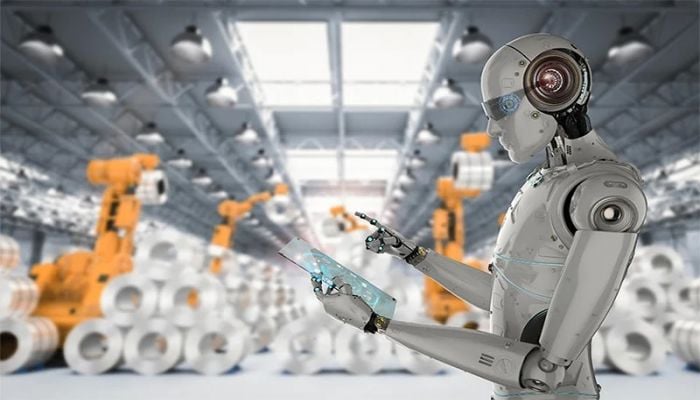
Bangladesh’s industrial development has always depended on labour-intensive production. This is especially true in the ready-made garments sector, as well as in other manufacturing industries, construction, agriculture, and the large informal economy. There is no doubt that this model has created many jobs, supported export earnings, and helped keep the economy stable during various global crises.
The garments sector alone employs around four million people and accounts for more than 80 percent of the country’s total export earnings. It contributes directly about 11 to 12 percent to gross domestic product, with an even larger indirect contribution through its links with trade and services. While this sector has been the backbone of Bangladesh’s industrial success, it also creates a structural risk because it depends heavily on changes in foreign markets.
Manufacturing activities outside the garments sector, mostly led by small and medium enterprises, are slowly growing. However, levels of productivity and efficiency vary widely. At the same time, Bangladesh’s labour market still shows the features of a traditional developing economy, with a large part of the workforce engaged in low-productivity work.
For example, agriculture still employs about two-fifths of the total labour force but contributes only 11 to 14 percent to gross domestic product. This long-standing mismatch between where people work and where real value is created highlights a deeper structural problem.
Bangladesh has been fairly successful in creating jobs, but it has not been equally successful in raising productivity across different sectors.
Meanwhile, the global industrial landscape is changing very quickly. Automation, artificial intelligence, and smart manufacturing are transforming how goods are produced and services are delivered worldwide. As these technologies become a normal part of global value chains, Bangladesh faces an important question: how can we adopt new technologies to increase productivity in industry without harming employment, social stability, and inclusive growth?
Artificial intelligence refers to computer systems that can carry out tasks normally requiring human intelligence, such as recognising patterns, understanding language, making decisions, or solving complex problems. When artificial intelligence is combined with sensors, data analysis, and connected machines, the resulting production system is known as smart manufacturing.
In traditional factories, machines simply produce goods. In automated factories, machines follow set instructions. In smart factories, machines communicate with one another, learn from data, and continuously improve production processes. In short, production is shifting from being machine-centred to data-centred. Smart manufacturing clearly reduces hard physical work and increases efficiency. At the same time, however, it reveals a major weakness in Bangladesh’s labour market.
Around 20 to 25 percent of the country’s total workforce has no formal education or only very limited education. Workers with primary or secondary education make up the majority. A large number of them perform routine, repetitive tasks that are most vulnerable to automation. By contrast, only about 10 to 15 percent of the workforce, who are highly educated, work in knowledge-intensive areas such as engineering, advanced manufacturing, economics, or information technology. Without careful planning and intervention, technological change could displace or remove a large part of the labour force before new jobs are created.
However, an important point is often missed. Automation does not completely remove the need for human labour; it changes the nature of work. With proper training, many routine jobs can be turned into new roles such as supervising machines, checking quality, carrying out maintenance, coordinating logistics, or making decisions based on data. Even workers with limited formal education can learn useful digital and artificial intelligence skills through training provided by industry. For those who cannot move into technology-related roles, new job opportunities must be created in sectors where human presence, skilled hands, and personal interaction remain essential.
At the same time, it is essential to begin reforming the education system now to prepare the next generation for these changes. All university students should receive basic knowledge of artificial intelligence and data. In engineering and technical subjects, more specialised courses should be offered. At school and college levels, basic concepts related to artificial intelligence should gradually be introduced into the curriculum.
It is important to remember that even the most advanced artificial intelligence systems still fall short in many areas where humans excel, such as creativity, the ability to reframe complex problems, ethical judgement, leadership, learning from experience, thinking across different subjects, and adapting quickly to new situations. For this reason, the future of work will not depend on technology alone. It will be based on the intelligent combination of human skills and technology.
This situation sends a strong warning about Bangladesh’s current education system. Our education system still focuses mainly on memorising information and increasing the quantity of content, with too little attention given to the actual learning process and the development of skills. To stay relevant in a fast-changing labour market, the education system must be redesigned to emphasise problem identification and solving, teamwork, critical thinking, and the habit of lifelong learning. Education reform is no longer simply an educational matter; it has become an economic necessity.
Bangladesh today stands at a critical point in its industrial journey. Artificial intelligence and automation are gradually entering factories, farms, and the service sector. Technology by itself will not decide the country’s future. Real progress will only come when the adoption of technology is supported by clear policies, the reskilling of workers, and a fundamental change in culture that values innovation and higher productivity. The question is no longer whether smart manufacturing will arrive. It has already begun. The real question is whether Bangladesh can ensure that its people move forward together with the machines.
Writer: M M Shahidul Hasan is Distinguished Professor, Eastern University and former Vice-Chancellor, East West University, Bangladesh
The article was originally published in the print and online editions of The Daily Samakal and has been rewritten for the English version by Mohammed Humayun Kabir, Assistant News Editor.

