The Teesta Test
Sheikh Rokon
12 May 2026 23:38 PM । Update: 13 May 2026 00:19 AM
A report broadcast on India’s NDTV on May 6 termed the Teesta issue as the ‘South Asia’s most sensitive river dispute’. This description is hardly an exaggeration.
The Bharatiya Janata Party (BJP) has come to power in West Bengal this week after the fifteen-year rule of the Trinamool Congress. Suvendu Adhikari, who was once the right-hand man of the outgoing Chief Minister Mamata Banerjee and later became her fierce opponent, took oath as the new Chief Minister on Saturday. Ever since the election results were announced, there has been considerable ‘hype’ in both the Bangladeshi and Indian media about what will happen to the Teesta agreement.
It should be remembered that, after nearly six decades of negotiations, the fully prepared agreement that was ready for signing in September 2011 was stalled mainly because of the opposition of the Mamata Banerjee. I have written in detail elsewhere about how the Teesta agreement remained held up until the mass uprising in Bangladesh in July 2024.
In fact, during Sheikh Hasina’s three and a half consecutive terms as Prime Minister, Dhaka and New Delhi came closer than ever before on various bilateral and regional issues. Yet the Teesta agreement remained delayed for years. Even in the later years Mamata Banerjee set an informal condition that the Teesta treaty could not be raised in any talks involving her. Clear evidence of this hard stance could be seen during the inauguration of the Bangladesh Bhaban in Santiniketan, West Bengal, in May 2018. Sheikh Hasina, Narendra Modi and Mamata Banerjee were all present at the event, but the Teesta issue was not uttered in any of their speeches. In 2023, the West Bengal state government took the initiative to excavate and re-excavate three more canals as part of the Teesta irrigation project.
By then, however, Bangladesh had already taken its own initiative to implement the TRCMRP (Teesta River Comprehensive Management and Restoration Project) better known as Teesta Master Plan with Chinese financing and technical assistance as an alternative measure. This development made India waver. The Teesta issue returned in the joint statement issued after the last summit between Sheikh Hasina and Narendra Modi, which was held in New Delhi on June 21 and 22, 2024. Paragraph 6 of that statement said, ‘As part of our development cooperation, we will also undertake conservation and management of Teesta River inside Bangladesh with Indian assistance within a mutually agreed timeframe’.
At that time, in an article titled 'What is the Teesta situation then', I pointed out that during this visit the actual Teesta water sharing issue had practically been put into the deep freeze. Instead, India wanted to implement the technical solution that Bangladesh had been considering with Chinese help; because of the uncertainty about water availability from the upstream country [June 24, 2024, Daily Samakal].
Sheikh Hasina visited Beijing from July 8 to 10 that year. After returning from there, on July 14 she gave a speech regarding the 'grandsons and granddaughters of razakars' at a ‘fate-determining’ press conference. Protests spread rapidly after that speech. Eventually, she was ousted from power through a mass uprising.
The interim government that came to power after the mass uprising once again moved forward with the implementation of the Teesta Master Plan with Chinese assistance. On April 28, 2025, during the visit of the then Chief Adviser Muhammad Yunus to Beijing, Article 6 of the joint declaration confirmed the re-entry of China. It stated that the Bangladesh side welcomes the participation of Chinese companies in the Teesta River Comprehensive Management and Restoration Project.
The interim government then finalized the project and sent it to the Chinese government by August 2025. A news report at the time stated that a letter had been sent to China requesting a loan of Tk6,700 crore to implement the project. Government policymakers said that the two countries could sign a financial agreement within that same year [August 19, 2025, Prothom Alo].
Meanwhile, in the Rangpur region where Teesta flows, meetings and rallies were held demanding the implementation of the Teesta Master Plan before the election schedule was announced. Going against this trend, I wrote in an article saying that, “Based on my limited experience and observations, I believed the implementation of the Teesta Master Plan would not begin before the elections [October 26, 2025, Daily Samakal.”
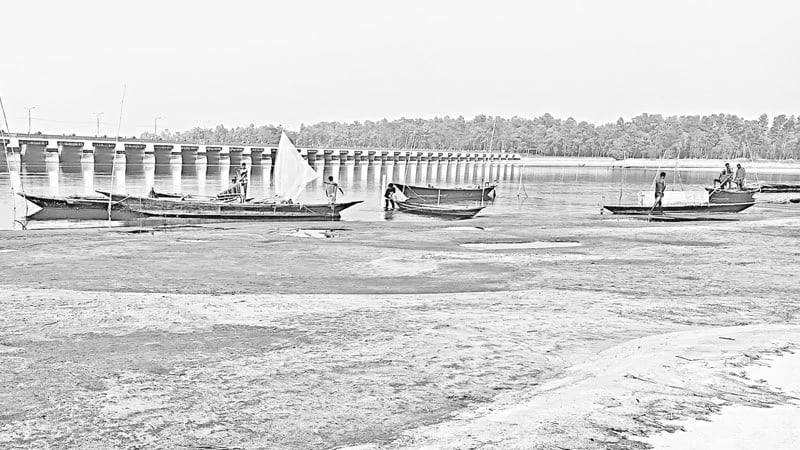
This time also, after the BJP came to power in West Bengal, several media outlets on both sides of the border have asked for my opinion on this issue. However, it is difficult for anyone who knows the internal politics of the two countries and the recent situation of bilateral relations to convey a message of hope.
It is important to remember that even though Mamata Banerjee, who opposed the Teesta accord, has left power, the socio-economic conditions in the Teesta basin of West Bengal, or in North Bengal more broadly, have not changed. Whether we like it or not, it is clear that the people of the northern part of West Bengal were against the Teesta agreement. That was one of the main reasons behind Mamata’s opposition. The same political logic that led Mamata to oppose the Teesta accord in order to gain popularity in North Bengal can now be followed by the BJP to maintain its own popularity there.
It is also important to remember that Mamata Banerjee was only against Bangladesh on the Teesta issue. In contrast, the new Chief Minister of West Bengal, Suvendu Adhikari, has already reiterated a strong reservation on almost any issues relating to Bangladesh on many occasions in the past. Mamata still used to talk about maintaining good relations with Bangladesh; but Suvendu Adhikari has not yet shown that same unneighborly courtesy.
Apart from this, even though the central government of India has been pleading with the West Bengal government on the Teesta issue for the past decade and a half, how realistic or effective that effort has been remains open to question. This is because, according to Article 253 of the Indian Constitution, the central government is not obliged to accept the objections of a state government in any international agreement. Even though the central government ignored the opposition of various states, including West Bengal, when implementing the National Register of Citizens and the Citizenship Amendment Act, it was clearly unable to do the same on the Teesta issue.
It is true that the Indian government is now very keen to improve relations with the elected government of Bangladesh. If they sincerely want better ties, then the Teesta Agreement should become easier to achieve than before. Since the central government and the state government are now from the same party, political decisions on this crucial matter should also become easier. For example, the Land Boundary Agreement was easily passed in the Lok Sabha when the BJP was in power both at the Centre and in Assam state. The important question, however, is whether the BJP sincerely wanted or is now sincerely seeking the Teesta Agreement.
If we look at the matter objectively, the Teesta Master Plan that is to be built with the financial and technical assistance of the Chinese government should not create a big problem for the Teesta water sharing agreement. There is already a precedent of India and China working together on mega projects in Bangladesh, such as the Padma Bridge. Although we have repeatedly said that we want to avoid geopolitical conflicts, the Master Plan can be implemented through self-financing or multilateral financing and technical assistance. Apart from China and India, countries and institutions such as the Netherlands, the World Bank and the Asian Development Bank could also be involved.
Now all that is needed is India’s goodwill on the Teesta issue. If the central government is sincere, it seems that the state government will not create obstacles in the way it did before. Diplomatically far-sighted decisions and steps will also be necessary from the Bangladesh side.
The NDTV report rightly says, “For now, the Teesta Agreement remains as a test of political consensus, regional diplomacy, and strategic trust between India and Bangladesh. Whether the long-stalled deal finally moves forward will depend on how New Delhi and the new govt. in West Bengal align their priorities”.
Writer: Sheikh Rokon is Writer and River Researcher; Secretary General, Riverine People.
skrokon@gmail.com
The article was originally published in the print and online editions of The Daily Samakal and has been rewritten for the English version by Mohammed Humayun Kabir, Assistant News Editor.

