Why our digital classrooms not producing employable graduates
Reyad Hasnain
16 Jul 2026 20:33 PM । Update: 17 Jul 2026 12:35 PM
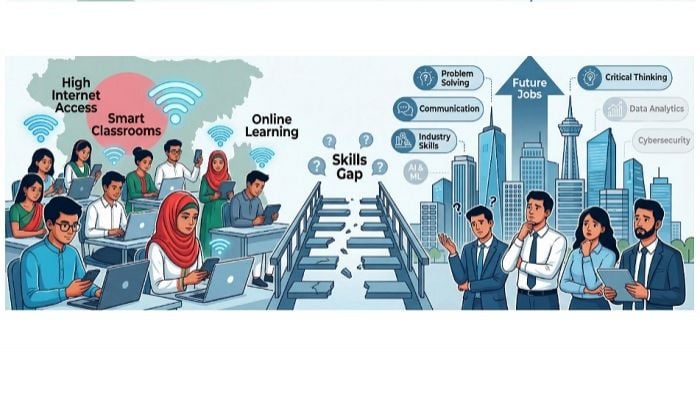
According to the Bangladesh Bureau of Statistics Labour Force Survey 2024, the unemployment rate among tertiary-educated youth has climbed to 13.5 percent—up from 9.7 percent just a decade ago. Among young people with bachelor’s degrees, some 885,000 currently cannot find work. Meanwhile, the International Labour Organization estimates youth unemployment at 16.8 percent overall, with the figure climbing to a staggering 22.7 percent for young women.
These numbers become even more alarming when placed alongside another statistic: a UNICEF study found that nearly 85 percent of Bangladeshi youth lack basic digital skills. We are graduating students from “digital classrooms” who cannot perform the fundamental tasks that employers now consider routine—building spreadsheets, writing professional emails, analysing data, or troubleshooting basic software problems.
The disconnect is painful to witness. Companies in the IT sector, which exported services worth over $700 million last fiscal year, report chronic difficulty filling mid-level positions. The Bangladesh Association of Software and Information Services (BASIS) regularly notes that a significant percentage of computer science graduates require months of retraining before they can write production code. The ready-made garment sector, now transforming through automation, desperately needs managers who can handle supply chain software and compliance systems. Our schools are not producing them.
Hardware fantasy
Where did we go wrong? The answer lies in a fundamental misunderstanding about what technology can and cannot do. Over the past decade, Bangladesh has invested heavily in digital infrastructure for education. The last government initiative established computer facilities in thousands of secondary schools. Multimedia classrooms spread across districts. The a2i programme pushed digital content onto e-learning platforms. On paper, the transformation looked complete.
But infrastructure has a seductive quality. Ribbon-cutting ceremonies photograph well. Ministers can point to numbers—thousands of schools connected, millions of devices distributed. What doesn’t get photographed is the teacher standing uncertainly before the new equipment, unsure how to integrate it into her lesson, quietly relieved when the period ends and she can return to the familiar blackboard.
Walk into most “digitally equipped” classrooms outside Dhaka, and you will witness a familiar paradox. The smart board remains covered because the headmaster fears maintenance costs. The projector serves as a substitute blackboard, displaying PDFs of the same rote-learning textbooks teachers have used for decades. Technology becomes decoration rather than transformation.
Teacher problem
No technology succeeds without the people who use it, and here we encounter the heart of the problem. Bangladesh’s teaching corps has received woefully inadequate preparation for the digital age. The standard training—twelve days covering basic computer operations and PowerPoint presentations—barely scratches the surface. Teachers learn to turn on devices and open files. Nobody teaches them how to curate online resources for meaningful discussion, use collaboration tools to develop teamwork, or assess project work rather than memorized answers.
Research consistently shows that teachers with strong constructivist orientations—those who view learning as active knowledge construction rather than passive absorption—are far more likely to integrate technology effectively. But our training programmes focus on operational skills while ignoring the pedagogical transformation that gives those skills meaning.
Assessment trap
Perhaps nothing reveals the depth of the problem more clearly than our examination system. The SSC and HSC examinations remain the gold standard of educational success in Bangladesh. These high-stakes tests determine futures—university admission, social status, family pride. And they test, almost exclusively, the ability to memorize and reproduce textbook content.
Consider the perverse incentive this creates. A student might access a brilliant online simulation to understand thermodynamics, explore interactive modules, engage with cutting-edge digital content. But when examination day arrives, he or she will be judged solely on her ability to reproduce a paragraph from the textbook. Under these conditions, the digital classroom becomes an extracurricular distraction rather than the core of learning.
Teachers and students are rational actors. They teach and learn what examinations reward. If exams prioritize memorization, classrooms will prioritize memorization—regardless of how many projectors and tablets we distribute.
Two scenarios
The failures of digital education fall unevenly across the population, creating what amounts to two parallel educational systems. In affluent urban enclaves—Gulshan, Banani, Khulshi—well-resourced private schools complement digital infrastructure with international curricula, trained facilitators, and a culture of critical inquiry. Students there build portfolios, learn programming, develop presentation skills. They emerge equipped for knowledge-economy jobs.
In the vast majority of government and low-cost private schools serving rural and semi-urban Bangladesh, the “digital classroom” often ends with hardware installation. Without reliable electricity, without technology-comfortable teachers, without parental awareness of digital learning’s purpose, these facilities become symbols of disparity rather than tools of equity.
We risk creating a two-tiered system: one tier produces knowledge workers ready for the global economy; the other produces young people who can operate devices but cannot innovate with them. The promise of digital education—that a student in a char village could compete with a student in a global city—remains unfulfilled.
Cautionary tale from the freelancing world
The consequences of our failure are already visible in the freelancing sector—once a source of national pride. In 2019, an Oxford Internet Institute report placed Bangladesh second globally for online outsourcing, with 16 percent of worldwide freelance work flowing through our workforce. We celebrated this achievement, pointed to it in government presentations, used it to project an image of digital competitiveness.
Five years later, that position has collapsed. A 2024 ranking by CEOWorld Magazine placed Bangladesh 29th out of 30 countries for hiring freelancers. We dropped 27 positions in half a decade. Industry analysts say the decline stems from our workforce’s failure to move beyond basic services—data entry, simple graphics work—into higher-value skills like AI development, advanced data analytics, and UX design. The technologies shifted; we did not shift with them.
This decline should serve as a warning. The global digital economy does not wait for countries to catch up. Skills that commanded premium rates yesterday become commoditized tomorrow. Our educational system is not preparing students for this relentless evolution.
What must change
If digital classrooms are to deliver genuine employability, we need to move from infrastructure to integration. The question can no longer be “how many schools have Wi-Fi?” It must become “how many students can use that Wi-Fi to build a resume, a portfolio, or a startup?”
First, we need sustained investment in teacher development—not twelve-day workshops but continuous professional training where educators learn digital pedagogy. Teachers must be equipped to facilitate project-based learning, encourage collaboration, and assess practical competencies rather than rote recall.
Second, curriculum reform must accelerate. Digital literacy cannot remain siloed in a single ICT class. It must be embedded across subjects—mathematics, science, languages, social studies. Students should learn to analyse data in math class, research online sources critically in history, communicate professionally in English. Data science, digital marketing, and applied computing should become foundational skills, not elective curiosities.
Third, and most critically, examination reform must follow. The SSC and HSC must incorporate continuous assessment, practical examinations, and portfolio evaluation. If we tested students’ ability to code a simple algorithm or analyse a case study, the entire orientation of digital classrooms would shift from passive consumption to active creation.
Finally, industry must step into the classroom. The tech companies and large enterprises that complain about the skills gap must participate in curriculum design, offer embedded apprenticeships, and provide certification programmes running alongside formal education. This cannot be sporadic CSR activity; it must become systemic partnership.
Road ahead
Bangladesh stands at an inflection point. With one of the world’s largest youth populations, we possess an immense demographic dividend waiting to be harvested. The government’s Vision 2041 stakes the country’s future on moving up the value chain—toward IT exports, financial services, a genuine knowledge economy. These ambitions require a workforce with market-relevant digital skills.
The fibre optic cables have been laid. The routers are blinking. The projectors are mounted on classroom walls. What remains is the unglamorous, painstaking work of changing what happens between a teacher and a student. That transformation—not the hardware—will determine whether our children can compete in the global economy.
The router was never enough. It was never supposed to be. The question now is whether we will do the harder work of actually educating our children for the world that awaits them—or continue admiring our equipment while they remain unemployable.
The connection is established. But the signal remains weak.
Writer: Reyad Hasnain is a policy analyst specialising in digital governance and public-sector reform

