End of Stubble Burning by deploying Crop-Twice and Crop-Thrice Technologies
Dr. Abed Chaudhury and Shaila Sultana Sraboni
11 Aug 2021 11:08 AM
Starting from the dawn of civilization to the current era human beings have devastated the environment in many different ways for their immediate need.
Important examples include destruction of biodiversity, an increase of greenhouse gases in the atmosphere, and whole-sale deforestation in all continents excepting Antarctica. But one that has attracted high attention in recent times, particularly in India, is the burning of stubbles (remnants of crops).
It is a common practice to burn the crop residues as removing them is way too expensive. However, the cheapest option for the farmer is the most expensive one for nature.
Specifically, the burning of stubble is merely the practice of eliminating the rice crop residue to sow wheat again on the same field.
The economy of the system is forcing the farmers to burn it as they are under pressure to start the wheat crop during the onsets of winter. The pressure to sow the next crop makes farmers burn the remnants of rice crops, as recycling the crop remnants requires a lot of money and equipment.
The process is considered to be needed as this is economically beneficial but what is a good business decision, is a disaster for the environment. So here the market is pitted against nature.
And sadly, this damaging practice is not only confined to India but is also practiced in other developed countries like Australia, China, Indonesia, North America and so on.
It is very profitable for a farmer to cultivate wheat directly after burning rice straw on the same land. But indirectly, the costs they are incurring through environmental pollution are not being taken into account because we have justified harming the environment in the name of efficiency in production in agriculture. Let us look at all issues in detail.
What is Stubble Burning?
The use of a subjugated fire to remove the crop residues that remain on the field after harvesting is named stubble burning. It can be more appropriately called 'crop residue burning'.
The major cause for stubble burning of paddy (rice crop) is the short timeframe available between rice harvest and wheat sowing; a delay in sowing wheat adversely affects the wheat crop.
The combine harvesting machine doesn’t cut the crop low enough to the ground. As a result, crop residue is left behind on the land which is actually of no use. On the other hand, Farmers are in a great rush as they have to clear out all the crop leftovers of the previous crop within 30-45 days to sow the next crop before winter sets in.
If they postpone the removal of the stubble-straw a little, they won’t get the maximum yield from the next crop and will incur a great loss. In this instance, the easiest and cheapest solution is to burn all the stubbles.
Why Steps should be taken to stop this practice?
Impacts on Climate: The open burning of husk emits toxic pollutants at a large scale that causes widespread air pollution. A study says Farmers in Punjab in India burn around 7 to 8 million metric tons of crop residues each year during the onsets of winter which makes Delhi the most polluted city. Pollution drifts out of Indias national border and becomes a source of pollution in all of south Asia.
According to reports, burning 63 million tons of agricultural stubble emits 3.4 Mt of CO, 0.1 Mt of NOx, 91 Mt of CO2, 0.6 Mt of CH4, and 1.2 Mt of PM into the atmosphere. In India, it is estimated that 352 Mt of stubble is produced each year, with wheat and rice stubble contributing 22 and 34 percent, respectively. Each year, approximately 84 Mt (23.86%) of the stubble is burned on the field right after harvest.
Impact on Health: The adverse consequences of air pollution range from the irritation of skin and eyes to serious respiratory, cardiovascular, neurological illnesses. Estimates show that more than 600000 people die every year in India due to high exposure to polluted air.
In chronic cases, exposure to excessive air pollution may result in permanent health damage, especially lung diseases such as asthma, bronchitis, emphysema, COPD, cancer, etc. The mortality rates are also increasing gradually over the last decades due to air pollution.
Impact on Soil: As per IRRI, Rice straw burning causes not just nutrient loss but also soil organic matter depletion and a decline in soil biota. The soil loses its fertility and the chances of soil erosion increase.
An estimate says, 40% of Nitrogen, 80-85% of Potash, 30-35% of Phosphorous, 40-50% of Sulphur left in the stubble or straw after harvest. All the nitrogen that remained in the straw was lost in the air with burning and there is no way to reduce the loss of Nitrogen.
Since organic nutrients couldn’t get back to the soil, an additional amount of fertilizer is required, which costs the farmer an extra charge for better yield.
We can’t calculate the environmental costs accurately in the cost-benefit ratio of stubble burning as there is no perfect data on the monetization of air pollution. These uncalculated costs occur in different forms.
It is the cost in the form of serious respiratory disease. Every year thousands of people especially from Haryana, Punjab and Delhi are suffering from serious respiratory diseases caused by air pollution only.
According to the International Food Policy Research Institute (IFPRI), crop residue burning generates an estimated annual economic loss of USD 30 billion in Northern India.
Farmers think that burning is the cheapest solution for them to sow the next crop early which indirectly hits others so hard that, even costs their lives.
Alternative Uses & Crop Residue Management
To curb the burning of remnants is to find alternative uses of them. The more we find alternatives the less the environment will be affected.
Straws can be pulped to make papers. It’s the most inexpensive non-wood papermaking fiber material.
Once the straw pulp is made it can be fed into existing paper mills alongside postconsumer recycled paper or FSC certified wood pulps. Some companies produce market pulp, which is then sold to a variety of customers who turn it into a variety of papers ranging from packaging to printing papers, coated magazine paper, newsprint, tissue, and possibly a rayon/viscose alternative.
Again, Rice straws can be used for making bioethanol
Rice straw is one of the most abundant lignocellulosic waste materials, with 731 million tons produced annually. This amount of rice straw has the potential to supply 205 billion liters of bioethanol per annum, the foremost ever produced from one biomass feedstock.
To liquefy the starch, rice straw or the whole crop that had been crushed to a small size was mixed with water and α-amylase and kept at 90°C for 1 hour. After that, the temperature was lowered to 30°C to begin the fermentation process with simultaneous addition of glucoamylase and yeast. According to the findings, one ton of rice straw yields 135 liters of ethanol and 580 kg of distillation residues, whereas a ton of whole crop yields 242 liters of ethanol and 550 kg of distillation residues. The nutritional value of these distillation residues outweighs that of the original raw materials.
If we discuss some crop residue management, People are already practicing some conventional methods for managing crop residues other than burning. As example, no-till or zero tillage seed-drilling farming method. No-till seeding involves planting food crops straight into a field without further tillage after the previous crop was harvested (usually corn, soybean, or small grain). No-till is till actually, the machine is tilling a tiny little spot, dropping the seed in and recompacting it back down. The machine that sows seeds contains few discs and each of the discs does different work. In northern India, some rich farmers use this machine.
This seed drilling machine and other alternative uses require a lot of monetary currency to work out. So, today we will be discussing an amazing solution that requires no burning and less money with sustainability.
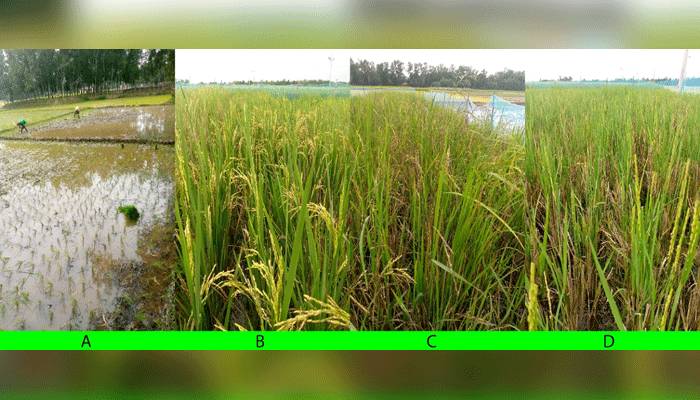
Rice twice crop technology, is a revolutionary farming procedure that is also known as ratooning. This elegant approach has been developed by one of us (Abed Chaudhury) inspired by an ancient song from Sylhet which talks about an old woman who used to live by cultivating “Nera Dhan” or old straw. . By deploying this technology, we now can regrow plants from the uncut stems leaving behind on the land, which can lead to the actual biological utility of stubble into a crop that is as high as 90% of the first harvest in just 50 days.
Over the last 10 years small farmers in Kanihati, Sylhet in Bangladesh led by one of us (AC) have developed 21 early varieties that are genetically and epigenetically developed using the non-GM conventional breeding procedure to produce a second and third harvest towards its journey to total perenniality for mitigation of GHG gases and permanent prevention of stubble burning.
With deployment of this technology, no burning is needed to manage the crop residuals as the second crop will regrow from the stubble. The operational cost for the second crop and costing for new seedlings is also saved which is economically beneficial. This key technology should be transferred to India without delay to help India reduce its stubble-burning footprint in the atmosphere of South Asia
Conclusion
Stubble burning is identified as one of the significant sources of air pollution with no end in sight for a solution, and yet the solution can be very simple if only resources could be mobilized for research. Rice Twice and Rice thrice is one such technology which can be extended to other cereal crops of the world such as wheat and Barley.
The whole concept is also relevant in terms of its ability to produce controllable and usable hidden Perenniality mechanisms of existing high yielding crops of existing crops and also generate more eco-friendly variants with a significant amount of yield and considerably less climate damaging emission.
Lastly, if we can bring Rice-Twice under regular practice, it may work as one of the major forces against GHG emissions and provide a permanent solution to Stubble burning in the world.
The writers are respectively a Climate Scientist and Geneticist and a Student of Agricultural Economics and Rural Sociology of Bangladesh Agricultural University.

