Indian lunar landing mission enters Moon's orbit
AFP
06 Aug 2023 08:46 AM
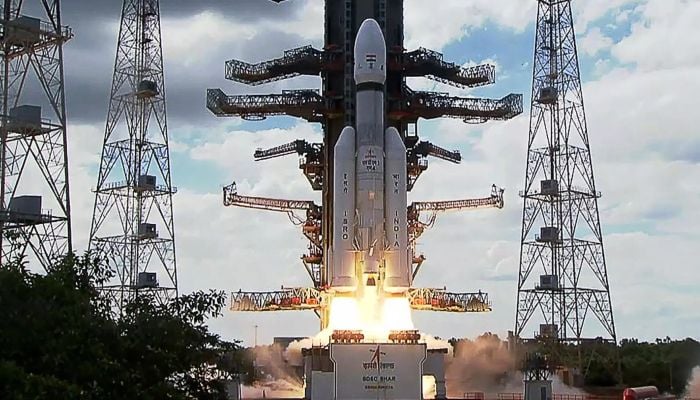
India's space programme has grown considerably in size and momentum since it first sent a probe to orbit the Moon in 2008. AFP Photo
India's latest space mission entered the Moon's orbit on
Saturday ahead of the country's second attempted lunar landing, as its
cut-price space programme seeks to reach new heights.
The world's most populous nation has a comparatively
low-budget aerospace programme that is rapidly closing in on the milestones set
by global space powers.
Only Russia, the United States and China have previously
achieved a controlled landing on the lunar surface.
The Indian Space Research Organisation (ISRO) confirmed that
Chandrayaan-3, which means "Mooncraft" in Sanskrit, had been
"successfully inserted into the lunar orbit", more than three weeks
after its launch.
If the rest of the current mission goes to plan, the mission
will safely touch down near the Moon's little-explored south pole between
August 23 and 24.
India's last attempt to do so ended in failure four years
ago, when ground control lost contact moments before landing.
Developed by ISRO, Chandrayaan-3 includes a lander module
named Vikram, which means "valour" in Sanskrit, and a rover named
Pragyan, the Sanskrit word for wisdom.
The mission comes with a price tag of $74.6 million – far
smaller than those of other countries, and a testament to India's frugal space
engineering.
Experts say India can keep costs low by copying and adapting
existing space technology, and thanks to an abundance of highly skilled
engineers who earn a fraction of their foreign counterparts' wages.
'A moment of glory'
The Chandrayaan-3 spacecraft has taken much longer to reach
the Moon than the manned Apollo missions of the 1960s and 1970s, which arrived
in a matter of days.
The Indian rocket used is much less powerful than the United
States' Saturn V and instead the probe orbited the earth five or six times
elliptically to gain speed, before being sent on a month-long lunar trajectory.
If the landing is successful the rover will roll off Vikram
and explore the nearby lunar area, gathering images to be sent back to Earth
for analysis.
The rover has a mission life of one lunar day or 14 Earth
days.
ISRO chief S Somanath has said his engineers carefully
studied data from the last failed mission and tried their best to fix the
glitches.
India's space programme has grown considerably in size and
momentum since it first sent a probe to orbit the Moon in 2008.
In 2014, it became the first Asian nation to put a satellite
into orbit around Mars, and three years later, the ISRO launched 104 satellites
in a single mission.
The ISRO's Gaganyaan ("Skycraft") programme is
slated to launch a three-day manned mission into Earth's orbit by next year.
India is also working to boost its two percent share of the
global commercial space market by sending private payloads into orbit for a
fraction of the cost of competitors.
/KN/

