India's latest Moon mission sends first photos
Online Desk
07 Aug 2023 12:55 PM
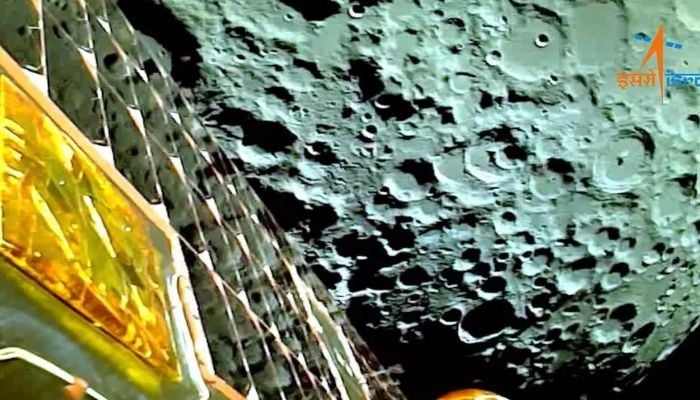
A series of images sent by Chandrayaan-3 show the craters on the lunar surface getting larger and larger as the spacecraft gets closer. BBC Photo
India's space agency has released the first images of the
Moon taken by the Chandrayaan-3 spacecraft, which entered the lunar orbit on
Saturday.
The images show the craters on the lunar surface getting
larger and larger as the spacecraft draws closer, BBC reports.
Chandrayaan-3 with an orbiter, lander and a rover, is due to
land on the Moon's surface on 23 August. If successful, India will be the first
country to land near the Moon's little-explored south pole.
It will also become only the fourth to achieve a soft landing
on the Moon after the US, the former Soviet Union and China.
After the spacecraft orbited the Earth for about 10 days, it
was sent into the translunar orbit last Tuesday and successfully injected into
the lunar orbit on Saturday.
Indian Space Research Agency (Isro) says in a press release
that it has been monitoring Chandrayaan-3's "health" and that it's
"normal".
It has also pointed out that "this is the third time in
succession that Isro has successfully injected a spacecraft into the lunar
orbit".
Scientists say Chandrayaan-3, the third in India's programme
of lunar exploration, is expected to build on the success of its earlier Moon
missions.
It comes 13 years after the country's first Moon mission in
2008, which discovered the presence of water molecules on the parched lunar
surface and established that the Moon has an atmosphere during daytime.
Chandrayaan-2 – which also comprised an orbiter, a lander
and a rover – was launched in July 2019 but it was only partially successful.
Its orbiter continues to circle and study the Moon even today, but the
lander-rover failed to make a soft landing and crashed during touchdown.
Indian Space Research Organisation (Isro) chief Sreedhara
Panicker Somanath has said they have carefully studied the data from its crash
and carried out simulation exercises to fix the glitches in Chandrayaan-3,
which weighs 3,900kg and cost 6.1bn rupees ($75m; £58m).
The lander (called Vikram, after the founder of Isro) weighs
about 1,500kg and carries within its belly the 26kg rover which is named
Pragyaan, the Sanskrit word for wisdom.
Now that the craft has entered the Moon's orbit, scientists
will begin reducing the rocket's speed gradually to bring it to a point which
will allow a soft landing for Vikram.
"A series of manoeuvres have been planned to gradually
reduce the spacecraft's orbit and position it over the lunar poles," says
Isro.
"After some manoeuvres, the propulsion module will
separate from the lander while in orbit. Then a series of complex braking
manoeuvres will be executed to facilitate a soft landing in the South Pole
region of the Moon on 23 August," it adds.
Once it lands, the six-wheeled rover will eject and roam
around the rocks and craters on the Moon's surface, gathering crucial data and
images to be sent back to Earth for analysis.
"The rover is carrying five instruments which will
focus on finding out about the physical characteristics of the surface of the
Moon, the atmosphere close to the surface and the tectonic activity to study
what goes on below the surface. I'm hoping we'll find something new,"
Somanath has said.
The south pole of the Moon is still largely unexplored – the
surface area that remains in shadow there is much larger than that of the
Moon's north pole, and scientists say it means there is a possibility of water
in areas that are permanently shadowed.
India is not the only country with an eye on the Moon –
there's a growing global interest in it. And scientists say there is still much
to understand about the Moon that's often described as a gateway to deep space.
/KN/
The images show the craters on the lunar surface getting
larger and larger as the spacecraft draws closer, BBC reports.
Chandrayaan-3 with an orbiter, lander and a rover, is due to
land on the Moon's surface on 23 August. If successful, India will be the first
country to land near the Moon's little-explored south pole.
It will also become only the fourth to achieve a soft landing
on the Moon after the US, the former Soviet Union and China.
After the spacecraft orbited the Earth for about 10 days, it
was sent into the translunar orbit last Tuesday and successfully injected into
the lunar orbit on Saturday.
Indian Space Research Agency (Isro) says in a press release
that it has been monitoring Chandrayaan-3's "health" and that it's
"normal".
It has also pointed out that "this is the third time in
succession that Isro has successfully injected a spacecraft into the lunar
orbit".
Scientists say Chandrayaan-3, the third in India's programme
of lunar exploration, is expected to build on the success of its earlier Moon
missions.
It comes 13 years after the country's first Moon mission in
2008, which discovered the presence of water molecules on the parched lunar
surface and established that the Moon has an atmosphere during daytime.
Chandrayaan-2 – which also comprised an orbiter, a lander
and a rover – was launched in July 2019 but it was only partially successful.
Its orbiter continues to circle and study the Moon even today, but the
lander-rover failed to make a soft landing and crashed during touchdown.
Indian Space Research Organisation (Isro) chief Sreedhara
Panicker Somanath has said they have carefully studied the data from its crash
and carried out simulation exercises to fix the glitches in Chandrayaan-3,
which weighs 3,900kg and cost 6.1bn rupees ($75m; £58m).
The lander (called Vikram, after the founder of Isro) weighs
about 1,500kg and carries within its belly the 26kg rover which is named
Pragyaan, the Sanskrit word for wisdom.
Now that the craft has entered the Moon's orbit, scientists
will begin reducing the rocket's speed gradually to bring it to a point which
will allow a soft landing for Vikram.
"A series of manoeuvres have been planned to gradually
reduce the spacecraft's orbit and position it over the lunar poles," says
Isro.
"After some manoeuvres, the propulsion module will
separate from the lander while in orbit. Then a series of complex braking
manoeuvres will be executed to facilitate a soft landing in the South Pole
region of the Moon on 23 August," it adds.
Once it lands, the six-wheeled rover will eject and roam
around the rocks and craters on the Moon's surface, gathering crucial data and
images to be sent back to Earth for analysis.
"The rover is carrying five instruments which will
focus on finding out about the physical characteristics of the surface of the
Moon, the atmosphere close to the surface and the tectonic activity to study
what goes on below the surface. I'm hoping we'll find something new,"
Somanath has said.
The south pole of the Moon is still largely unexplored – the
surface area that remains in shadow there is much larger than that of the
Moon's north pole, and scientists say it means there is a possibility of water
in areas that are permanently shadowed.
India is not the only country with an eye on the Moon –
there's a growing global interest in it. And scientists say there is still much
to understand about the Moon that's often described as a gateway to deep space.
/KN/

