India's Sun mission Aditya-L1 takes off
Online Desk
02 Sep 2023 13:35 PM
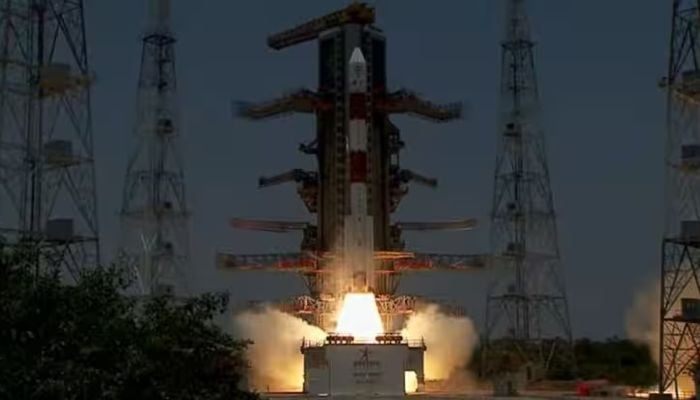
Aditya-L1 is carrying seven different payloads to conduct a detailed study of the sun. NDTV Photo
Days after scripting history by becoming the only nation to
achieve a successful soft landing near the south pole of the moon, India added
another feather to its space exploration cap on Saturday with the launch of the
Aditya-L1 mission, reports NDTV.
India's first solar space observatory mission has been
launched on the Polar Satellite Launch Vehicle (PSLV) XL from the Satish Dhawan
Space Centre in Sriharikota. The separation of Aditya-L1 is expected to take
about 63 minutes.
Aditya-L1 will be placed in the halo orbit around Lagrange
point 1 (L1) of the sun-earth system, which is about 1.5 million km from Earth.
The journey to L1 will take 125 days.
Discovered by mathematician Joseph-Louis Lagrange, Lagrangian
points are places in space where gravitational forces, acting between two
objects, balance each other in such a way that the spacecraft can remain in a
fixed position with minimal fuel consumption.
The L1 point is considered the most significant of the
Lagrangian points for solar observations.
According to ISRO, the key objectives of the mission are
understanding the coronal heating and solar wind acceleration; understanding
the initiation of Coronal Mass Ejection (CME), flares and near-earth space weather;
gaining knowledge of coupling and dynamics of the solar atmosphere; and getting
a deeper understanding of solar wind distribution and temperature anisotropy
(non-uniformity in different directions).
Solar wind refers to a continual stream of protons and
electrons from the sun's corona, or outermost atmosphere, while coronal mass
ejections are huge expulsions of coronal plasma and magnetic field lines
ejected from the sun.
Aditya-L1 is carrying seven different payloads to conduct a
detailed study of the sun, four of which will observe the light from the sun
and the other three will measure in-situ parameters of the plasma and magnetic
fields.
The primary payload, the Visible Emission Line Coronagraph,
will be sending 1,440 images per day to the ground station for analysis after
it reaches the orbit around L1.
/KN/

