Webb telescope finds planet-like objects in Orion
Online Desk
02 Oct 2023 17:58 PM
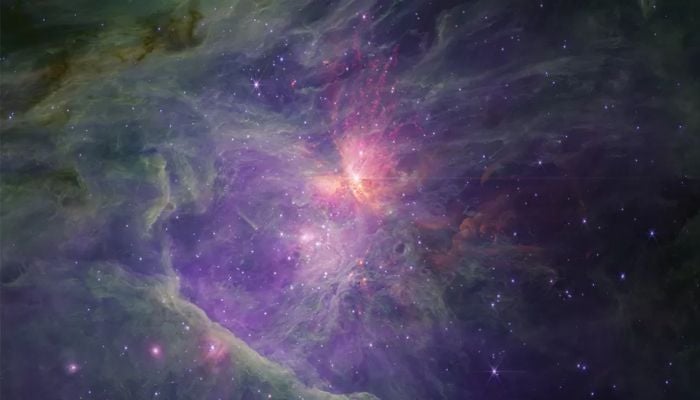
At just 1,400 light-years from Earth, the Orion Nebula, M42, is visible to the naked eye as a faint smudge. NASA Photo
Jupiter-sized "planets" free-floating in space,
unconnected to any star, have been spotted by the James Webb Space Telescope
(JWST), BBC reports.
What's intriguing about the discovery is that these objects
appear to be moving in pairs. Astronomers are currently struggling to explain
them.
The telescope observed about 20 pairs in a fabulously
detailed new survey of the famous Orion Nebula.
They've been nicknamed Jupiter Mass Binary Objects, or
"JuMBOs" for short.
One possibility is that these objects grew out of regions in
the nebula where the density of material was insufficient to make fully fledged
stars.
Another possibility is that they were made around stars and
were then kicked out into interstellar space through various interactions.
"The ejection hypothesis is the favoured one at the
moment," said Prof Mark McCaughrean.
"Gas physics suggests you shouldn't be able to make
objects with the mass of Jupiter on their own, and we know single planets can
get kicked out from star systems. But how do you kick out pairs of these things
together? Right now, we don't have an answer. It's one for the
theoreticians," the European Space Agency's (Esa) senior science adviser
told BBC News.
Prof McCaughrean led the team that produced the new Orion
survey.
Using JWST's remarkable resolution and infrared sensitivity,
the astronomers have added substantially to the information already mined by
older telescopes, including Webb's direct predecessor, the Hubble Space
Telescope.
The Orion Nebula, also known by its sky catalogue name of
M42, is the nearest, large star-forming region to Earth.
Along with the quartet of bright suns at its centre called
the Trapezium, this region of space is visible to the naked eye as a smudge on
the sky.
If you don't know it, it can be found low down in the
constellation of Orion, which is named after a mythical Greek hunter. The
nebula forms part of the hunter's "sword", hanging from his
"belt".
The new JWST image is actually a mosaic of 700 views
acquired by Webb's NIRCam instrument over a week of observations.
To give a sense of scale, it would take a spaceship
travelling at light speed a little over four years to traverse the entire
scene. The nebula itself is about 1,400 light-years from Earth.
Tucked away in this vista are thousands of young stars,
spanning a range of masses from 40 down to less than 0.1 times the mass of our
Sun.
Many of these stars are surrounded by dense discs of gas and
dust which may be forming planets, although in some cases, these discs are
being destroyed by the intense ultraviolet radiation and strong winds from the
most massive stars in the region, in particular from the Trapezium.
There is so much to peruse and probe in the full-sized
survey image which is 21,000 by 14,500 pixels. But it is the JuMBOs that have
caught the immediate attention of astronomers.
"My reactions ranged from: 'Whaaat?!?' to 'Are you
sure?" to 'That's just so weird!' to 'How could binaries be ejected
together?'" recalled Dr Heidi Hammel who was not on the survey team.
She said there were no models of planetary system formation
that predicted the ejection of binary pairs of planets.
"But... maybe all star formation regions host these
double-Jupiters (and maybe even double-Neptunes and double Earths!), and we
just haven't had a telescope powerful enough to see them before," the
multidisciplinary scientist on JWST told BBC News.
Esa will be posting the full image of M42 on its EsaSky
portal which allows anyone to explore publicly available astronomical data.
Initial papers describing the survey and the JuMBO discovery will be posted on
the arXiv pre-print server on Tuesday.
JWST is a joint venture between the US, European and
Canadian space agencies.
/KN/

