NASA asteroid sample contains life-critical water and carbon
AFP
12 Oct 2023 10:46 AM
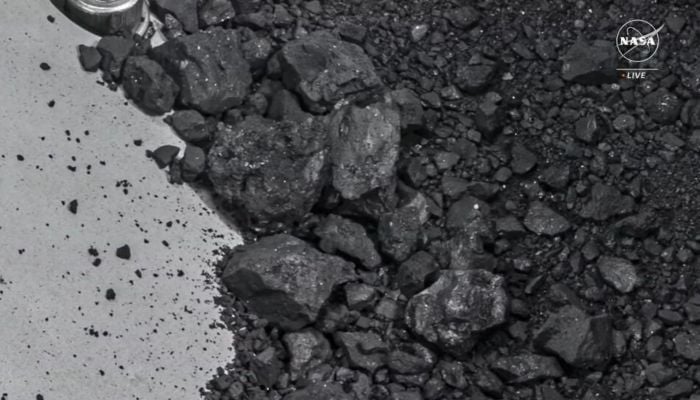
Sample material from asteroid Bennu. AFP Photo
A sample collected from the 4.5-billion-year-old asteroid
Bennu contains abundant water and carbon, NASA revealed on Wednesday, offering
more evidence for the theory that life on Earth was seeded from outer space.
The discovery follows a seven-year-round-trip to the distant
rock as part of the OSIRIS-REx mission, which dropped off its precious payload
in the Utah desert last month for painstaking scientific analysis.
"This is the biggest carbon-rich asteroid sample ever
returned to Earth," NASA administrator Bill Nelson said at a press event
at the Johnson Space Center in Houston, where the first images of black dust
and pebbles were revealed.
Carbon accounted for almost five per cent of the sample's
total weight, and was present in both organic and mineral form, while the water
was locked inside the crystal structure of clay minerals, he said.
Scientists believe the reason Earth has oceans, lakes and
rivers is because it was hit with water-carrying asteroids 4 to 4.5 billion
years ago, making it a habitable planet.
All life on Earth meanwhile is based on carbon, which forms
bonds with other elements to produce proteins and enzymes as well as the
building blocks of genetic code, DNA and RNA.
The findings were made through a preliminary analysis
involving scanning electron microscopy, X-ray computed tomography and more.
"This stuff is an astrobiologist's dream," said
scientist Daniel Glavin, adding there was much more work to be done and the
sample would be shared with labs around the world for further study.
Biggest asteroid sample
OSIRIS-REx wasn't the first probe to rendezvous with an
asteroid and bring back samples for study – Japan succeeded in the feat twice,
returning celestial dust in 2010 and 2020.
But the amount collected – an estimated 250 grams (half a
pound) – dwarfs that returned by the Japanese missions, with Hayabusa2 managing
only 5.4 grams.
Named after an ancient Egyptian deity, Bennu is a
"primordial artifact preserved in the vacuum of space," according to
NASA, making it an attractive target for study.
Its orbit, which intersects that of our planet, also made
the journey easier than going to the Asteroid Belt, which lies between Mars and
Jupiter.
In addition to scientific insights, better understanding of
Bennu's composition could prove useful if humanity ever needs to steer it away.
While there is no risk of it hitting Earth through the mid
2100s, the chances rise to around 1 in 1,750 between then and the year 2300,
NASA says.
Data gathered by the OSIRIS-REx spacecraft revealed the
particles making up Bennu's exterior were so loosely packed that if a person
were to step onto the surface, they might sink in, much like a pit of plastic
balls in children's play areas.
Future study
Researchers have so far focused their efforts not on the
main sample itself but on "bonus particles," that lay on top of the
sample collecting mechanism.
An inspection of the remainder of the sample will follow
later.
Back in October 2020, when the OSIRIS-REx probe shot
nitrogen gas at Bennu to collect material, a flap meant to seal the sample got
wedged open, allowing some of the material to flow out into another
compartment.
"The very best 'problem' to
have is that there is so much material, it's taking longer than we expected to
collect it," said deputy OSIRIS-REx curation lead Christopher Snead, in a
statement.
NASA says it will preserve at least 70 per cent of the
sample at Houston for future study – a practice first started in the Apollo era
with Moon rocks.
"The samples are then available for new questions, new
techniques, new instrumentation far into the future," said Eileen
Stansbery, division chief of astromaterials research at the Johnson Space
Center.
Additional pieces will be sent for public display at the
Smithsonian Institution, Space Center Houston, and the University of Arizona.
/KN/

