Mysterious medieval cemetery unearthed in Wales
Online Desk
03 Jan 2024 15:34 PM
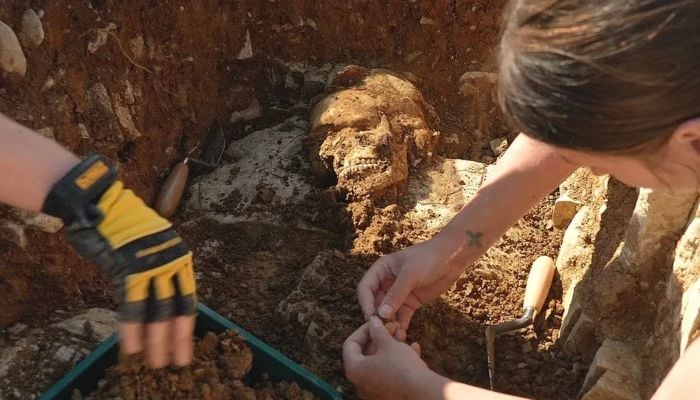
The team will carry out a DNA analysis of the bones to find out more about this community. BBC Photo
A rare, early medieval cemetery has been unearthed in Wales
and it has left archaeologists scratching their heads.
It's thought to date to the 6th or 7th Century and 18 of the
estimated 70 graves have been excavated so far, BBC reports.
Some of the well-preserved skeletons have been found lying
in unusual positions and unexpected artefacts are also emerging from the site.
The dig is starting to reveal more about this ancient
community - but it's also raising questions.
The cemetery lies in an unremarkable field in the grounds of
Fonmon Castle, close to the end of the runway at Cardiff airport.
Over two summers, a team has been busy carefully removing
the thin layer of topsoil to expose the graves that were carved into the
bedrock so long ago.
Summer Courts, an osteoarchaeologist from the University of
Reading, says the skeletons are in good condition despite being around 1,500
years old.
She points to a skull that's just been excavated, which is
providing clues about how these people lived and worked.
"We have some teeth that are very worn in a kind of a
funny way that might indicate the use of teeth as tools," she says.
"Maybe for textile work, leather work or basketry -
they're pulling something through their front teeth."
But some of the skeletons are posing a puzzle - they're
lying in a whole variety of positions.
Some are flat on their backs, normal for the period, while
others are placed on their sides, and a few are buried in a crouching position
with their knees tucked up against their chest.
The archaeologists aren't sure what this means. Was the
cemetery used over a long period of time as burial practices were changing? Or
were some people being marked out as different?
The items being found around the graves are also surprising
and they show how life in the middle of the first millennium was very different
from now.
Fragments of dishes and cups have been found, and splinters
of animal bone that have been butchered and burnt. One item really brings this
community to life: a tiny carved peg that may have been used as a marker for
scoring in a game, perhaps something like we use in a cribbage board.
Dr Andy Seaman, a specialist in early medieval archaeology
from the University of Cardiff - who is leading the digging team - says unlike
cemeteries now, this doesn't seem to be just a place to dispose of the dead.
"We tend to think of graveyards as sort of enclosed
spaces that we don't really go to, but they probably would have been quite
central to life in the past," he explained.
"And it's not just a place for people being buried, but
it's a place where communities are coming together: they are burying their
dead, but they're also undertaking other forms of activity, and social
practice, including eating and drinking - and feasting"
Most perplexing though is that the artefacts being
discovered here suggest these people were far from ordinary.
While we're at the dig, an excited shout goes up: "I've
just found a piece of glass."
It's lying in one of the graves.
"It's a rim shard, an ice-cream shaped cone vessel -
very fine material, very fine glass… it's a really nice find," Andy Seaman
says as he admires the fragment.
He thinks it's from the Bordeaux region in France - and it's
not the only imported item, the team has also found pieces of pottery, possibly
from North Africa.
The quality of these finds suggests that the people there
were of a high status.
Tudur Davies, from the University of Cardiff, says:
"The evidence we've got here is that the people have access to very high
quality imported goods, that you can only get through trading or exchange
networks, with people with a lot of wealth, to bring it here.
"What exactly is going on? Who are these people being
buried here?"
Further research is needed to get a more precise date for
when the graveyard was in use, and DNA analysis will reveal more about the
skeletons buried there.
The cemetery will provide a snapshot in time of both each
individual and the community as a whole helping to shed more light on an era
that we still know very little about.
But the questions about who actually lived and died here may
take a lot longer to answer.
/KN/

