Jupiter is a tiny bit smaller than previously thought
Online Desk
05 Feb 2026 16:49 PM
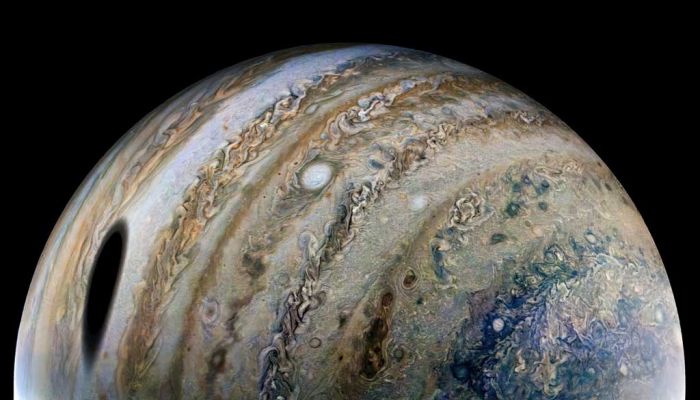
Jupiter, without a doubt, is the biggest planet in our solar system. But it turns out that it is not quite as large - by ever so small an amount - as scientists had previously thought.
Using new data obtained by NASA's robotic Juno spacecraft, scientists have obtained the most precise measurements to date of Jupiter's size and shape. This is important information to gain a fuller understanding of this gas giant, including studying its complex interior structure, reports Reuters.
The Juno observations showed that Jupiter has an equatorial diameter of 88,841 miles (142,976 km), which is about 5 miles (8 km) smaller than previous measurements had indicated. The observations also showed that Jupiter's diameter from north pole to south pole is 83,067 miles (133,684 km), about 15 miles (24km) smaller than previously estimated.
The planet, like our own, is not a perfect sphere, but rather a bit flattened - and, based on the new data, slightly more so than previously known. Jupiter is about 7percent larger at the equator than at the poles. For comparison, Earth's equator is only 0.33percent larger than its diameter at the poles.
The previous measurements of Jupiter were based on data gathered by NASA's Voyager and Pioneer robotic spacecraft in the late 1970s. Juno, launched in 2011, has been orbiting Jupiter since 2016, transmitting raw data back to Earth. NASA extended the Juno mission in 2021, giving scientists the opportunity to carry out the type of observations needed in order to fine-tune the measurements of its and shape, including traveling behind Jupiter from Earth's point of view.
"When Juno passed behind Jupiter from Earth's perspective, its radio signal traveled through the planet's atmosphere before reaching Earth," said planetary scientist Eli Galanti of the Weizmann Institute of Science in Israel, lead author of the study publi stripes and a few storms dominate Jupiter's colorful outward appearance.
Juno has been collecting data about Jupiter's atmosphere, interior structure, internal magnetic field and magnetosphere, the region around the planet created by its internal magnetism.
Precise new measurements of Jupiter are helpful to scientists because its radius - a measure that is half its diameter - is a fundamental reference used in models of the planet's interior and its atmospheric structure.
"Jupiter is the largest planet in the solar system and contains most of its planetary mass, so understanding its composition and internal structure is central to understanding how the solar system formed and evolved. Jupiter likely formed early, and strongly influenced the distribution of material, the growth of other planets and the delivery of volatiles to the inner solar system, including Earth," Galanti said.
Volatiles are substances like water, carbon dioxide and ammonia that evaporate easily. The delivery of these to the inner solar system, where the four rocky planets reside, was essential because volatiles, Galanti said, "supplied Earth with water and key ingredients for its atmosphere and for life."

