NASA finds complex water history on early Mars
Online Desk
3 Hours Ago
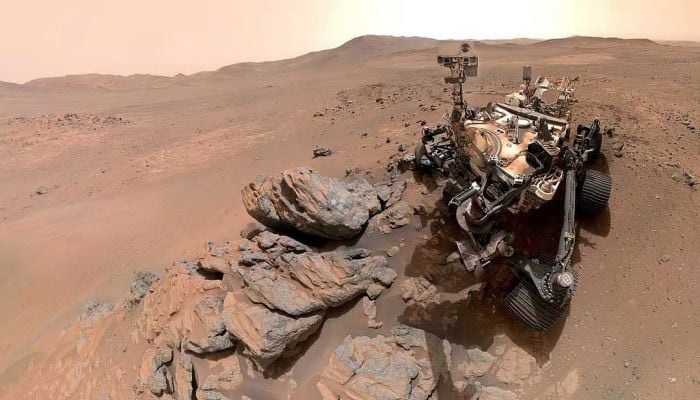
NASA's Perseverance rover has found evidence that rocks in Mars' Jezero Crater interacted with water at least three times, offering new clues about the planet's watery past. The findings were published in Communications Earth & Environment.
Initially, Scientists were particularly interested in the region because Mars orbiters had detected strong signals of carbonate minerals. Scientists had expected to find sedimentary rocks formed from layers of material deposited over time, instead, the rover encountered igneous rocks, which formed from magma and preserved evidence of their interaction with water, reports NDTV.
The discovery was made in the Margin Unit, a geological area along the shoreline of an ancient lake in Jezero Crater. On Earth, carbonates often form in shallow water and can preserve evidence of past microbial activity.
One of Perseverance's key goals is to look for signs of ancient microbial life while studying Mars' geology and climate. The rover is also collecting and storing rock and regolith samples that could be analysed in the future.
How was the water discovered?
Perseverance's SuperCam instrument analysed more than 185 bedrock targets across the Margin Unit. The instrument uses a laser to examine rocks from a distance of up to 6.5 metres and determines their chemical composition from the resulting plasma.
At higher elevations, the rover found coarse-grained olivine-rich rocks that showed little evidence of water interaction. These rocks formed deep underground from slowly cooling magma before being exposed at the surface through erosion.
At lower elevations, however, the rocks had been significantly altered. The olivine grains were fractured and contained silica, while carbonate-filled fractures formed after carbon-dioxide-rich groundwater interacted with the rock.
Scientists believe a second water event may have been associated with the ancient lake that once occupied Jezero Crater. Silica found in some rocks provides further evidence of water-related alteration, particularly in areas that were once below the lake's waterline.
A third and later event involved heated underground water. Mineral veins containing calcium sulphate and fluorite were discovered in the eastern part of the Margin Unit. Fluorite commonly forms when hot water circulates through volcanic rocks, indicating a later hydrothermal event.
Researchers said the findings could help scientists reconstruct the changing climate and habitability of early Mars.

