God’s will? Destiny? Lionel Messi, Lamine Yamal, that photo and the World Cup final
Online Desk
18 Jul 2026 19:53 PM
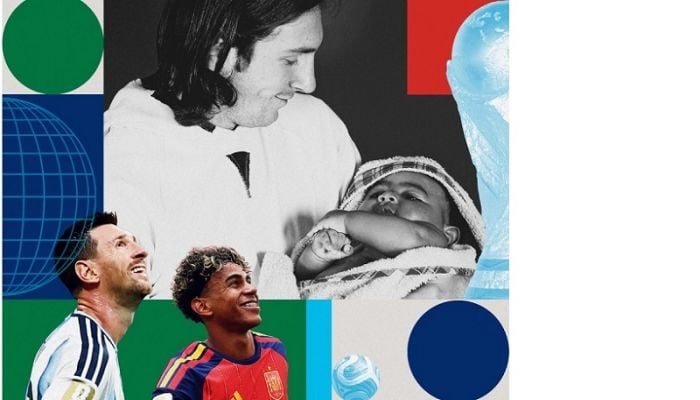
Lionel Messi cradles a four-month old baby in the Camp Nou dressing room in 2007. That baby was, of course, Lamine Yamal. Composite: Guardian Design; Reuters; FIFA/Getty Images; AP
“Maybe Lionel Messi has picked up lots of babies, maybe it’s chance, but for those of us who have faith, who believe in something beyond, ‘chance’ is God’s pseudonym when he doesn’t want to sign his name,” Luis de la Fuente says. “In life, everything happens for a reason. Sometimes it’s true that the circle isn’t closed, but in my view there’s something else, something … I don’t know, mystical, spiritual.”
Contemplate the scene, gaze upon the image of this World Cup, and you may be inclined to agree with Spain’s coach, to reach out and touch faith. How else to comprehend this? You will have seen the picture and will certainly see it again, and still it won’t make sense, reports The Guardian.
The man who took it, the photographer Joan Monfort, says he didn’t believe in destiny before but does now. In it, Messi, the greatest footballer of all time, bathes an unknown baby with a cherubic smile. The child, chosen at random and surrounded by bubbles, is Lamine Yamal. The footballer De la Fuente says was “touched by God’s wand” was baptised by him too.
On Sunday they face each other in the World Cup final.
The photograph was taken around Christmas 2007. Sport newspaper was putting together a charity calendar on behalf of Barcelona and Unicef, a studio set up in the away dressing room at the Camp Nou. Each player had a month and appeared with a child. Ronaldinho, the star, was July. Messi was January. Lamine Yamal was four months old. His mum, Sheila, had put him into a draw to take part. Monfort got the idea the night before when bathing his daughter, taking a plastic tub and a rubber duck with him. Although the baby was tiny and Messi was timid, with Sheila’s help he got a shot he was happy with.
And then, well, everyone forgot about it. Monfort left it in a drawer, another photo among thousands, no idea of a significance it didn’t yet have. The image was lost and then it was found. During Euro 2024 Lamine Yamal’s father, Mounir, posted it on social media, with the tag “the beginning of two legends”.
Wait, what? How had this happened? How had that baby, chosen by chance, become Lamine Yamal? How, in fact, had Messi, a shy 19-year-old, become Messi? Of all the people in all the world how had they ended up together? How had no one seen this sooner? How on earth, why on earth, had Mounir not shared it before? Where did he suddenly find it? How had Lamine Yamal not known? When Monfort was introduced to him a while later, Lamine Yamal said he didn’t remember it. Well of course not, he was four months old.
“What if it’s not actually Lamine?” Monfort had worried at the time, suddenly thrust into the spotlight. Which was understandable: there was no way this could be real. Stop for a moment and it messes with your mind. Mounir’s timing, it turned out, was perfect. Four days later Lamine Yamal scored that goal against France which took Spain to the Euro 2024 final and announced his arrival. It’s like the creation, Monfort reckoned, although one day in Rocafonda, where Lamine Yamal grew up, Mounir later joked with him that maybe things were the other way round, maybe it was Lamine giving Messi life.
Unicef too posted that, yes, this was real. It was July 2026, and still it felt the need. Then on Wednesday when Argentina beat England, it got even more absurd: this was the first portrait of the poster stars of the biggest sporting event on the planet, and Monfort’s phone rang off the hook again.
Not long ago Lamine Yamal was shown the photo. “God willing, I can face him in the final.” It still felt unlikely but if God had willed it this far, why stop now? So much had happened; some things had needed to not happen too: Spain and Argentina were supposed to play the Finalissima in March. How much better that they play here instead. Lamine Yamal smiled as he looked at the picture. “I’ve grown a little bit … and so has Leo,” he said.
They had done so in public, under pressure, the weight of expectation. The next time Lamine Yamal appeared in a photo with Messi it was at Barcelona’s training ground. He was still small, barely 11 or 12; and by then Messi was, well, Messi. Although this was a fan meeting the planet’s best footballer, Lamine Yamal was no longer just a kid from Catalonia who had won a draw. Spotted playing for CF La Torreta in Mataro, he had joined La Masia. He recalls the first time he felt something like fame, exposure coming one day when he was down the park, aged 13 and already that kid from Barcelona.
Messi knows that well, and it is not all they share. He had come from Argentina to Catalonia aged 12, famously “signed” on a napkin in the Pompeia tennis club. Lamine Yamal’s dad is from Morocco, his mum from Equatorial Guinea. Born in Catalonia, he signals Rocafonda’s 08304 postcode when he scores. It is a barrio where half of the population is at risk of poverty and about 20% are Moroccan, where he played on the gravel plaza of Joan XXIII. He could have represented Morocco, but had no doubt choosing Spain. Messi could have done too but chose Argentina, clinging to a country that took longer to truly embrace him than they might have and now couldn’t love him more.
“Messi is the best,” Lamine Yamal has said. Listen to him talk about Messi and the first thing you may notice is how rarely he does, the answers a little evasive, almost formulaic. When he does talk there is respect, admiration, no doubt that the Argentinian is the finest footballer there has been, but not the excitement awoken by Neymar. In part that is strategic, seen perhaps in choosing the same sponsors – you can’t compete with Messi, can’t go up against him; but there is something simpler: Neymar was his idol, the player he identified with most.
In Lamine Yamal’s character, his background, even in elements of his play, there’s more of Neymar than Messi: in the fun, the flash, the mischief, the glint in his eye. “Life is for living,” he says. He was seven when he first saw Neymar at the Camp Nou; yes, Messi was there, but Neymar was different, captivating. That was the football that came to him, a player who sees in himself the ideal between the street and the school. It was Neymar he watched on videos, Neymar he tried to emulate, Neymar he visited last summer in Brazil.
And Messi he is measured against.

