Meta 'stifling' pro-Palestine voices on social media: Report
Online Desk
21 Dec 2023 19:18 PM
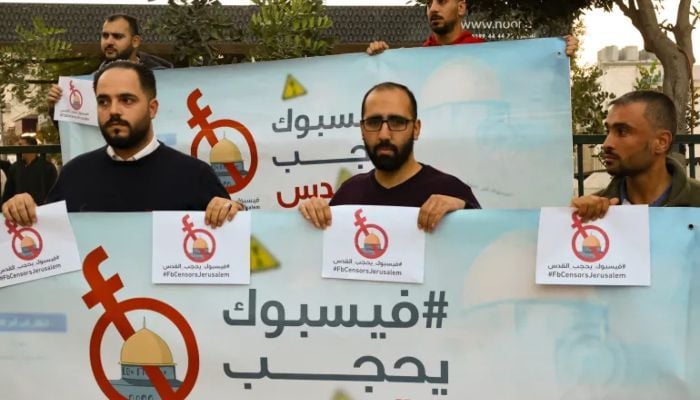
Palestinian activists and journalists hold banners denouncing what they consider censorship by Facebook of pro-Palestine content, in the occupied-West Bank city of Hebron. AFP Photo
Social media giant Meta has systematically censored
pro-Palestine voices during the current Israel-Palestinian conflict, according
to a new report by Human Rights Watch (HRW).
The report alleges that Meta, the owner of Facebook and
Instagram, has pulled down or suppressed hundreds of pro-Palestine posts due to
flawed content moderation policies, poor implementation, and "undue
government influence," Al Jazeera reports.
"Meta's censorship of content in support of Palestine
adds insult to injury at a time of unspeakable atrocities and repression
already stifling Palestinians' expression," said Deborah Brown, HRW's
acting associate technology and human rights director.
"Social media is an essential platform for people to
bear witness and speak out against abuses while Meta's censorship is furthering
the erasure of Palestinians’ suffering."
HRW said it went through more than 1,000 cases of Meta
censorship in 60 countries, documenting a pervasive "pattern of undue
removal and suppression of protected speech, including peaceful expression in
support of Palestine and public debate about Palestinian human rights."
In dozens of cases, Meta took down newsworthy posts
documenting Palestinian suffering or death. It justified these decisions by
referencing its restrictions on "violent and graphic content, violence and
incitement, hate speech, and nudity and sexual activity."
For hundreds of other posts, Meta applied its
"Dangerous Organizations and Individuals" (DOI) policy, which aims to
stop "organisations or individuals that proclaim a violent mission"
from having a presence on the platform. HRW said Meta had misused this policy
to broadly "restrict legitimate speech around hostilities between Israel
and Palestinian armed groups."
In other cases, Meta deleted or suspended users' accounts,
limited users' engagement, or "shadow banned" them, making their
posts less visible without telling them, HRW added.
Nearly a third of censored posts could not be appealed
because of glitches in the appeals system, leaving users without access to
redress, HRW said.
'Empty promises'
HRW's concern with Meta's content policies tracks with
previous independent investigations and rulings from the company's oversight
body.
In 2021, a Meta-commissioned report found that the company's
flawed content moderation policies had stopped Palestinians from sharing
"information and insights about their experiences as they occurred,"
having a negative "human rights impact."
On Tuesday, Meta's independent oversight board criticised
the company for removing posts that showed human suffering in the ongoing Gaza
war. It restored two such posts, including an Instagram video of the aftermath
of a strike on or near al-Shifa Hospital in Gaza City.
The board's co-chair Michael McConnel said it was important
for the platform to keep such posts up because they provide "timely and
diverse information about ground-breaking events."
These posts may even constitute "important evidence of
potential grave violations of international human rights and humanitarian
law," McConnel said.
In 2022, Meta said it would make changes to its content
moderation policies based on recommendations from its oversight board, but it
has failed to follow through, HRW alleges.
"Instead of tired apologies and empty promises, Meta
should demonstrate that it is serious about addressing Palestine-related
censorship once and for all by taking concrete steps toward transparency and
remediation," Brown said.
/KN/

